


Security News
The Hidden Blast Radius of the Axios Compromise
The Axios compromise shows how time-dependent dependency resolution makes exposure harder to detect and contain.
By Ahmad Nassri - Apr 01, 2026






bdlm/log is a fork of the excellent sirupsen/logrus package.

This package adds:
host and caller.bdlm/log is a structured logger for Go and is fully API compatible with both the standard libaray log package as well as the sirupsen/logrus package.
The simplest way to use bdlm/log is with the exported package-level logger:
package main

import (
    log "github.com/bdlm/log"
)

func main() {
    log.WithFields(log.Fields{
        "animal": "walrus",
    }).Info("A walrus appears")
}
Note that bdlm/log is fully api-compatible with the stdlib logger, so you can replace your log imports everywhere or using a strangler pattern with "github.com/bdlm/log" and add the full logging flexibility to your service without impacting existing code.
The default log format of this package does not match the stdlib logger's default output so a compatible formatter, StdFormatter, is provided which includes the additional information inline:
log.SetFormatter(&log.StdFormatter{})
Which results in the following log output. StdFormatter does not have a TTY feature:
2018/08/17 20:17:45 Oh, look, a bird... level="debug" data.animal="bird" data.count=1 caller="main.go:39 main.main" host="myhost"
2018/08/17 20:17:45 A group of walrus emerges from the ocean level="info" data.animal="walrus" data.count=20 caller="main.go:43 main.main" host="myhost"
2018/08/17 20:17:45 The group's number increased tremendously! level="warn" data.animal="walrus" data.count=100 caller="main.go:47 main.main" host="myhost"
2018/08/17 20:17:45 Tremendously sized cow enters the ocean. level="error" data.animal="cow" data.count="wait, what?" caller="main.go:51 main.main" host="myhost"
2018/08/17 20:17:45 The walrus are attacking! level="panic" data.animal="walrus" data.run=true caller="main.go:55 main.main" host="myhost"
2018/08/17 20:17:45 That could have gone better... level="fatal" data.dead=true data.winner="walrus" caller="main.go:30 main.main.func1" host="myhost"
By default, bdlm/log uses a basic text format:
time="2018-08-17T18:28:07.385-06:00" level="debug" msg="Oh, look, a bird..." data.animal="bird" data.count=1 caller="main.go:34 main.main" host="myhost"
time="2018-08-17T18:28:07.385-06:00" level="info" msg="A group of walrus emerges from the ocean" data.animal="walrus" data.count=20 caller="main.go:38 main.main" host="myhost"
time="2018-08-17T18:28:07.385-06:00" level="warn" msg="The group's number increased tremendously!" data.animal="walrus" data.count=100 caller="main.go:42 main.main" host="myhost"
time="2018-08-17T18:28:07.385-06:00" level="error" msg="Tremendously sized cow enters the ocean." data.animal="cow" data.count="wait, what?" caller="main.go:46 main.main" host="myhost"
time="2018-08-17T18:28:07.385-06:00" level="panic" msg="The walrus are attacking!" data.animal="walrus" data.run=true caller="main.go:50 main.main" host="myhost"
time="2018-08-17T18:28:07.385-06:00" level="fatal" msg="That could have gone better..." data.dead=true data.winner="walrus" caller="main.go:25 main.main.func1" host="myhost"
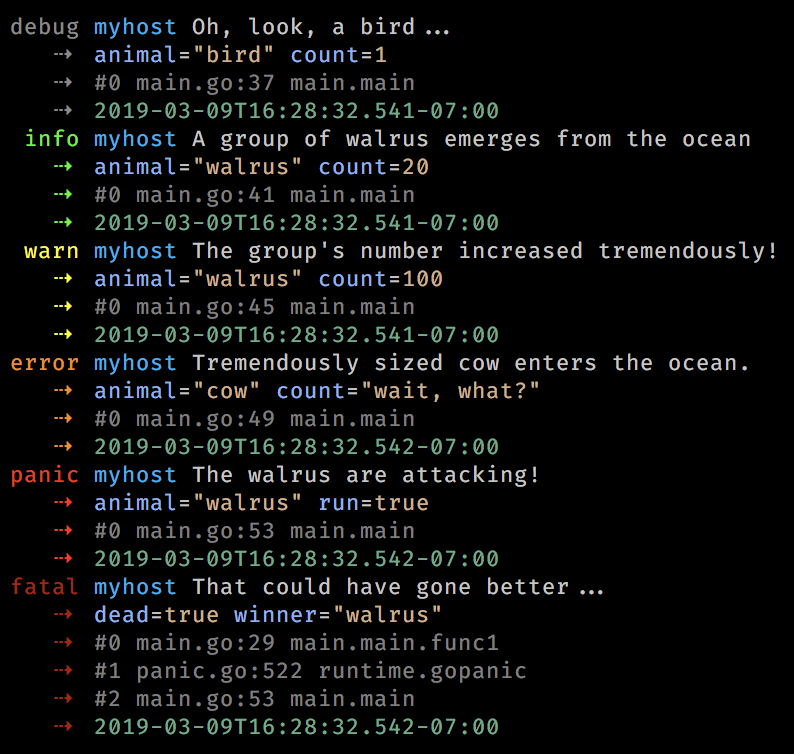
For development, color-coded output formated for humans is automatically enabled when a tty terminal is detected (this can be disabled with log.SetFormatter(&log.TextFormatter{DisableTTY: true})):

JSON formatting is also available with log.SetFormatter(&log.JSONFormatter{}) for easy parsing by logstash or similar:
{"caller":"main.go:36 main.main","data":{"animal":"bird","count":1},"host":"myhost","level":"debug","msg":"Oh, look, a bird...","time":"2018-08-17T18:32:30.786-06:00"}
{"caller":"main.go:40 main.main","data":{"animal":"walrus","count":20},"host":"myhost","level":"info","msg":"A group of walrus emerges from the ocean","time":"2018-08-17T18:32:30.786-06:00"}
{"caller":"main.go:44 main.main","data":{"animal":"walrus","count":100},"host":"myhost","level":"warn","msg":"The group's number increased tremendously!","time":"2018-08-17T18:32:30.786-06:00"}
{"caller":"main.go:48 main.main","data":{"animal":"cow","count":"wait, what?"},"host":"myhost","level":"error","msg":"Tremendously sized cow enters the ocean.","time":"2018-08-17T18:32:30.786-06:00"}
{"caller":"main.go:52 main.main","data":{"animal":"walrus","run":true},"host":"myhost","level":"panic","msg":"The walrus are attacking!","time":"2018-08-17T18:32:30.786-06:00"}
{"caller":"main.go:27 main.main.func1","data":{"dead":true,"winner":"walrus"},"host":"myhost","level":"fatal","msg":"That could have gone better...","time":"2018-08-17T18:32:30.787-06:00"}
The JSON formatter also makes adjustments by default when a tty terminal is detected and can be disabled similarly with log.SetFormatter(&log.JSONFormatter{DisableTTY: true}):
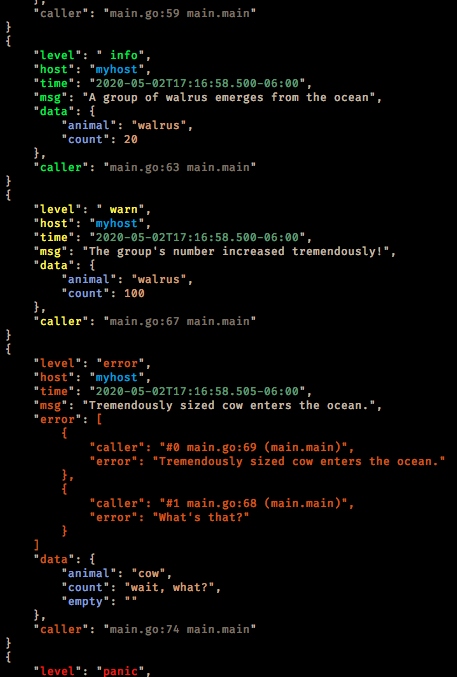
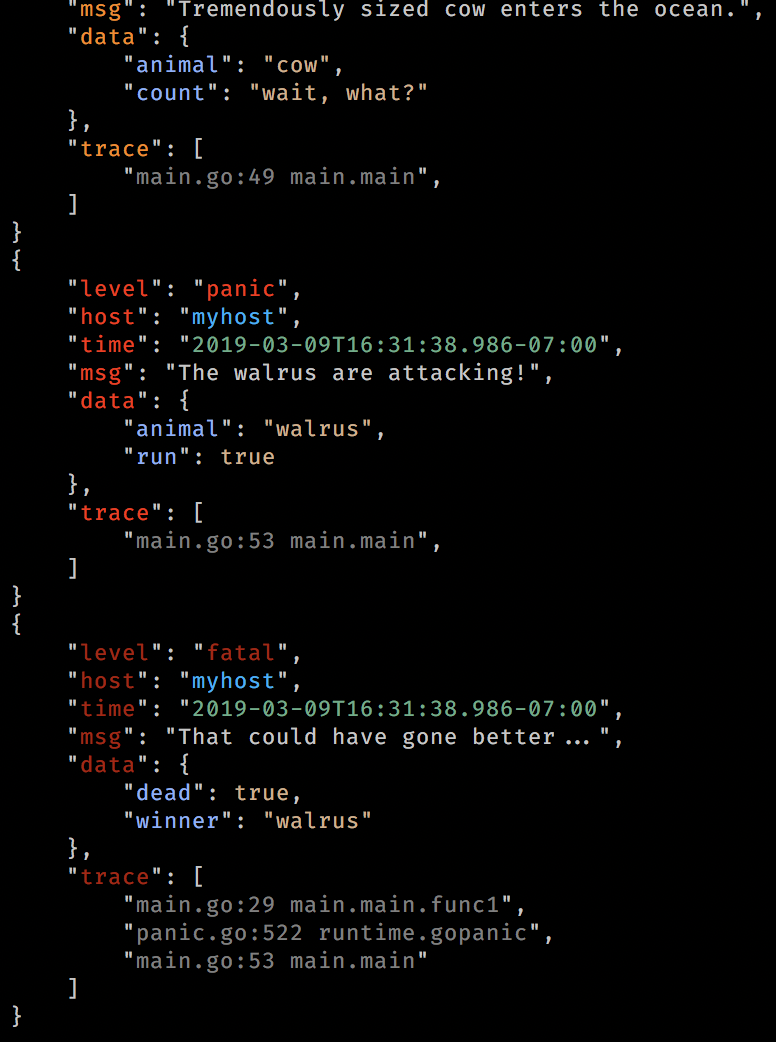
The standard formatters also have a trace mode that is disabled by default. Rather than acting as an additional log level, it is instead a verbose mode that includes the full backtrace of the call that triggered the log write. To enable trace output, set EnableTrace to true.
Here are the above examples with trace enabled:
Non-TTY trace output:
log.SetFormatter(&log.TextFormatter{
    DisableTTY: true,
    EnableTrace: true,
})
time="2018-08-18T00:20:36.468-06:00" level="debug" msg="Oh, look, a bird..." data.animal="bird" data.count=1 host="myhost" trace.0="main.go:38 main.main"
time="2018-08-18T00:20:36.469-06:00" level="info" msg="A group of walrus emerges from the ocean" data.animal="walrus" data.count=20 host="myhost" trace.0="main.go:42 main.main"
time="2018-08-18T00:20:36.469-06:00" level="warn" msg="The group's number increased tremendously!" data.animal="walrus" data.count=100 host="myhost" trace.0="main.go:46 main.main"
time="2018-08-18T00:20:36.469-06:00" level="error" msg="Tremendously sized cow enters the ocean." data.animal="cow" data.count="wait, what?" host="myhost" trace.0="main.go:50 main.main"
time="2018-08-18T00:20:36.469-06:00" level="panic" msg="The walrus are attacking!" data.animal="walrus" data.run=true host="myhost" trace.0="main.go:54 main.main"
time="2018-08-18T00:20:36.469-06:00" level="fatal" msg="That could have gone better..." data.dead=true data.winner="walrus" host="myhost" trace.0="main.go:30 main.main.func1" trace.1="asm_amd64.s:573 runtime.call32" trace.2="panic.go:502 runtime.gopanic" trace.3="main.go:54 main.main"
TTY trace output:
log.SetFormatter(&log.TextFormatter{
    EnableTrace: true,
    ForceTTY: true,
})
To enable trace output:
log.SetFormatter(&log.JSONFormatter{
    DisableTTY: true,
    EnableTrace: true,
})
Non-TTY trace output:
{"caller":"main.go:38 main.main","data":{"animal":"bird","count":1},"host":"myhost","level":"debug","msg":"Oh, look, a bird...","time":"2018-08-18T00:22:16.057-06:00","trace":["main.go:38 main.main"]}
{"caller":"main.go:42 main.main","data":{"animal":"walrus","count":20},"host":"myhost","level":"info","msg":"A group of walrus emerges from the ocean","time":"2018-08-18T00:22:16.058-06:00","trace":["main.go:42 main.main"]}
{"caller":"main.go:46 main.main","data":{"animal":"walrus","count":100},"host":"myhost","level":"warn","msg":"The group's number increased tremendously!","time":"2018-08-18T00:22:16.058-06:00","trace":["main.go:46 main.main"]}
{"caller":"main.go:50 main.main","data":{"animal":"cow","count":"wait, what?"},"host":"myhost","level":"error","msg":"Tremendously sized cow enters the ocean.","time":"2018-08-18T00:22:16.058-06:00","trace":["main.go:50 main.main"]}
{"caller":"main.go:54 main.main","data":{"animal":"walrus","run":true},"host":"myhost","level":"panic","msg":"The walrus are attacking!","time":"2018-08-18T00:22:16.058-06:00","trace":["main.go:54 main.main"]}
{"caller":"main.go:30 main.main.func1","data":{"dead":true,"winner":"walrus"},"host":"myhost","level":"fatal","msg":"That could have gone better...","time":"2018-08-18T00:22:16.058-06:00","trace":["main.go:30 main.main.func1","asm_amd64.s:573 runtime.call32","panic.go:502 runtime.gopanic","main.go:54 main.main"]}
TTY trace output:
log.SetFormatter(&log.JSONFormatter{
    EnableTrace: true,
    ForceTTY: true,
})
FAQs
Unknown package
Did you know?

Socket for GitHub automatically highlights issues in each pull request and monitors the health of all your open source dependencies. Discover the contents of your packages and block harmful activity before you install or update your dependencies.
Security News
The Axios compromise shows how time-dependent dependency resolution makes exposure harder to detect and contain.

Research
A supply chain attack on Axios introduced a malicious dependency, plain-crypto-js@4.2.1, published minutes earlier and absent from the project’s GitHub releases.

Research
Malicious versions of the Telnyx Python SDK on PyPI delivered credential-stealing malware via a multi-stage supply chain attack.