


Security News
Deno 2.6 + Socket: Supply Chain Defense In Your CLI
Deno 2.6 introduces deno audit with a new --socket flag that plugs directly into Socket to bring supply chain security checks into the Deno CLI.
By Sarah Gooding - Dec 12, 2025
github.com/cloudfoundry-incubator/cf-mysql-benchmark-app
Advanced tools
The purpose of this app is to benchmark a deployment of a MySQL cluster. Benchmarking allows the user to collect useful metrics about the service, such as the number of read/write requests received per second, the number of DB transactions performed per second, the number of deadlock conditions hit, etc.
The app works by invoking the sysbench utility, which is a benchmark tool for evaluating a system running a database under intensive load. It creates a test database in the MySQL deployment, and then writes and reads back a given number of rows from it, while measuring the performance of these transactions.
sysbench can be run in isolation from the command line, but the app provides a user-friendly wrapper around it which works in tandem with the MySQL deployment. By deploying the app to the same subnet/AZ as your MySQL cluster, the app is able to avoid having to jump through firewalls.
The app runs on a Docker image which is described in Dockerfile. Among other things, the image has sysbench installed on it. The image can be built and pushed to Docker Hub by running the following command from the top-level directory of the app
docker build -t pivotalcf/cf-mysql-benchmark-app . && docker push pivotalcf/cf-mysql-benchmark-app
The application can be run on Diego, assuming that the Docker image has already been pushed with a simple
cf push -f <PATH_TO_APP_MANIFEST> -o pivotalcf/cf-mysql-benchmark-app
A sample manifest file for the app is structured as follows:
---
applications:
  - name: sysbench
    env:
      MYSQL_HOSTS: "mysql_z1=<IP_OF_MYSQL_NODE_1>,mysql_z2=<IP_OF_MYSQL_NODE_2>,mysql_z3=<IP_OF_MYSQL_NODE_3>"
      MYSQL_PORT: <MYSQL_DATABASE_PORT>
      MYSQL_USER: <MYSQL_USERNAME>
      MYSQL_PASSWORD: <MYSQL_PASSWORD>
      TEST_DB: <NAME_OF_TEST_DATABASE_CREATED_BY_SYSBENCH>
      NUMBER_TEST_ROWS: <NUMBER OF ROWS >
      MAX_TIME: <NUMBER OF SECONDS TO RUN TEST>
      NUM_THREADS: <NUMBER OF CORES TO USE FOR TEST>
MYSQL_HOSTS contains the IP addresses of the nodes in the MySQL cluster, MySQL Proxies, or MySQL cluster ELBs – essentially any IP address that the app can use to talk to the cluster.MYSQL_PORT the port on which to connect to the MySQL clusterNUMBER_TEST_ROWS specifies the number of rows we want sysbench to write to the test database it creates, the name of which is specified in TEST_DB.TEST_DB is the name of the database that should be used to run the tests againstMAX_TIME is the length to run the sysbench run command, in SECONDSNUM_THREADS is the number of cores to use for the testsysbench works in two steps, called prepare and run. The prepare step logs in to the MySQL host, and sets up the database. The run step logs in to the MySQL host and runs the test against the specified host.
Analogously, the application has two endpoints that call through to the respective sysbench command.
-X POST /prepare/:node_index where node_index is the 0-based position of the node you which to target as specified in your CF application manifest. This will call through to sysbench prepare-X POST /start/:node_index where node_index is the 0-based position of the node you which to target as specified in your CF application manifest. This will call through to sysbench runFAQs
Unknown package
Did you know?

Socket for GitHub automatically highlights issues in each pull request and monitors the health of all your open source dependencies. Discover the contents of your packages and block harmful activity before you install or update your dependencies.
Security News
Deno 2.6 introduces deno audit with a new --socket flag that plugs directly into Socket to bring supply chain security checks into the Deno CLI.
Security News
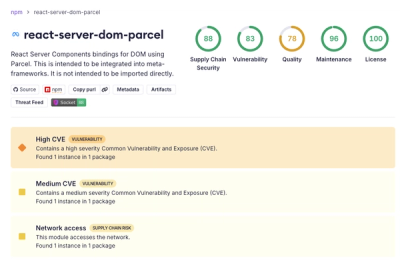
New DoS and source code exposure bugs in React Server Components and Next.js: what’s affected and how to update safely.

Security News
Socket CEO Feross Aboukhadijeh joins Software Engineering Daily to discuss modern software supply chain attacks and rising AI-driven security risks.