

Product
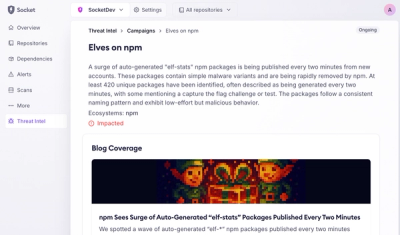
Introducing Supply Chain Attack Campaigns Tracking in the Socket Dashboard
Campaign-level threat intelligence in Socket now shows when active supply chain attacks affect your repositories and packages.
By Philipp Burckhardt - Jan 21, 2026
MAAS: Metal as a Service
Metal as a Service -- MAAS -- lets you treat physical servers like virtual machines in the cloud. Rather than having to manage each server individually, MAAS turns your bare metal into an elastic cloud-like resource.
What does that mean in practice? Tell MAAS about the machines you want it to manage and it will boot them, check the hardware's okay, and have them waiting for when you need them. You can then pull nodes up, tear them down and redeploy them at will; just as you can with virtual machines in the cloud.
When you're ready to deploy a service, MAAS gives your tool of choice (e.g. Ansible, Chef, Puppet, SALT, Juju) the nodes it needs to power that service. It's as simple as that: no need to manually provision, check and, afterwards, clean-up. As your needs change, you can easily scale services up or down. Need more power for your Hadoop cluster for a few hours? Simply tear down one of your Nova compute nodes and redeploy it to Hadoop. When you're done, it's just as easy to give the node back to Nova.
MAAS is ideal where you want the flexibility of the cloud, and the hassle-free power of Juju charms, but you need to deploy to bare metal.
For more information see the MAAS guide_.
.. _MAAS guide: https://maas.io/
FAQs
Unknown package
Did you know?

Socket for GitHub automatically highlights issues in each pull request and monitors the health of all your open source dependencies. Discover the contents of your packages and block harmful activity before you install or update your dependencies.
Product
Campaign-level threat intelligence in Socket now shows when active supply chain attacks affect your repositories and packages.
Research
Malicious PyPI package sympy-dev targets SymPy users, a Python symbolic math library with 85 million monthly downloads.

Security News
Node.js 25.4.0 makes require(esm) stable, formalizing CommonJS and ESM compatibility across supported Node versions.