

Product
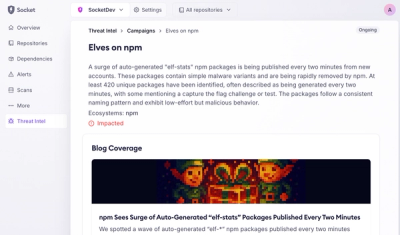
Introducing Supply Chain Attack Campaigns Tracking in the Socket Dashboard
Campaign-level threat intelligence in Socket now shows when active supply chain attacks affect your repositories and packages.
By Philipp Burckhardt - Jan 21, 2026




atomfs is a tool that can mount OCI images built in the squashfs format as
a read-only overlayfs filesystem that can be used by a container runtime.
For OCI-squashfs images that were created with dm-verity data appended, which stacker does by default, then atomfs will mount each individual squashfs layer using dm-verity before constructing the final overlayfs stack. This ensures the integrity of the contents of the image when mounted, and the use of squashfs removes the window of time between tar extraction and image mounting when an image could be tampered with.
Please find the atomfs library documentation at godoc.
This can be used to mount an OCI+squashfs image. If you are host root, then squashfs will be mounted by the kernel. If you are container root but not host root, then squashfuse will be used.
Example:
atomfs mount containers/oci:minbase:latest mnt
atomfs umount mnt
Longer example:
$ lxc-usernsexec -s
$ atomfs mount zothub:busybox-squashfs dest
$ ls dest
bin  dev  etc  home  lib  lib64  root  tmp  usr  var
$ atomfs umount dest
$ mkdir upper
$ atomfs mount --upper=./upper zothub:busybox-squashfs dest
$ ls dest
bin  dev  etc  home  lib  lib64  root  tmp  usr  var
$ touch dest/ab
$ atomfs umount dest
$ ls upper/
ab
The atomfs binary uses the atomfs package's Molecule API to mount oci
images.
Each squashfs layer is mounted separately at a subdir under
/run/atomfs/meta/$mountnsid/$mountpoint/, and then an overlay mount is
constructed for the specified mountpath. If specified in the config, a writeable
upperdir is added to the overlay mount.
Note that if you simply call umount on the mountpoint, then
you will be left with all the individual squashfs mounts under
/run/atomfs/meta/$mountnsid/$mountpoint/. Use atomfs umount instead.
Note that you do need to be root in your namespace in order to do the final overlay mount. (We could get around this by using fuse-overlay, but creating a namespace seems overall tidy).
FAQs
Unknown package
Did you know?

Socket for GitHub automatically highlights issues in each pull request and monitors the health of all your open source dependencies. Discover the contents of your packages and block harmful activity before you install or update your dependencies.
Product
Campaign-level threat intelligence in Socket now shows when active supply chain attacks affect your repositories and packages.
Research
Malicious PyPI package sympy-dev targets SymPy users, a Python symbolic math library with 85 million monthly downloads.

Security News
Node.js 25.4.0 makes require(esm) stable, formalizing CommonJS and ESM compatibility across supported Node versions.