

Product
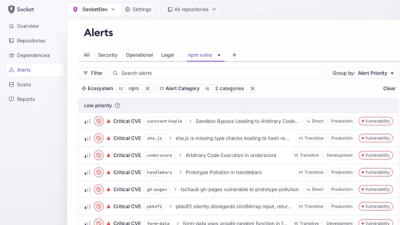
Introducing Custom Tabs for Org Alerts
Create and share saved alert views with custom tabs on the org alerts page, making it easier for teams to return to consistent, named filter sets.
By André Staltz - Jan 20, 2026




sqlx is a library which provides a set of extensions on go's standard
database/sql library. The sqlx versions of sql.DB, sql.TX, sql.Stmt,
et al. all leave the underlying interfaces untouched, so that their interfaces
are a superset on the standard ones. This makes it relatively painless to
integrate existing codebases using database/sql with sqlx.
Major additional concepts are:
Get and Select to go quickly from query to struct/sliceIn addition to the godoc API documentation,
there is also some user documentation that
explains how to use database/sql along with sqlx.
The introduction of sql.ColumnType sets the required minimum Go version to 1.8.
sqlx/types.JsonText has been renamed to JSONText to follow Go naming conventions.
This breaks backwards compatibility, but it's in a way that is trivially fixable
(s/JsonText/JSONText/g). The types package is both experimental and not in
active development currently.
types.JSONText and types.GzippedText can be potentially unsafe, especially when used with common auto-scan sqlx idioms like Select and Get. See golang bug #13905.There is no Go1-like promise of absolute stability, but I take the issue seriously and will maintain the library in a compatible state unless vital bugs prevent me from doing so. Since #59 and #60 necessitated breaking behavior, a wider API cleanup was done at the time of fixing. It's possible this will happen in future; if it does, a git tag will be provided for users requiring the old behavior to continue to use it until such a time as they can migrate.
go get github.com/jmoiron/sqlx
Row headers can be ambiguous (SELECT 1 AS a, 2 AS a), and the result of
Columns() does not fully qualify column names in queries like:
SELECT a.id, a.name, b.id, b.name FROM foos AS a JOIN foos AS b ON a.parent = b.id;
making a struct or map destination ambiguous. Use AS in your queries
to give columns distinct names, rows.Scan to scan them manually, or
SliceScan to get a slice of results.
Below is an example which shows some common use cases for sqlx. Check sqlx_test.go for more usage.
package main

import (
    "database/sql"
    "fmt"
    "log"

    _ "github.com/lib/pq"
    "github.com/jmoiron/sqlx"
)

var schema = `
CREATE TABLE person (
    first_name text,
    last_name text,
    email text
);

CREATE TABLE place (
    country text,
    city text NULL,
    telcode integer
)`

type Person struct {
    FirstName string `db:"first_name"`
    LastName  string `db:"last_name"`
    Email     string
}

type Place struct {
    Country string
    City    sql.NullString
    TelCode int
}

func main() {
    // this Pings the database trying to connect, panics on error
    // use sqlx.Open() for sql.Open() semantics
    db, err := sqlx.Connect("postgres", "user=foo dbname=bar sslmode=disable")
    if err != nil {
        log.Fatalln(err)
    }

    // exec the schema or fail; multi-statement Exec behavior varies between
    // database drivers;  pq will exec them all, sqlite3 won't, ymmv
    db.MustExec(schema)

    tx := db.MustBegin()
    tx.MustExec("INSERT INTO person (first_name, last_name, email) VALUES ($1, $2, $3)", "Jason", "Moiron", "jmoiron@jmoiron.net")
    tx.MustExec("INSERT INTO person (first_name, last_name, email) VALUES ($1, $2, $3)", "John", "Doe", "johndoeDNE@gmail.net")
    tx.MustExec("INSERT INTO place (country, city, telcode) VALUES ($1, $2, $3)", "United States", "New York", "1")
    tx.MustExec("INSERT INTO place (country, telcode) VALUES ($1, $2)", "Hong Kong", "852")
    tx.MustExec("INSERT INTO place (country, telcode) VALUES ($1, $2)", "Singapore", "65")
    // Named queries can use structs, so if you have an existing struct (i.e. person := &Person{}) that you have populated, you can pass it in as &person
    tx.NamedExec("INSERT INTO person (first_name, last_name, email) VALUES (:first_name, :last_name, :email)", &Person{"Jane", "Citizen", "jane.citzen@example.com"})
    tx.Commit()

    // Query the database, storing results in a []Person (wrapped in []interface{})
    people := []Person{}
    db.Select(&people, "SELECT * FROM person ORDER BY first_name ASC")
    jason, john := people[0], people[1]

    fmt.Printf("%#v\n%#v", jason, john)
    // Person{FirstName:"Jason", LastName:"Moiron", Email:"jmoiron@jmoiron.net"}
    // Person{FirstName:"John", LastName:"Doe", Email:"johndoeDNE@gmail.net"}

    // You can also get a single result, a la QueryRow
    jason = Person{}
    err = db.Get(&jason, "SELECT * FROM person WHERE first_name=$1", "Jason")
    fmt.Printf("%#v\n", jason)
    // Person{FirstName:"Jason", LastName:"Moiron", Email:"jmoiron@jmoiron.net"}

    // if you have null fields and use SELECT *, you must use sql.Null* in your struct
    places := []Place{}
    err = db.Select(&places, "SELECT * FROM place ORDER BY telcode ASC")
    if err != nil {
        fmt.Println(err)
        return
    }
    usa, singsing, honkers := places[0], places[1], places[2]

    fmt.Printf("%#v\n%#v\n%#v\n", usa, singsing, honkers)
    // Place{Country:"United States", City:sql.NullString{String:"New York", Valid:true}, TelCode:1}
    // Place{Country:"Singapore", City:sql.NullString{String:"", Valid:false}, TelCode:65}
    // Place{Country:"Hong Kong", City:sql.NullString{String:"", Valid:false}, TelCode:852}

    // Loop through rows using only one struct
    place := Place{}
    rows, err := db.Queryx("SELECT * FROM place")
    for rows.Next() {
        err := rows.StructScan(&place)
        if err != nil {
            log.Fatalln(err)
        }
        fmt.Printf("%#v\n", place)
    }
    // Place{Country:"United States", City:sql.NullString{String:"New York", Valid:true}, TelCode:1}
    // Place{Country:"Hong Kong", City:sql.NullString{String:"", Valid:false}, TelCode:852}
    // Place{Country:"Singapore", City:sql.NullString{String:"", Valid:false}, TelCode:65}

    // Named queries, using `:name` as the bindvar.  Automatic bindvar support
    // which takes into account the dbtype based on the driverName on sqlx.Open/Connect
    _, err = db.NamedExec(`INSERT INTO person (first_name,last_name,email) VALUES (:first,:last,:email)`,
        map[string]interface{}{
            "first": "Bin",
            "last": "Smuth",
            "email": "bensmith@allblacks.nz",
    })

    // Selects Mr. Smith from the database
    rows, err = db.NamedQuery(`SELECT * FROM person WHERE first_name=:fn`, map[string]interface{}{"fn": "Bin"})

    // Named queries can also use structs.  Their bind names follow the same rules
    // as the name -> db mapping, so struct fields are lowercased and the `db` tag
    // is taken into consideration.
    rows, err = db.NamedQuery(`SELECT * FROM person WHERE first_name=:first_name`, jason)
}
FAQs
Unknown package
Did you know?

Socket for GitHub automatically highlights issues in each pull request and monitors the health of all your open source dependencies. Discover the contents of your packages and block harmful activity before you install or update your dependencies.
Product
Create and share saved alert views with custom tabs on the org alerts page, making it easier for teams to return to consistent, named filter sets.
Product
Socket’s Rust and Cargo support is now generally available, providing dependency analysis and supply chain visibility for Rust projects.

Security News
Chrome 144 introduces the Temporal API, a modern approach to date and time handling designed to fix long-standing issues with JavaScript’s Date object.