

Product
Introducing Immutable Scans
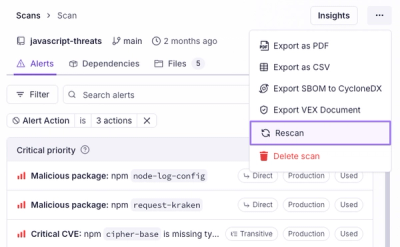
Scan results now load faster and remain consistent over time, with stable URLs and on-demand rescans for fresh security data.
By Nolan Lawson - Jan 23, 2026
We have been using Dgraph for over a year at Mooncamp and while loving the product we found some issues that we needed to write additional tools for.
dgx allows you to render GraphQL+- queries based on its data
representation. The types for the data representation are mostly
copied from the github.com/dgraph-io/dgraph/gql package.
Start testing the translation between the data and string
representation of the query by starting the querybuilder tool.
$ go get -u mooncamp.com/dgx/cmd/dgx
$ dgx querybuilder
We find that using the data representation over the string form gives us several advantages. When defining queries, we realized that composing queries can speed up development and reduce maintenance. However, in the string representation queries are hard to compose, as string concatenations are messy and error prone. When the query is in the data form compositions are substantially easier. Using a typed language like Go brings additional safety, as the query structure can be verified using the language's type system.
query {
  bladerunner (func: eq(name@en, "Blade Runner")) {
	name@en
	initial_release_date
   }
}
gql.GraphQuery{
	Alias: "bladerunner",
	Func: &gql.Function{
		Attr: "name",
		Lang: "en",
		Name: "eq",
		Args: []gql.Arg{
			{Value: "Blade Runner"},
		},
	},
	Children: []gql.GraphQuery{
		{Attr: "Name", Langs: []string{"en"}},
		{Attr: "initial_release_date"},
	},
}
While it is standard practice for GraphQL clients to take ownership of the queries, with Dgraph this is usually not an option as there is no safe way for the backend to implement access restriction based on the string representation of the query. However, moving the queries to the client offers great flexibility and should therefore be the preferable option. Using the data representation the backend now has access to every aspect of the query.
This project comes with an example implementation of how minimal access restriction could be implemented. The approach assumes that any identity accessing the graph is stored in the graph itself and that there are no edges connecting the network of the identity itself and the network the identity doesn't have access to.

In the example the approach assumes that there is no connection between the networks {0,1,2,3,4} and {5,6,7,8,9,10,12}. This is often the case when you implement multi tenancy with a single database instance. For example a user John Doe has access to the data of his own company Goggles Inc, but no access to the other company Amazing Corp. At the same time there is no connection between the data of Goggles Inc and Amazing Corp.
The approach works by only allowing uid as the root function, where
the corresponding uid is the users identity. Additionally, if the uid
is not the users identity a separate query can be provided that proofs
the connection between the input uid and the users identity.
When taking control over the query language we have the ability to
extend the language itself. For example we sometimes want to set a
default value for a non found relation in dgraph. Therefore the
GraphQuery type was enhanced with a Default interface{}
property. Extensions are applied on the response of dgraph. Another
extension is planned, which will allow setting the cardinality between
two nodes. This solves the issue of representing one-to-one
relationships within dgraph.
Although the rendering code is pretty well tested using the actual dgraph tests as an inspiration there could still be bugs which could potentially lead to security issues. Luckily we can use the dgraph query parser as a source of truth, meaning any bug in the rendering code will be detected right away. We are actually testing any query coming from the client for potential issues and return 500 if the query couldn't be verified.
Checkout example/webapp/main.go for an example usage of all components
described above in a web application setting. The example makes use of
the gokit architecture, so if you are confused about what is going on
checkout gokit.io.
FAQs
Unknown package
Did you know?

Socket for GitHub automatically highlights issues in each pull request and monitors the health of all your open source dependencies. Discover the contents of your packages and block harmful activity before you install or update your dependencies.
Product
Scan results now load faster and remain consistent over time, with stable URLs and on-demand rescans for fresh security data.
Product
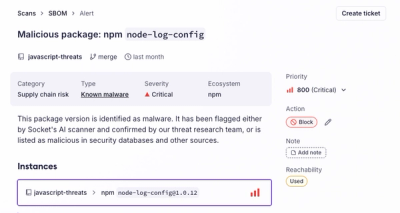
Socket's new Alert Details page is designed to surface more context, with a clearer layout, reachability dependency chains, and structured review.
Product
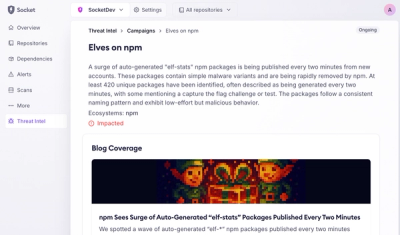
Campaign-level threat intelligence in Socket now shows when active supply chain attacks affect your repositories and packages.