


Company News
Socket Has Acquired Secure Annex
Socket has acquired Secure Annex to expand extension security across browsers, IDEs, and AI tools.
By Feross Aboukhadijeh - Apr 28, 2026
The yaml package enables Go programs to comfortably encode and decode YAML values. It was developed within Canonical as part of the juju project, and is based on a pure Go port of the well-known libyaml C library to parse and generate YAML data quickly and reliably.
The yaml package supports most of YAML 1.1 and 1.2, including support for anchors, tags, map merging, etc. Multi-document unmarshalling is not yet implemented, and base-60 floats from YAML 1.1 are purposefully not supported since they're a poor design and are gone in YAML 1.2.
The import path for the package is gopkg.in/yaml.v2.
To install it, run:
go get gopkg.in/yaml.v2
If opened in a browser, the import path itself leads to the API documentation:
The package API for yaml v2 will remain stable as described in gopkg.in.
The yaml package is licensed under the Apache License 2.0. Please see the LICENSE file for details.
Some more examples can be found in the "examples" folder.
package main

import (
        "fmt"
        "log"

        "gopkg.in/yaml.v2"
)

var data = `
a: Easy!
b:
  c: 2
  d: [3, 4]
`

// Note: struct fields must be public in order for unmarshal to
// correctly populate the data.
type T struct {
        A string
        B struct {
                RenamedC int   `yaml:"c"`
                D        []int `yaml:",flow"`
        }
}

func main() {
        t := T{}

        err := yaml.Unmarshal([]byte(data), &t)
        if err != nil {
                log.Fatalf("error: %v", err)
        }
        fmt.Printf("--- t:\n%v\n\n", t)

        d, err := yaml.Marshal(&t)
        if err != nil {
                log.Fatalf("error: %v", err)
        }
        fmt.Printf("--- t dump:\n%s\n\n", string(d))

        m := make(map[interface{}]interface{})

        err = yaml.Unmarshal([]byte(data), &m)
        if err != nil {
                log.Fatalf("error: %v", err)
        }
        fmt.Printf("--- m:\n%v\n\n", m)

        d, err = yaml.Marshal(&m)
        if err != nil {
                log.Fatalf("error: %v", err)
        }
        fmt.Printf("--- m dump:\n%s\n\n", string(d))
}
This example will generate the following output:
--- t:
{Easy! {2 [3 4]}}

--- t dump:
a: Easy!
b:
  c: 2
  d: [3, 4]


--- m:
map[a:Easy! b:map[c:2 d:[3 4]]]

--- m dump:
a: Easy!
b:
  c: 2
  d:
  - 3
  - 4
FAQs
Unknown package
Did you know?

Socket for GitHub automatically highlights issues in each pull request and monitors the health of all your open source dependencies. Discover the contents of your packages and block harmful activity before you install or update your dependencies.
Company News
Socket has acquired Secure Annex to expand extension security across browsers, IDEs, and AI tools.

Research
/Security News
Socket is tracking cloned Open VSX extensions tied to GlassWorm, with several updated from benign-looking sleepers into malware delivery vehicles.
Product
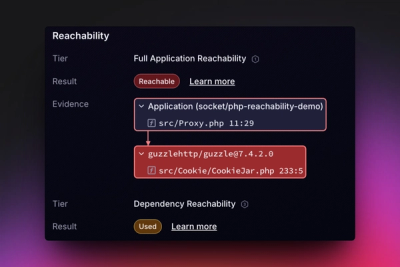
Reachability analysis for PHP is now available in experimental, helping teams identify which vulnerabilities are actually exploitable.