

Security News
/Research
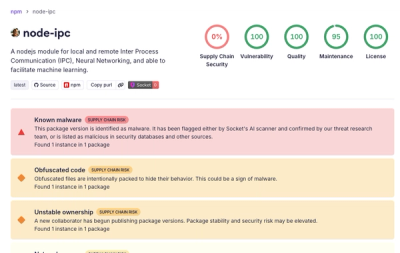
node-ipc npm Package Compromised in Supply Chain Attack
Socket detected malicious node-ipc versions with obfuscated stealer/backdoor behavior in a developing npm supply chain attack.
By Socket Research Team - May 14, 2026
@jasmith79/sequable
Advanced tools
Library functions for working with generators.
This library aims to be something like the array methods of lodash-fp but for working with generators and iterables. All of the functions in sequable will take a generator function, iterable object with a [Symbol.iterator] method, or iterator conforming to the { next: () => ({ value: T, done?: boolean }) } interface. They should also all compose naturally with each other, for example:
import { filter, map, take } from "@jasmith79/sequable";

const square = (n: number): number => n * n;
const isOdd = (n: number): boolean => n % 2 !== 0;

const take3 = take.bind(null, 3);
const filterOdd = filter.bind(null, isOdd);
const squareNum = map.bind(null, square);

// use your favorite library for function composition:
const getThreeOddSquares = compose(take3, squareNum, filterOdd);
console.log(...getThreeOddSquares([1, 2, 3, 4, 5, 6])); // 1 9 25
If you've ever worked with lodash-fp or ramda or this should be starting to seem familiar. And as you can see from example above the sequable functions return Iterables that can work with Array.from, the spread operator ..., for...of loops, ...or be piped to other functions that handle Iterables.
Because they work with arbitrary iterables you can use any type that implements the iterator protocol: Sets, Arrays, Maps, etc. Even Strings:
import { map, partition } from "@jasmith79/sequable";

const upperABCs = map(
  (x: string) => x.toUpperCase(),
  partition(3, "abcdefghikjlmnopqrstuvwxyz"),
);
for (let trio of upperABCs) {
  console.log(...trio); // prints A B C, then D E F, etc.
}
The idea here is to be able to write processing logic for sequential linear data that is container agnostic: the processing logic (especially at the type level in Typescript) should not be coupled to a specific concrete container type like an Array or Set (or FIFO Queue, or DFS over a tree, or...) unless it absolutely has to be. With sequable, anything that is or can be converted to an iterator will work. Additionally the fact that we're working with iterators means we can work with infinite data sets and lazily consume them:
const allPositiveIntegers = function* () {
  let i = 0;
  while (true) {
    yield ++i;
  }
};

console.log(...getThreeOddSquares(allPositiveIntegers)); // still just 1 9 25
Unlike the Array.prototype versions of map, filter, etc. which materialize a new Array at every step in the method chain composed sequable functions will pull each item all the way through the processing chain one at a time. We're still filtering out even numbers and then squaring but we only consume as many of the (infinity!) of positive integers as we need.
Iterators are inherently stateful. I've shown only pure function usage above for a reason. Just like you shouldn't mutate an array while iterating it with a for loop, you should be careful what side effects you introduce here too. Also walking through an iterator consumes it: don't hand the same iterator to multiple consumers:
const iter = getThreeOddSquares(allPositiveIntegers)[Symbol.iterator]();
console.log(...iter); // logs 1, 9, 25
const foo = Array.from(iter); // foo is empty because iter is already exhausted!
Fortunately since the library returns iterables rather than raw iterators this can usually be avoided.
It is possible when defining a generator function to return a value in addition to yielding values:
function* f() {
  let n = 2;
  while (n--) {
    yield n;
  }

  return 7;
}

const iter = f();
let result = {};
while (result.done) {
  result = iter.next();
  console.log(result);
}
will log out
{ done: false, value: 2 }
{ done: false, value: 1 }
{ done: false, value: 0 }
{ done: true, value: 7 }
HOWEVER, these returned values are mostly ignored by constructs in the language that process iterators/iterables:
const arr = Array.from(f()); // [2, 1, 0], no 7
for (const n of f()) {
  console.log(n); // logs 2, 1. 0 but not 7
}
With the exception of concat the functions in sequable largely pass these through with the expected semantics: map will return the value transformed by the function argument, filter will return the value if it passes the predicate, etc. But since concat combines sequables it's not clear to me at least at present what the semantics should be if one or both have return values so they are just dropped. See the unit tests for examples of how they are handled but if you never use the raw .next() method and instead use the usual constructs above you'll probably never even notice the return values.
FAQs
Library functions for working with generators
We found that @jasmith79/sequable demonstrated a not healthy version release cadence and project activity because the last version was released a year ago. It has 1 open source maintainer collaborating on the project.
Did you know?

Socket for GitHub automatically highlights issues in each pull request and monitors the health of all your open source dependencies. Discover the contents of your packages and block harmful activity before you install or update your dependencies.
Security News
/Research
Socket detected malicious node-ipc versions with obfuscated stealer/backdoor behavior in a developing npm supply chain attack.

Security News
TeamPCP and BreachForums are promoting a Shai-Hulud supply chain attack contest with a $1,000 prize for the biggest package compromise.

Security News
Packagist urges PHP projects to update Composer after a GitHub token format change exposed some GitHub Actions tokens in CI logs.