Legend-State
Legend-State is a super fast and powerful state library for JavaScript apps with four primary goals:
1. 🦄 As easy as possible to use
There is no boilerplate and there are no contexts, actions, reducers, dispatchers, sagas, thunks, or epics. It doesn't modify your data at all, and you can just call get() to get the raw data and set() to change it.
In React components you can call use() on any observable to get the raw data and automatically re-render whenever it changes.
const state$ = observable({ settings: { theme: 'dark' } })
const theme = state$.settings.theme.get();
state$.settings.theme.set('light')
observe(() => {
console.log(state$.settings.theme.get())
})
enableReactTracking({ auto: true })
const Component = function Component() {
const theme = state$.settings.theme.get()
return <div>Theme: {theme}</div>
}
2. ⚡️ The fastest React state library
Legend-State beats every other state library on just about every metric and is so optimized for arrays that it even beats vanilla JS on the "swap" and "replace all rows" benchmarks. At only 4kb and with the massive reduction in boilerplate code, you'll have big savings in file size too.
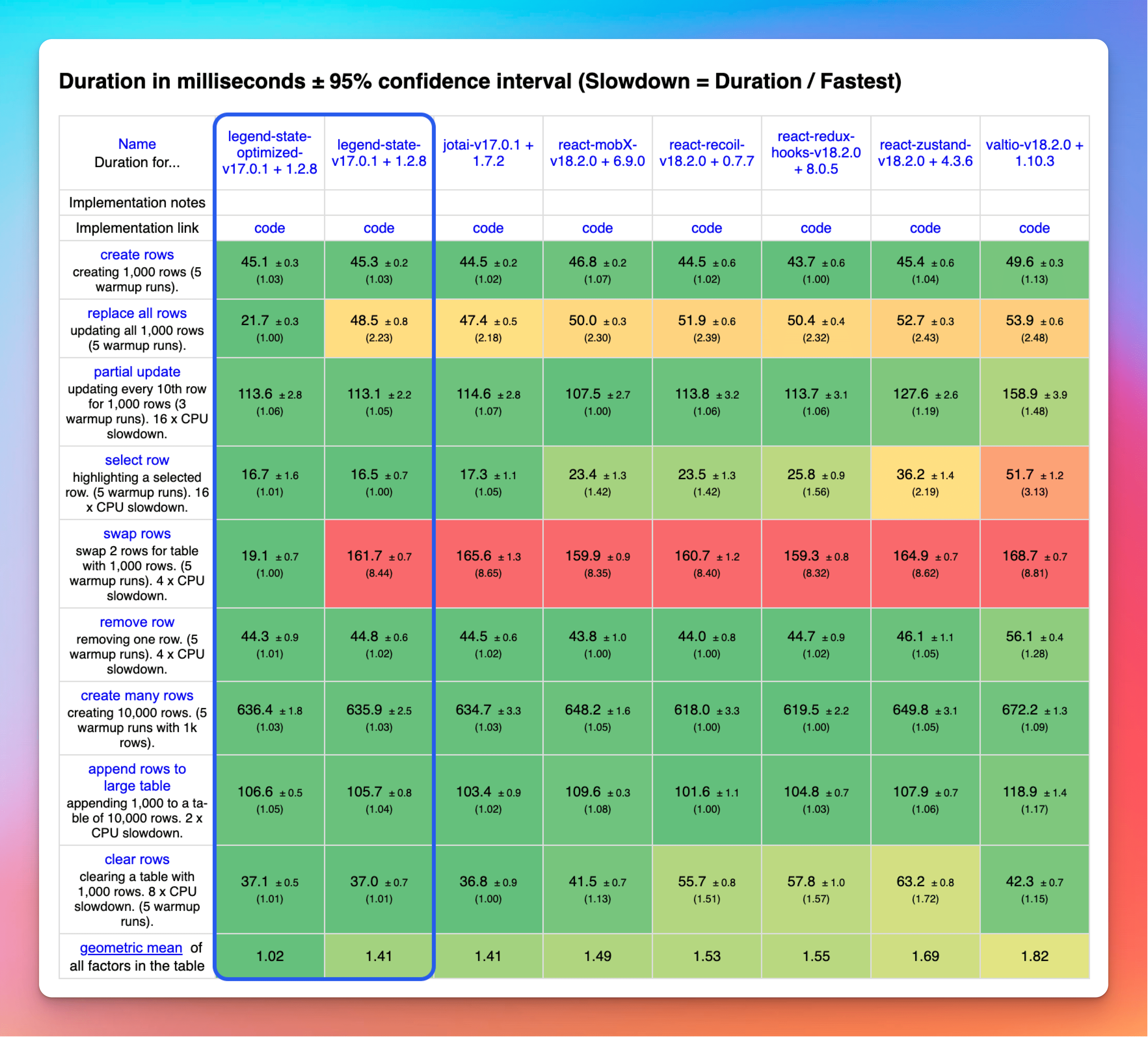
See the documentation for more details.
3. 🔥 Fine-grained reactivity for minimal renders
Legend-State lets you make your renders super fine-grained, so your apps will be much faster because React has to do less work. The best way to be fast is to render less, less often.
function FineGrained() {
const count$ = useObservable(0)
useInterval(() => {
count$.set(v => v + 1)
}, 600)
return (
<div>
Count: <Memo>{count$}</Memo>
</div>
)
}
4. 💾 Powerful persistence
Legend-State includes a powerful persistence plugin system for local caching and remote sync. It easily enables offline-first apps by tracking changes made while offline that save when coming online, managing conflict resolution, and syncing only small diffs. We use Legend-State as the sync systems in Legend and Bravely, so it is by necessity very full featured while being simple to set up.
Local persistence plugins for the browser and React Native are included, and a remote sync plugin for Firebase will be ready soon.
import { ObservablePersistLocalStorage } from '@legendapp/state/persist-plugins/local-storage'
import { persistObservable } from '@legendapp/state/persist'
const state$ = observable({ store: { bigObject: { ... } } })
persistObservable(state$, {
pluginLocal: ObservablePersistLocalStorage,
local: 'store'
})
Install
npm install @legendapp/state or yarn add @legendapp/state
Example
import { observable, observe } from "@legendapp/state"
import { persistObservable } from "@legendapp/state/persist"
const state$ = observable({ settings: { theme: 'dark' } })
state$.settings.theme.get() === 'dark'
observe(() => {
console.log(state$.settings.theme.get())
})
state$.settings.theme.set('light')
persistObservable(state$, { local: 'exampleState' })
function Component() {
const theme = state$.settings.theme.use()
const toggle = () => {
state$.settings.theme.set(theme =>
theme === 'dark' ? 'light' : 'dark'
)
}
return (
<div
className={theme === 'dark' ? 'theme-dark' : 'theme-light'}
>
<div>Theme: {theme}</div>
<Button onClick={toggle}>
Toggle theme
</Button>
</div>
)
}
Highlights
- ✨ Super easy to use 😌
- ✨ Super fast ⚡️
- ✨ Super small at 4kb 🐥
- ✨ Fine-grained reactivity 🔥
- ✨ No boilerplate
- ✨ Designed for maximum performance and scalability
- ✨ React components re-render only on changes
- ✨ Very strongly typed with TypeScript
- ✨ Persistence plugins for automatically saving/loading from storage
- ✨ State can be global or within components
Read more about why Legend-State might be right for you.
Documentation
See the documentation site.
Join us on Slack to get involved with the Legend community.
👩⚖️ License
MIT
Legend-State is created and maintained by Jay Meistrich with Legend and Bravely.