About stdlib...
We believe in a future in which the web is a preferred environment for numerical computation. To help realize this future, we've built stdlib. stdlib is a standard library, with an emphasis on numerical and scientific computation, written in JavaScript (and C) for execution in browsers and in Node.js.
The library is fully decomposable, being architected in such a way that you can swap out and mix and match APIs and functionality to cater to your exact preferences and use cases.
When you use stdlib, you can be absolutely certain that you are using the most thorough, rigorous, well-written, studied, documented, tested, measured, and high-quality code out there.
To join us in bringing numerical computing to the web, get started by checking us out on GitHub, and please consider financially supporting stdlib. We greatly appreciate your continued support!
dmeanstdev



Calculate the mean and standard deviation of a double-precision floating-point strided array.
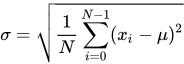
The population standard deviation of a finite size population of size N is given by
-->
where the population mean is given by
Often in the analysis of data, the true population standard deviation is not known a priori and must be estimated from a sample drawn from the population distribution. If one attempts to use the formula for the population standard deviation, the result is biased and yields an uncorrected sample standard deviation. To compute a corrected sample standard deviation for a sample of size n,
where the sample mean is given by
The use of the term n-1 is commonly referred to as Bessel's correction. Note, however, that applying Bessel's correction can increase the mean squared error between the sample standard deviation and population standard deviation. Depending on the characteristics of the population distribution, other correction factors (e.g., n-1.5, n+1, etc) can yield better estimators.
Installation
npm install @stdlib/stats-base-dmeanstdev
Usage
var dmeanstdev = require( '@stdlib/stats-base-dmeanstdev' );
dmeanstdev( N, correction, x, strideX, out, strideOut )
Computes the mean and standard deviation of a double-precision floating-point strided array x.
var Float64Array = require( '@stdlib/array-float64' );
var x = new Float64Array( [ 1.0, -2.0, 2.0 ] );
var out = new Float64Array( 2 );
var v = dmeanstdev( x.length, 1, x, 1, out, 1 );
var bool = ( v === out );
The function has the following parameters:
- N: number of indexed elements.
- correction: degrees of freedom adjustment. Setting this parameter to a value other than
0 has the effect of adjusting the divisor during the calculation of the standard deviation according to N-c where c corresponds to the provided degrees of freedom adjustment. When computing the standard deviation of a population, setting this parameter to 0 is the standard choice (i.e., the provided array contains data constituting an entire population). When computing the corrected sample standard deviation, setting this parameter to 1 is the standard choice (i.e., the provided array contains data sampled from a larger population; this is commonly referred to as Bessel's correction).
- x: input
Float64Array.
- strideX: index increment for
x.
- out: output
Float64Array for storing results.
- strideOut: index increment for
out.
The N and stride parameters determine which elements are accessed at runtime. For example, to compute the standard deviation of every other element in x,
var Float64Array = require( '@stdlib/array-float64' );
var floor = require( '@stdlib/math-base-special-floor' );
var x = new Float64Array( [ 1.0, 2.0, 2.0, -7.0, -2.0, 3.0, 4.0, 2.0 ] );
var out = new Float64Array( 2 );
var N = floor( x.length / 2 );
var v = dmeanstdev( N, 1, x, 2, out, 1 );
Note that indexing is relative to the first index. To introduce an offset, use typed array views.
var Float64Array = require( '@stdlib/array-float64' );
var floor = require( '@stdlib/math-base-special-floor' );
var x0 = new Float64Array( [ 2.0, 1.0, 2.0, -2.0, -2.0, 2.0, 3.0, 4.0 ] );
var x1 = new Float64Array( x0.buffer, x0.BYTES_PER_ELEMENT*1 );
var out0 = new Float64Array( 4 );
var out1 = new Float64Array( out0.buffer, out0.BYTES_PER_ELEMENT*2 );
var N = floor( x0.length / 2 );
var v = dmeanstdev( N, 1, x1, 2, out1, 1 );
dmeanstdev.ndarray( N, correction, x, strideX, offsetX, out, strideOut, offsetOut )
Computes the mean and standard deviation of a double-precision floating-point strided array and alternative indexing semantics.
var Float64Array = require( '@stdlib/array-float64' );
var x = new Float64Array( [ 1.0, -2.0, 2.0 ] );
var out = new Float64Array( 2 );
var v = dmeanstdev.ndarray( x.length, 1, x, 1, 0, out, 1, 0 );
The function has the following additional parameters:
- offsetX: starting index for
x.
- offsetOut: starting index for
out.
While typed array views mandate a view offset based on the underlying buffer, the offset parameters support indexing semantics based on a starting index. For example, to calculate the mean and standard deviation for every other value in x starting from the second value
var Float64Array = require( '@stdlib/array-float64' );
var floor = require( '@stdlib/math-base-special-floor' );
var x = new Float64Array( [ 2.0, 1.0, 2.0, -2.0, -2.0, 2.0, 3.0, 4.0 ] );
var out = new Float64Array( 4 );
var N = floor( x.length / 2 );
var v = dmeanstdev.ndarray( N, 1, x, 2, 1, out, 2, 1 );
Notes
- If
N <= 0, both functions return a mean and standard deviation equal to NaN.
- If
N - c is less than or equal to 0 (where c corresponds to the provided degrees of freedom adjustment), both functions return a standard deviation equal to NaN.
Examples
var randu = require( '@stdlib/random-base-randu' );
var round = require( '@stdlib/math-base-special-round' );
var Float64Array = require( '@stdlib/array-float64' );
var dmeanstdev = require( '@stdlib/stats-base-dmeanstdev' );

var out;
var x;
var i;

x = new Float64Array( 10 );
for ( i = 0; i < x.length; i++ ) {
    x[ i ] = round( (randu()*100.0) - 50.0 );
}
console.log( x );

out = new Float64Array( 2 );
dmeanstdev( x.length, 1, x, 1, out, 1 );
console.log( out );
Notice
This package is part of stdlib, a standard library for JavaScript and Node.js, with an emphasis on numerical and scientific computing. The library provides a collection of robust, high performance libraries for mathematics, statistics, streams, utilities, and more.
For more information on the project, filing bug reports and feature requests, and guidance on how to develop stdlib, see the main project repository.

License
See LICENSE.
Copyright
Copyright © 2016-2024. The Stdlib Authors.