


Security News
Deno 2.6 + Socket: Supply Chain Defense In Your CLI
Deno 2.6 introduces deno audit with a new --socket flag that plugs directly into Socket to bring supply chain security checks into the Deno CLI.
By Sarah Gooding - Dec 12, 2025
@aparajita/tailwind-ionic
Advanced tools

This plugin for Tailwind CSS and Ionic provides several features:
part variant to target CSS parts in an Ionic component (or any other component that uses CSS parts).ion-checked variant to target the checked state of an Ionic checkbox or radio button.ios and md variants have been renamed to mode-ios and mode-md, and only apply to the mode attribute of the html element.pnpm add @aparajita/tailwind-ionic
If you only want the default variants and no Ionic theme colors, add the plugin to your tailwind.config.js file:
module.exports = {
  plugins: [require('@aparajita/tailwind-ionic')]
}
If you want to configure the behavior, read on.
The platform/mode variants in the table below are supported. Variants lower in the list are more specific and are applied after variants higher in the list. This means that a less specific variant applied to a given class will be overridden by a more specific variant applied to the same class.
Note that you cannot combine variants directly, but you can combine the effect of separate variants.
| Variant | Target |
|---|---|
| plt-desktop | Desktop mode |
| plt-mobile | Mobile-like device (including browser simulations) |
| plt-mobileweb | Mobile device simulation mode in a browser |
| plt-native | Real device using Capacitor |
| plt-ios | iOS device (including browser simulations) |
| plt-android | Android device (including browser simulations) |
| mode-ios | App is in iOS style mode |
| mode-md | App is in Material Design style mode |
<!-- BAD. Can't combine these variants with others directly. -->
<ion-label class="plt-native:plt-ios:text-ion-color-primary" />

<!--
  GOOD. Separate variants combine.
  On a real iOS device, bold blue color.
  On a real Android device, bold yellow color.
-->
<ion-label
  class="
  plt-native:font-bold
  plt-ios:text-blue-500
  plt-android:text-yellow-500
"
/>

<!-- GOOD. More specific variant overrides. On a real iOS device, red color. -->
<ion-label class="plt-native:text-blue-500 plt-ios:text-red-500" />
The part- variant allows you to target CSS parts in an Ionic component (or any other component that uses CSS parts). All of the currently defined component parts are provided as auto-complete suggestions in your editor. Part variants can be combined with other variants.
<!-- Make a button fully rounded -->
<ion-button class="part-native:rounded-full" />

<!-- Equivalent to: -->
<ion-button class="my-button" />

<style>
  .my-button::part(native) {
    @apply rounded-full;
  }
</style>
The ion-checked variant allows you to target the checked state of an ion-checkbox or ion-radio. It can be combined with other variants, in particular the part- variant, to accomplish complex styling of ion-checkbox and ion-radio components entirely with Tailwind.
Here is a radio group using images for the radio buttons. The checked state is indicated by a blue ring.

Here is the markup:
<ion-radio-group
  v-model="appearance"
  class="flex w-full justify-around pt-5 pb-3"
>
  <div
    v-for="info in kAppearanceInfo"
    :key="info.label"
    class="relative flex flex-col items-center"
  >
    <ion-radio
      :value="info.value"
      class="m-0 h-[80px] w-[72px] rounded-lg part-container:border-none part-mark:hidden ion-checked:ring ion-checked:ring-blue-500"
    />
    <img
      :src="info.src"
      :alt="info.label"
      class="absolute inset-0 h-[80px] w-[72px] rounded-lg border"
      :class="info.class"
    />
    <p class="mt-2 text-sm text-ion-color-dark">
      {{ info.label }}
    </p>
  </div>
</ion-radio-group>
Or, for example, if you want a checkbox to be yellow-500 in the unchecked state and indigo-500 with an indigo-400 border in the checked state, you would do this:
<ion-checkbox
  class="
    part-container:!bg-yellow-500
    ion-checked:part-container:!bg-indigo-500
    ion-checked:part-container:!border-indigo-400
  "
/>
Note that part-container is used to target the checkbox markup itself and ! is necessary to override the Ionic styles.
If you pass the plugin one or more valid paths to a CSS file containing Ionic theme variables, they are converted into Tailwind theme colors.
/** @type {import('tailwindcss/types').Config} */
/** @type {import('@aparajita/tailwind-ionic').plugin} */

const ionic = require('@aparajita/tailwind-ionic')

module.exports = {
  plugins: [ionic('src/theme/variables.css')]
}
You may also pass the path as a .theme property of an options object, or an array of strings or objects with a .theme property. This allows you to access the Ionic theme files along with your own customizations.
/** @type {import('tailwindcss/types').Config} */
/** @type {import('@aparajita/tailwind-ionic').plugin} */

const ionic = require('@aparajita/tailwind-ionic')

module.exports = {
  plugins: [ionic({
    theme: 'src/theme/variables.css',
  })]
}
/** @type {import('tailwindcss/types').Config} */
/** @type {import('@aparajita/tailwind-ionic').plugin} */

const ionic = require('@aparajita/tailwind-ionic')

module.exports = {
  plugins: [ionic([
    'src/theme/variables.css',
    'assets/css/theme.css',
    require.resolve('@ionic/vue/css/palettes/dark.class.css'),
  )]
}
If the file variables.css is this:
/** Ionic CSS Variables **/
:root {
  /** primary **/
  --ion-color-primary: #3880ff;
  --ion-color-primary-rgb: 56, 128, 255;
  --ion-color-primary-contrast: #ffffff;
  --ion-color-primary-contrast-rgb: 255, 255, 255;
  --ion-color-primary-shade: #3171e0;
  --ion-color-primary-tint: #4c8dff;

  /* ...lots more */
}
then your effective Tailwind config ends up being this:
module.exports = {
  theme: {
    extend: {
      colors: {
        // ...whatever colors you have in your tailwind.config.js

        'ion-color-primary': 'var(--ion-color-primary)',
        'ion-color-primary-rgb': 'var(--ion-color-primary-rgb)',
        'ion-color-primary-contrast': 'var(--ion-color-primary-contrast)',
        'ion-color-primary-contrast-rgb': 'var(--ion-color-primary-contrast-rgb)',
        'ion-color-primary-shade': 'var(--ion-color-primary-shade)',
        'ion-color-primary-tint': 'var(--ion-color-primary-tint)',
        // ...and so on
      }
    }
  }
}
Because the variables are part of the color palette, they are added into all of the Tailwind color utilities: text, bg, border, etc.
<ion-label class="text-ion-color-primary">My label</ion-label>
<span class="text-ion-color-success">Success!</span>
<div class="bg-ion-color-background">
  <!-- content -->
</div>
<div class="border-ion-color-tertiary-tint">
  <!-- content -->
</div>
FAQs
Tailwind utilities for Ionic
The npm package @aparajita/tailwind-ionic receives a total of 524 weekly downloads. As such, @aparajita/tailwind-ionic popularity was classified as not popular.
We found that @aparajita/tailwind-ionic demonstrated a not healthy version release cadence and project activity because the last version was released a year ago. It has 1 open source maintainer collaborating on the project.
Did you know?

Socket for GitHub automatically highlights issues in each pull request and monitors the health of all your open source dependencies. Discover the contents of your packages and block harmful activity before you install or update your dependencies.
Security News
Deno 2.6 introduces deno audit with a new --socket flag that plugs directly into Socket to bring supply chain security checks into the Deno CLI.
Security News
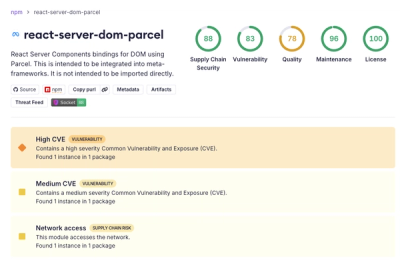
New DoS and source code exposure bugs in React Server Components and Next.js: what’s affected and how to update safely.

Security News
Socket CEO Feross Aboukhadijeh joins Software Engineering Daily to discuss modern software supply chain attacks and rising AI-driven security risks.