


Security News
Deno 2.6 + Socket: Supply Chain Defense In Your CLI
Deno 2.6 introduces deno audit with a new --socket flag that plugs directly into Socket to bring supply chain security checks into the Deno CLI.
By Sarah Gooding - Dec 12, 2025
@coder/wxnm
Advanced tools
A library for providing TypeScript typed communication between your web extension and your native Node application using Native Messaging
wxnm is a TypeScript library for providing typed communication between your web extension and your native Node application using Native Messaging. It also provides some utilities for installing your native application's app manifest.
wxnm is meant for long-running applications and uses the runtime.connectNative API under the hood. If your use case only requires infrequent, one-off messages to be sent, it's recommended you use runtime.sendNativeMessage directly.
| Browser | Windows | Linux | Mac |
|---|---|---|---|
| Firefox | ✕ | ✓ | ✓ |
| Waterfox | ✕ | ✓ | ✓ |
| Chrome | ✕ | ✓ | ✓ |
| Chrome Canary | ✕ | ✓ | |
| Chrome Beta | ✕ | ✓ | |
| Chromium | ✓ | ✓ | |
| Brave | ✕ | ✓ | ✓ |
| Opera | ✕ | ✕ | ✓ |
| Vivaldi | ✕ | ✓ | ✓ |
Windows support is a WIP
npm install @coder/wxnm
# or #
yarn add @coder/wxnm
See the example directory for a full implementation of an extension that talks to a native application to get its process ID.
Before your extension and your native app can communicate, the app will need to register an application manifest on the user's machine, and the extension will need to declare the nativeMessaging permission in its manifest. This library provides an installManifest utility to install a manifest for all of the user's currently installed browsers, which you can put somewhere in your app as either its own executable, or run via a flag on your main executable. For instance:
// If passed --install, install the manifest
const argv = yargs.argv
if (argv.install) {
  installManifest({
    name: "com.coder.wxnm_example",
    description: "Example of the wxnm library",
    path: path.resolve("./node/dist/wxnm-node-example"),
    chromeExtensionIds: [process.env.CHROME_EXTENSION_ID],
    webExtensionIds: ["wxnmexample@coder.com"],
  })
  process.exit(0)
}
See the example for more info.
To get the full effectiveness of wxnm, you'll want to create some types that will be shared between your browser extension and your node application. They should look something like this:
import { NativeMessage } from "@coder/wxnm"

/**
 * Messages the extension will send, native app will recieve
 */
interface PingMessage extends NativeMessage {
  type: "PING"
  message: string
}

export type ExtensionMessages = PingMessage

/**
 * Messages the native app will send, extension will receive
 */
interface PongMessage extends NativeMessage {
  type: "PONG"
  message: string
}

interface ErrorMessage extends NativeMessage {
  type: "ERROR"
  error: string
}

export type NativeMessages = PongMessage | ErrorMessage
In your web extension, you'll call createExtensionMessenger which will allow you to send messages, listen for messages, and listen for disconnects:
import { createExtensionMessenger } from "@coder/wxnm/extension"
import { ExtensionMessages, NativeMessages } from "../shared/types"

/**
 * Create an instance of ExtensionNativeMessenger
 */
const msger = createExtensionMessenger<ExtensionMessages, NativeMessages>("com.company.name_of_app")

/**
 * Handle each message type as it comes in from the app
 */
msger.onMessage((msg: NativeMessages) => {
  switch (msg.type) {
    case "PONG":
      console.log("Got PONG back!", msg.message)
    case "ERROR":
      console.error("Uh oh!", msg.error)
  }
})

/**
 * Alert to an error if we unexpectedly disconnect
 */
msger.onDisconnect((err?: Error) => {
  if (err) {
    console.error("Error with disconnect!", err)
  }
})

/**
 * Send a ping message to the native app
 */
msger.sendMessage({
  type: "PING",
  message: "Hello",
})
The node side looks very similar, with the generics flipped for createNodeMessenger:
import { createNodeMessenger } from "@coder/wxnm/node"
import { ExtensionMessages, NativeMessages } from "../shared/types"

/**
 * Create an instance of NodeNativeMessenger
 */
const msger = createNodeMessenger<NativeMessages, ExtensionMessages>()

/**
 * Handle ping messages and respond with a pong message
 */
msger.onMessage((msg: ExtensionMessages) => {
  switch (msg.type) {
    case "PING":
      msger.sendMessage({
        type: "PONG",
        data: { message: `You said: ${msg.data.message}` },
      })
  }
})

/**
 * Alert to an error if we unexpectedly disconnect
 */
msger.onDisconnect((err?: Error) => {
  if (err) {
    console.error("Error with disconnect!", err)
  }
  // Maybe run some cleanup code if you need to as well
})
The wxnm API is not isomorphic, so you'll have two import paths depending on which environment you're in.
export class ExtensionNativeMessenger<ExtensionMessage, NodeMessage> {
  /**
   * Disconnect from the native app. This will kill the native app process and
   * trigger all onDisconnect listeners on both sides.
   */
  disconnect(): void
  /**
   * Add a listener for when you disconnect. Calls to `disconnect` will trigger
   * this without an error. Returns an unlistener function.
   */
  onDisconnect(listener: (err?: Error) => void): () => void
  /**
   * Add a listener for when you receive messages from the native app. Returns
   * an unlistener function.
   */
  onMessage(listener: (msg: NodeMessage) => void): () => void
  /**
   * Send a message to the native app. Must be JSON serializable.
   */
  sendMessage(msg: ExtensionMessage): void
}

/**
 * Creates an instance of ExtensionNativeMessenger
 */
export function createExtensionMessenger<ExtensionMessage, NodeMessage>()
export class NodeNativeMessenger<NodeMessage, ExtensionMessage> {
  /**
   * Add a listener for when the extension disconnects. The app will terminate
   * after this runs. Returns an unlistener function.
   */
  onDisconnect(listener: (err?: Error) => void): () => void
  /**
   * Add a listener for when you receive messages from the extension. Returns
   * an unlistener function.
   */
  onMessage(listener: (msg: NodeMessage) => void): () => void
  /**
   * Send a message to the extension. Must be JSON serializable.
   */
  sendMessage(msg: ExtensionMessage): void
}

/**
 * Creates an instance of ExtensionNativeMessenger
 */
export function createExtensionMessenger<NodeMessage, ExtensionMessage>()
Because using this package relies on you importing submodules, you must run npm publish from within the dist/ directory to avoid imports having to add /dist/ to their paths. If you attempt to publish from the top level, the prepublishOnly script will fail.
FAQs
A library for providing TypeScript typed communication between your web extension and your native Node application using Native Messaging
We found that @coder/wxnm demonstrated a not healthy version release cadence and project activity because the last version was released a year ago. It has 6 open source maintainers collaborating on the project.
Did you know?

Socket for GitHub automatically highlights issues in each pull request and monitors the health of all your open source dependencies. Discover the contents of your packages and block harmful activity before you install or update your dependencies.
Security News
Deno 2.6 introduces deno audit with a new --socket flag that plugs directly into Socket to bring supply chain security checks into the Deno CLI.
Security News
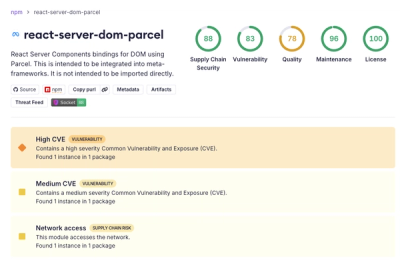
New DoS and source code exposure bugs in React Server Components and Next.js: what’s affected and how to update safely.

Security News
Socket CEO Feross Aboukhadijeh joins Software Engineering Daily to discuss modern software supply chain attacks and rising AI-driven security risks.