


Security News
Deno 2.6 + Socket: Supply Chain Defense In Your CLI
Deno 2.6 introduces deno audit with a new --socket flag that plugs directly into Socket to bring supply chain security checks into the Deno CLI.
By Sarah Gooding - Dec 12, 2025
@data-prism/postgres-store
Advanced tools
A PostgreSQL backend store implementation for Data Prism that provides CRUD operations, advanced querying, and relationship management backed by a PostgreSQL database. Designed for production applications requiring persistent data storage, concurrent acce
A PostgreSQL backend store implementation for Data Prism that provides CRUD operations, advanced querying, and relationship management backed by a PostgreSQL database. Designed for production applications requiring persistent data storage, concurrent access, and complex queries.
Data Prism PostgreSQL Store is built around several key principles:
npm install @data-prism/postgres-store
You'll also need to install the PostgreSQL client driver:
npm install pg
The PostgreSQL store manages your data in properly normalized PostgreSQL tables, with automatic schema generation and relationship management. Tables are created based on your Data Prism schema, with foreign keys maintaining referential integrity.
import { createPostgresStore } from "@data-prism/postgres-store";
import { Client } from "pg";

const client = new Client({
  connectionString: "postgresql://user:password@localhost:5432/mydb"
});
await client.connect();

const store = createPostgresStore(schema, client, {
  tablePrefix: "dp_", // optional
  validator: customValidator, // optional
});
The store automatically creates PostgreSQL tables that match your Data Prism schema:
createPostgresStore(schema, client, config?)Creates a new PostgreSQL store instance.
Parameters:
schema (Schema) - The Data Prism schema defining resource types and relationshipsclient (pg.Client) - Connected PostgreSQL client instanceconfig.tablePrefix (string, optional) - Prefix for generated table namesconfig.validator (Ajv, optional) - Custom AJV validator instanceReturns: PostgreSQL store instance with CRUD and query operations
import { createPostgresStore } from "@data-prism/postgres-store";
import { Client } from "pg";

const client = new Client({
  host: "localhost",
  port: 5432,
  database: "myapp",
  user: "myuser",
  password: "mypassword",
});

await client.connect();

const store = createPostgresStore(schema, client, {
  tablePrefix: "app_",
});
store.create(resource)Creates a new resource in the PostgreSQL database with automatic relationship linking and constraint validation.
Parameters:
resource (CreateResource) - The resource to createReturns: The created normalized resource
const newTeam = await store.create({
  type: "teams",
  attributes: {
    name: "Phoenix Rising FC",
    city: "Phoenix",
    founded: 2014,
  },
  relationships: {
    homeField: { type: "fields", id: "field-1" },
  },
});
store.update(resource)Updates an existing resource with automatic relationship management and validation.
Parameters:
resource (UpdateResource) - The resource updates to applyReturns: The updated normalized resource
const updatedTeam = await store.update({
  type: "teams",
  id: "team-1",
  attributes: {
    name: "Phoenix Rising FC (Updated)",
    active: true,
  },
});
store.upsert(resource)Creates a new resource or updates an existing one based on ID existence.
Parameters:
resource (CreateResource | UpdateResource) - The resource to create or updateReturns: The created or updated normalized resource
store.delete(resource)Deletes a resource from the database with proper relationship cleanup.
Parameters:
resource (DeleteResource) - Reference to the resource to deleteReturns: Confirmation of deletion
await store.delete({
  type: "teams",
  id: "team-1",
});
store.query(query)Executes a Data Prism query against the PostgreSQL database, generating efficient SQL.
Parameters:
query (RootQuery) - The query to executeReturns: Query results matching the query structure
const results = await store.query({
  type: "teams",
  where: {
    city: { eq: "Phoenix" },
  },
  select: {
    name: "name",
    homeMatches: {
      select: ["date", "opponent"],
      order: { date: "desc" },
      limit: 5,
    },
  },
});
Data Prism attribute types are mapped to PostgreSQL types:
string → VARCHAR or TEXTinteger → INTEGERnumber → NUMERICboolean → BOOLEANarray → JSONBobject → JSONBThe store automatically creates indexes for:
const store = createPostgresStore(schema, client, {
  tablePrefix: "myapp_", // Prefix all table names
  schemaName: "data_prism", // Use specific PostgreSQL schema
  createTables: true, // Auto-create tables (default: true)
  validator: customAjvValidator,
});
const store = createPostgresStore(schema, client, {
  columnTypeOverrides: {
    "teams.name": "VARCHAR(255)",
    "matches.metadata": "JSONB",
  },
  indexConfig: {
    "teams.city": { type: "btree" },
    "matches.date": { type: "btree" },
  },
});
Data Prism queries are translated to optimized PostgreSQL SQL:
// Data Prism query
const query = {
  type: "teams",
  select: ["name", "city"],
  limit: 10
};

// Generated SQL (approximately)
// SELECT name, city FROM teams LIMIT 10;
// Data Prism query
const query = {
  type: "teams",
  select: {
    name: "name",
    homeMatches: {
      select: ["date", "opponent"],
      where: { date: { gte: "2024-01-01" } }
    }
  }
};

// Generated SQL uses JOINs and subqueries for efficient execution
import { createPostgresStore } from "@data-prism/postgres-store";
import { Client } from "pg";

const schema = {
  resources: {
    teams: {
      attributes: {
        id: { type: "string" },
        name: { type: "string" },
        city: { type: "string" },
        founded: { type: "integer" },
      },
      relationships: {
        homeMatches: {
          type: "matches",
          cardinality: "many",
          inverse: "homeTeam",
        },
      },
    },
    matches: {
      attributes: {
        id: { type: "string" },
        date: { type: "string" },
        venue: { type: "string" },
      },
      relationships: {
        homeTeam: {
          type: "teams",
          cardinality: "one",
          inverse: "homeMatches",
        },
      },
    },
  },
};

const client = new Client(process.env.DATABASE_URL);
await client.connect();

const store = createPostgresStore(schema, client);
// Create
const team = await store.create({
  type: "teams",
  attributes: {
    name: "Arizona Cardinals",
    city: "Phoenix",
    founded: 1898,
  },
});

// Query
const phoenixTeams = await store.query({
  type: "teams",
  where: { city: { eq: "Phoenix" } },
  select: ["name", "founded"],
});

// Update
const updatedTeam = await store.update({
  type: "teams",
  id: team.id,
  attributes: {
    name: "Arizona Cardinals FC",
  },
});

// Delete
await store.delete({
  type: "teams",
  id: team.id,
});
// Complex query with multiple relationships and filtering
const results = await store.query({
  type: "teams",
  where: {
    founded: { gte: 2000 },
    city: { in: ["Phoenix", "Scottsdale", "Tempe"] },
  },
  select: {
    name: "name",
    city: "city",
    homeMatches: {
      where: { date: { gte: "2024-01-01" } },
      select: ["date", "venue"],
      order: { date: "desc" },
      limit: 5,
    },
  },
  order: { founded: "desc" },
  limit: 20,
});
const client = new Client(DATABASE_URL);
await client.connect();

try {
  await client.query('BEGIN');

  const store = createPostgresStore(schema, client);

  const team = await store.create({
    type: "teams",
    attributes: { name: "New Team" }
  });

  const match = await store.create({
    type: "matches",
    attributes: { date: "2024-12-01", venue: "Stadium" },
    relationships: { homeTeam: { type: "teams", id: team.id } }
  });

  await client.query('COMMIT');
} catch (error) {
  await client.query('ROLLBACK');
  throw error;
}
The store automatically creates indexes, but you may want to add custom indexes for your specific query patterns:
-- Custom indexes for common queries
CREATE INDEX idx_teams_city_founded ON teams(city, founded);
CREATE INDEX idx_matches_date_venue ON matches(date, venue);
For production applications, use connection pooling:
import { Pool } from "pg";

const pool = new Pool({
  connectionString: process.env.DATABASE_URL,
  max: 20, // maximum number of connections
});

const store = createPostgresStore(schema, pool);
Tests require Docker to be running for PostgreSQL test database containers.
@data-prism/core - Core Data Prism functionality and schema definitions@data-prism/interface-tests - Test suite for validating store implementations@data-prism/memory-store - In-memory store for development and testingFAQs
A PostgreSQL backend store implementation for Data Prism that provides CRUD operations, advanced querying, and relationship management backed by a PostgreSQL database. Designed for production applications requiring persistent data storage, concurrent acce
We found that @data-prism/postgres-store demonstrated a healthy version release cadence and project activity because the last version was released less than a year ago. It has 1 open source maintainer collaborating on the project.
Did you know?

Socket for GitHub automatically highlights issues in each pull request and monitors the health of all your open source dependencies. Discover the contents of your packages and block harmful activity before you install or update your dependencies.
Security News
Deno 2.6 introduces deno audit with a new --socket flag that plugs directly into Socket to bring supply chain security checks into the Deno CLI.
Security News
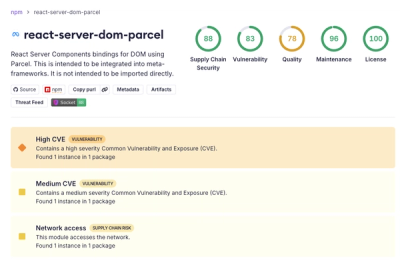
New DoS and source code exposure bugs in React Server Components and Next.js: what’s affected and how to update safely.

Security News
Socket CEO Feross Aboukhadijeh joins Software Engineering Daily to discuss modern software supply chain attacks and rising AI-driven security risks.