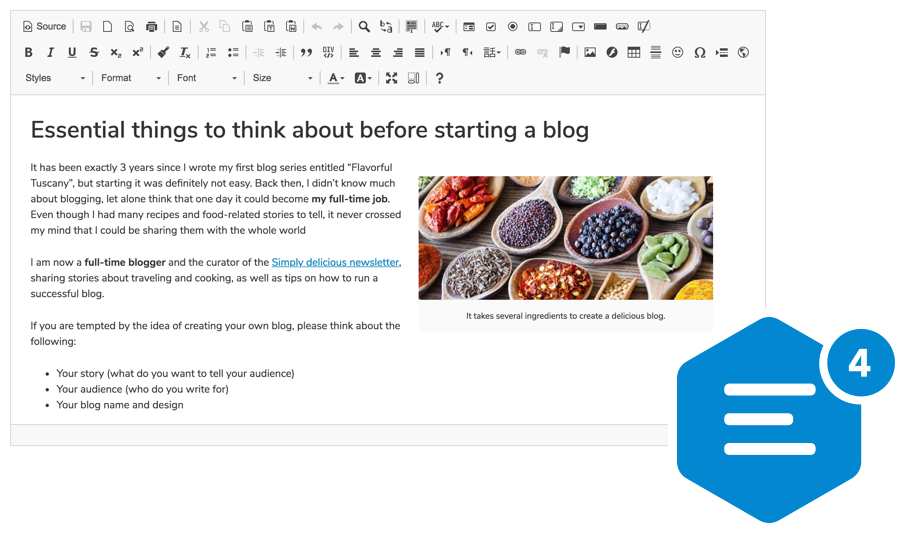
CKEditor 4 WYSIWYG editor Angular component



The official CKEditor 4 WYSIWYG editor component for Angular.
This is the beta version of the CKEditor 4 Angular integration. We are looking forward to your feedback! You can report any issues, ideas or feature requests on the integration issues page.
Usage
In order to create an editor instance in Angular, install the ckeditor4-angular npm package as a dependency of your project:
npm install --save ckeditor4-angular
After installing, import CKEditorModule to your application:
import { CKEditorModule } from 'ckeditor4-angular';

@NgModule( {
    imports: [
        ...
        CKEditorModule,
        ...
    ],
    …
} )
You can now use the <ckeditor> tag in the component template to include the rich text editor:
<ckeditor data="<p>Hello, world!</p>"></ckeditor>
The data attribute used in the example above is responsible for setting the editor’s data.
Documentation and examples
See the CKEditor 4 Angular Integration article and Angular examples in the CKEditor 4 documentation.
Browser support
The CKEditor 4 Angular component works with all the supported browsers except for Internet Explorer 8-10.
Supported Angular versions
The integration can be used together with Angular at version 5.0.0 and higher. It is an implication of Angular metadata produced for this package by the Angular builder. Note that the package.json used in the main repository isn't published on NPM (the production one is present in src/ckeditor/package.json), so there are only a few peer dependencies to @angular/core >= 5.0.0, @angular/common >= 5.0.0 and @angular/forms >= 5.0.0 required by this package.
Contributing
Here is how you can contribute to the development of the component. Any feedback and help will be most appreciated!
Reporting issues and feature requests
All issues and feature requests should be reported in the issues section of the official GitHub repository for the CKEditor 4 Angular integration.
Development
Clone the CKEditor 4 Angular integration repository.
Once you have cloned it, install dependencies by running:
npm install
The structure of the repository
This repository contains the following code:
./src/ckeditor contains the CKEditor component,./src/app is a demo application using the component.
Development server
Run ng serve to start the development server. Navigate to http://localhost:4200/. The app will automatically reload if you change any of the source files.
Building samples
Run ng build to build the samples. The build artifacts will be stored in the samples/ directory.
Running unit tests
Run npm test to execute unit tests via Karma.
There are two options available to alternate the testing process:
url / u - pass custom URL to Karma, for example custom CKEditor 4 build.watch / w - tell Karma to watch for changes.
For example:
npm run test -- -u http://localhost:5000/ckeditor.js -w
Running end-to-end tests
Run ng e2e to execute the end-to-end tests via Protractor.
Publishing
To build and publish the package, run npm run publish.
You can also manually build the package with npm run build-package which will be stored in dist/. Then you can publish it with npm publish dist/.
License
Copyright (c) 2003-2019, CKSource - Frederico Knabben. All rights reserved.
For licensing, see LICENSE.md or https://ckeditor.com/legal/ckeditor-oss-license





