


Security News
Deno 2.6 + Socket: Supply Chain Defense In Your CLI
Deno 2.6 introduces deno audit with a new --socket flag that plugs directly into Socket to bring supply chain security checks into the Deno CLI.
By Sarah Gooding - Dec 12, 2025
@esmj/schema-express-middleware
Advanced tools
Middleware for express that uses @esmj/schema to make requests type-safe.
Express middleware for validating request body, query, params, and headers using @esmj/schema. Inspired by popular validation middlewares like zod-express-middleware and express-joi-validation, but using @esmj/schema for fast, type-safe validation.
npm install @esmj/schema-express-middleware
import express from 'express';
import { s, validateBody } from '@esmj/schema-express-middleware';

const app = express();
app.use(express.json());

const userSchema = s.object({
  name: s.string({ message: 'Name is required' }).refine((value) => value.length > 0, { message: 'Name must not be empty' }),
  age: s.string({ message: 'Age is required' })
    .transform((value) => Number.parseInt(value))
    .pipe(s.number())
    .refine((value) => Number.isInteger(value) && value >= 0, { message: 'Age must be a non-negative integer' }),
});

app.post('/users', validateBody(userSchema), (req, res) => {
  // req.schema.body is now validated and typed
  res.json({ user: req.schema.body });
});

app.listen(3000);
Arguments:
schema: { body?, query?, params?, headers? } — An object where each property is an optional @esmj/schema SchemaInterface. Each provided schema will be used to validate the corresponding part of the request (req.body, req.query, req.params, req.headers).errorHandler (optional): (opts) => unknown — A function called on validation error. Receives an object with { req, res, next, part, error, result }.
part: One of 'body' | 'query' | 'params' | 'headers' indicating which part failed.error: The validation error (with message and optional cause).result: The failed parse result (with success: false).Returns: Express RequestHandler middleware.
import { validate, s } from '@esmj/schema-express-middleware';

app.post(
  '/login',
  validate({
    body: s.object({ username: s.string(), password: s.string() }),
    query: s.object({ next: s.string().optional() }),
  }),
  (req, res) => {
    // req.schema.body and req.schema.query are validated and typed
    res.send('ok');
  }
);
You can provide a custom error handler to control the response:
import { validate } from '@esmj/schema-express-middleware';

function myErrorHandler({ res, error, part }) {
  res.status(422).json({ part, message: error.message });
}

app.post('/users', validate({ body: userSchema }, myErrorHandler), handler);
Arguments:
schema: [@esmj/schema SchemaInterface] — The schema to validate req.body.errorHandler (optional): Same as above.Returns: Express RequestHandler middleware.
app.post('/users', validateBody(userSchema), handler);
Arguments:
schema: [@esmj/schema SchemaInterface] — The schema to validate req.query.errorHandler (optional): Same as above.Returns: Express RequestHandler middleware.
app.get('/search', validateQuery(s.object({ q: s.string() })), handler);
Arguments:
schema: [@esmj/schema SchemaInterface] — The schema to validate req.params.errorHandler (optional): Same as above.Returns: Express RequestHandler middleware.
app.get('/users/:id', validateParams(s.object({ id: s.string() })), handler);
Arguments:
schema: [@esmj/schema SchemaInterface] — The schema to validate req.headers.errorHandler (optional): Same as above.Returns: Express RequestHandler middleware.
app.get('/secure', validateHeaders(s.object({ authorization: s.string() })), handler);
req.schema property:
req.schema.body — validated request body (if body schema provided)req.schema.query — validated query parameters (if query schema provided)req.schema.params — validated route parameters (if params schema provided)req.schema.headers — validated headers (if headers schema provided)MIT
FAQs
Middleware for express that uses @esmj/schema to make requests type-safe.
The npm package @esmj/schema-express-middleware receives a total of 2 weekly downloads. As such, @esmj/schema-express-middleware popularity was classified as not popular.
We found that @esmj/schema-express-middleware demonstrated a healthy version release cadence and project activity because the last version was released less than a year ago. It has 1 open source maintainer collaborating on the project.
Did you know?

Socket for GitHub automatically highlights issues in each pull request and monitors the health of all your open source dependencies. Discover the contents of your packages and block harmful activity before you install or update your dependencies.
Security News
Deno 2.6 introduces deno audit with a new --socket flag that plugs directly into Socket to bring supply chain security checks into the Deno CLI.
Security News
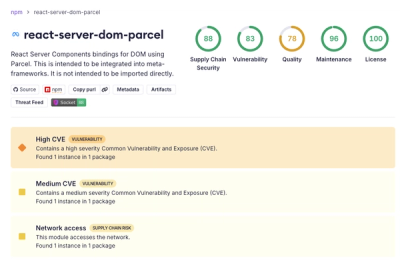
New DoS and source code exposure bugs in React Server Components and Next.js: what’s affected and how to update safely.

Security News
Socket CEO Feross Aboukhadijeh joins Software Engineering Daily to discuss modern software supply chain attacks and rising AI-driven security risks.