

Research
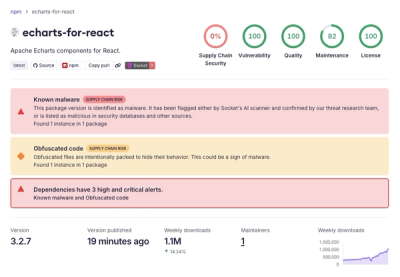
Active Supply Chain Attack Compromises @antv Packages on npm
Active npm supply chain attack compromises @antv packages in a fast-moving malicious publish wave tied to Mini Shai-Hulud.
By Socket Research Team - May 19, 2026
@jeganwrites/claudash
Advanced tools
Claude Code usage intelligence dashboard. Reads your local session files, detects waste patterns, generates fixes, and measures whether they worked.

Most Claude Code usage tools tell you how many tokens you spent. Claudash tells you why and what to do about it.
It detects four waste patterns in your sessions — repeated file reads, stuck retry loops, sessions that ran too long without compacting, and cost outliers — then generates targeted CLAUDE.md rules to fix them and measures the before/after difference.
Before installing Claudash, you need:
| Requirement | Why | How to check |
|---|---|---|
| Claude Code | Claudash reads its session files | claude --version |
| Python 3.8+ | Claudash is written in Python | python3 --version |
| Node.js 16+ | Required for npx install method only | node --version |
Claude Code must have run at least one session before Claudash will show any data. Sessions are stored in:
~/.claude/projects/%APPDATA%\Claude\projects\/mnt/c/Users/<username>/AppData/Roaming/Claude/projects/Choose the method that works for your setup:
npx @jeganwrites/claudash
Requires Node.js 16+. Downloads and runs without permanent installation.
npm install -g @jeganwrites/claudash
claudash dashboard
Installs permanently. Run claudash from anywhere.
brew tap pnjegan/claudash
brew install claudash
claudash dashboard
No Node.js required. Python only.
git clone https://github.com/pnjegan/claudash.git
cd claudash
python3 cli.py dashboard
No npm, no Node.js required. Best for development or customisation.
Claudash runs on Windows via WSL2 (Windows Subsystem for Linux). Native Windows support is in progress.
Setup WSL2:
# In PowerShell (as administrator)
wsl --install

# Restart, then open Ubuntu from Start menu
# Install Node.js inside WSL
curl -fsSL https://deb.nodesource.com/setup_20.x | sudo -E bash -
sudo apt-get install -y nodejs

# Install Claudash
npx @jeganwrites/claudash
Claudash will automatically detect your Windows Claude Code sessions
at /mnt/c/Users/<username>/AppData/Roaming/Claude/projects/.
Quickest path:
# Install Node.js if you don't have it
brew install node

# Run Claudash
npx @jeganwrites/claudash
Or use Homebrew install (no Node.js needed):
brew tap pnjegan/claudash
brew install claudash
claudash dashboard
# Ubuntu / Debian — install Node.js
curl -fsSL https://deb.nodesource.com/setup_20.x | sudo -E bash -
sudo apt-get install -y nodejs

# Run
npx @jeganwrites/claudash
# 1. Start the dashboard (auto-opens browser)
claudash dashboard

# 2. If no data appears, run the scanner manually
claudash scan

# 3. Check what's in your session files
claudash stats
Dashboard opens at http://localhost:8080
If the port is in use:
PORT=9090 claudash dashboard
After your first scan:
A score below 50 is not unusual. The score measures how efficiently you're using your context window, not whether the work was good.
# Manual backup (creates snapshot + JSON export)
claudash backup

# Restore from backup
claudash restore --file ~/.claudash/backups/claudash-20260418.db

# Automated hourly backup (add to crontab)
0 * * * * cd /path/to/claudash && python3 cli.py backup --quiet
Your irreplaceable data is in the fixes and fix_measurements tables.
Everything else regenerates from your session files.
Claudash reads your Claude Code session files stored locally on your machine.
data/usage.db on your machineThe database is created with restricted file permissions (0600 on Unix systems). API keys for fix generation are stored locally in the same database.
For team or cloud deployment, see SECURITY.md.
Dashboard shows no data
claudash scan first~/.claude/projects/ contains .jsonl filesPort 8080 already in use
PORT=9090 claudash dashboard
Python not found
# macOS
brew install python@3.11

# Ubuntu
sudo apt install python3
Node.js version too old
Claudash requires Node.js 16+. Check with node --version.
Update via brew upgrade node (macOS) or via nvm.
Permission denied on database
chmod 600 data/usage.db
WSL2 can't find Windows sessions
Claudash looks for sessions in /mnt/c/Users/<username>/AppData/Roaming/Claude/projects/.
Confirm that path exists: ls /mnt/c/Users/ and find your username.
Pull requests welcome. Especially:
git clone https://github.com/pnjegan/claudash.git
cd claudash
python3 cli.py dashboard  # no install needed
MIT — use it, fork it, build on it.
All data stays on your machine. Zero pip dependencies. One command install.
FAQs
Claude Code usage intelligence dashboard
We found that @jeganwrites/claudash demonstrated a healthy version release cadence and project activity because the last version was released less than a year ago. It has 1 open source maintainer collaborating on the project.
Did you know?

Socket for GitHub automatically highlights issues in each pull request and monitors the health of all your open source dependencies. Discover the contents of your packages and block harmful activity before you install or update your dependencies.
Research
Active npm supply chain attack compromises @antv packages in a fast-moving malicious publish wave tied to Mini Shai-Hulud.
Security News
/Research
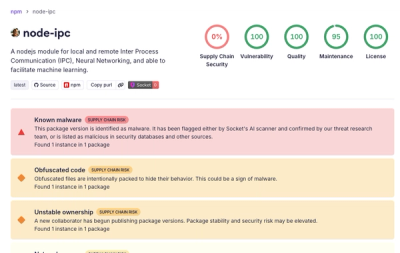
Socket detected malicious node-ipc versions with obfuscated stealer/backdoor behavior in a developing npm supply chain attack.

Security News
TeamPCP and BreachForums are promoting a Shai-Hulud supply chain attack contest with a $1,000 prize for the biggest package compromise.