

Product
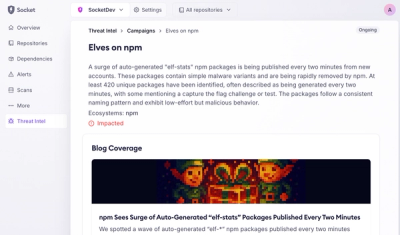
Introducing Supply Chain Attack Campaigns Tracking in the Socket Dashboard
Campaign-level threat intelligence in Socket now shows when active supply chain attacks affect your repositories and packages.
By Philipp Burckhardt - Jan 21, 2026
@jsepia/utils
Advanced tools


My utility library. Because some wheels still need to be reinvented.
import {isBrowser} from '@jsepia/utils'
if (isBrowser()) {
document.createElement('canvas')
}
import {IDGenerator} from '@jsepia/utils'

const catIDGenerator = new IDGenerator()
const dogIDGenerator = new IDGenerator()

function createCat(name) {
  return {
    id: catIDGenerator.generateID()
    name: name,
    toy: 'scratcher'
  }
}

function createDog(name) {
  return {
    id: dogIDGenerator.generateID()
    name: name,
    toy: 'ball'
  }
}
import {generateID} from '@jsepia/utils'

const entities = []

function spawnMonster() {
  entities[generateID()] = new Monster()
}

function spawnNPC() {
  entities[generateID()] = new NPC()
}

function getEntityType(id) {
  if (entities[id] instanceof Monster) {
    return 'monster'
  }
  else if (entities[id] instanceof NPC) {
    return 'npc'
  }
  return 'unknown'
}
Recursively merges the properties of an object into another.
import {deepExtend} from '@jsepia/utils'

const defaults = {
  targets: {
    'app.js': 'src/**/*.js',
    'tests.js': 'test/**/*.js'
  },
  verbose: false
}

const userPreferences = {
  targets: {
    'libs.js': 'lib/**/*.js'
  }
}

const commandLineParams = {
  verbose: true
}

const options = deepExtend(defaults, userPreferences, commandLineParams)
Output:
{
  "targets": {
    "app.js": "src/**/*.js",
    "tests.js": "test/**/*.js",
    "libs.js": "lib/**/*.js",
  },
  "verbose": true
}
Overrides the top-level properties of an object with another's.
import {extend} from '@jsepia/utils'

const config = {
  env: 'development',
  entry: ['app.js', 'test.js']
}

const params = {
  env: 'production',
  entry: 'lib/**/*.js'
}

const options = extend(config, params)
Output:
{
  "env": "production",
  "entry": "lib/**/*.js"
}
import {indexOfRegex} from '@jsepia/utils'

indexOfRegex('umm', /m/g)    // 1
indexOfRegex('umm', /m/g, 2) // 2
Finds the index at the last occurrence of a regular expression.
import {lastIndexOfRegex} from '@jsepia/utils'

lastIndexOfRegex('umm', /m/g)    // 2
lastIndexOfRegex('umm', /m/g, 2) // 1
Determines whether a value is an array.
import {isArray} from '@jsepia/utils'

isArray([]) // true
isArray({}) // false
isArray('') // false
import {isDefined} from '@jsepia/utils'

isDefined(null) // true
isDefined(undefined) // false

const kitty = {
  ears: 2,
  paws: 4,
  status: 'cute'
}
isDefined(kitty.status) // true
isDefined(kitty.wings)  // false
import {isIterable} from '@jsepia/utils'

isIterable()       // true
isIterable([])     // true
isIterable('meow') // true

isIterable(null)   // false
isIterable({})     // false
Determines if a value is numeric. All numbers are considered numeric. Strings are numeric only if they begin with a number (e.g. 5px).
Another way of looking at it is: isNumeric(foo) === true implies parseInt(foo) will return a valid number.
import {isNumeric} from '@jsepia/utils'

isNumeric(-95) // true
isNumeric('5.6') // true
isNumeric('-5.6') // true
isNumeric('5px') // true

isNumeric('five') // false
isNumeric('E79') // false

isNumeric() // false
isNumeric(null) // false
isNumeric(true) // false
isNumeric({}) // false
isNumeric([]) // false
Returns true if a value has the type object and is not null. This function helps you determine if it's safe to query a value's properties or perform any other object-specific operations on it.
import {isObject} from '@jsepia/utils'

isObject()              // false
isObject(null)          // false (even though typeof null === 'object')
isObject(function() {}) // false

isObject({})         // true
isObject([])         // true

// gotchas
isObject(true)          // false
isObject(new Boolean()) // false
isObject(1)             // false
isObject(new Number())  // false
isObject('')            // false
isObject(new String())  // false
Determines whether a value is a plain object - i.e. an object that is not an instance of a prototype or class, or otherwise does not have a constructor
import {isPlainObject} from '@jsepia/utils'

isPlainObject()            // false
isPlainObject([])          // false (even though typeof [] === 'object')
isPlainObject(NaN)         // false (even though NaN is a Number type)
isPlainObject(new Date())  // false

isPlainObject({})         // true
import {buildUri} from '@jsepia/utils'

buildUri({
  // it supports the basic options you would expect
  protocol: 'http',
  host: 'juliosepia.com',
  port: '8080',
  path: '/posts/util.html',
  anchor: 'introduction', // hash

  // you can pass credentials separately
  user: 'jsepia',
  password: 'hunter2',

  // or as a single string
  userInfo: 'jsepia:hunter2',

  // you can pass query params separately
  queryKey: {
    version: '1.0',
    format: 'html'
  },

  // or as a single string
  query: 'version=1.0&format=html',
})
Output:
http://jsepia:hunter2@juliosepia.com:8080/posts/util.html?version=1.0&format=html#introduction
parseUri('http://jsepia:hunter2@juliosepia.com/posts/util.html?version=1.0&format=html#introduction')
Output:
{
  "anchor": "introduction",
  "authority": "jsepia:hunter2@juliosepia.com",
  "directory": "/posts/",
  "file": "util.html",
  "host": "juliosepia.com",
  "password": "hunter2",
  "path": "/posts/util.html",
  "port": "",
  "protocol": "http",
  "query": "version=1.0&format=html",
  "queryKey": {
    "format": "html",
    "version": "1.0",
  },
  "relative": "/posts/util.html?version=1.0&format=html#introduction",
  "source": "http://jsepia:hunter2@juliosepia.com/posts/util.html?version=1.0&format=html#introduction",
  "user": "jsepia",
  "userInfo": "jsepia:hunter2"
}
import {isValidUrl} from '@jsepia/utils'

const url = prompt('enter URL here')
if (isValidUrl(url)) {
  request(url).then(
    (response) => handleResponse,
    (err) => handleError
  )
}
else {
  handleError(new Error(`Invalid URL: ${url}`))
}
# unit test
yarn test

# integ test (for CI and stuff)
yarn build && yarn test:integ
FAQs
My utility library. Because some wheels are worth reinventing.
We found that @jsepia/utils demonstrated a not healthy version release cadence and project activity because the last version was released a year ago. It has 1 open source maintainer collaborating on the project.
Did you know?

Socket for GitHub automatically highlights issues in each pull request and monitors the health of all your open source dependencies. Discover the contents of your packages and block harmful activity before you install or update your dependencies.
Product
Campaign-level threat intelligence in Socket now shows when active supply chain attacks affect your repositories and packages.

Research
Malicious PyPI package sympy-dev targets SymPy users, a Python symbolic math library with 85 million monthly downloads.

Security News
Node.js 25.4.0 makes require(esm) stable, formalizing CommonJS and ESM compatibility across supported Node versions.