

Security News
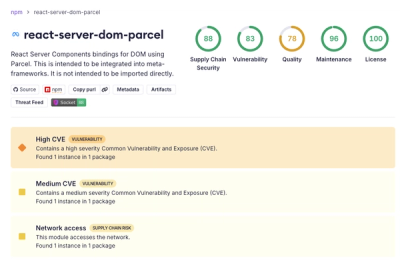
New React Server Components Vulnerabilities: DoS and Source Code Exposure
New DoS and source code exposure bugs in React Server Components and Next.js: what’s affected and how to update safely.
By Sarah Gooding - Dec 12, 2025
@laminarjs/cli
Advanced tools
A CLI for the Open Api implementation for the laminar http server.
yarn add @laminarjs/cli
Given a OpenAPI config file:
---
openapi: 3.0.0
info:
  title: Test
  version: 1.0.0
servers:
  - url: http://localhost:3333
paths:
  '/test':
    post:
      requestBody:
        required: true
        content:
          application/json:
            schema: { $ref: '#/components/schemas/User' }
      responses:
        '200':
          description: A Test Object
          content:
            application/json:
              schema: { $ref: '#/components/schemas/Test' }
    get:
      responses:
        '200':
          description: A Test Object
          content:
            application/json:
              schema: { $ref: '#/components/schemas/Test' }

components:
  schemas:
    User:
      additionalProperties: false
      properties:
        email:
          type: string
        scopes:
          type: array
          items:
            type: string
      required:
        - email

    Test:
      properties:
        text:
          type: string
        user:
          $ref: '#/components/schemas/User'
      required:
        - text
We can run:
yarn laminar api --file examples/api.yaml --output examples/__generated__/api.yaml.ts
Which would convert a given api.yaml file to a api.yaml.ts. Any external urls, referenced in it would be downloaded, and any local file references would be loaded as well.
Then you can load the types like this:
import { HttpService, init, jsonOk } from '@laminarjs/laminar';
import { join } from 'path';
import { openApiTyped } from './__generated__/api.yaml';

const main = async () => {
  const listener = await openApiTyped({
    api: join(__dirname, 'api.yaml'),
    paths: {
      '/test': {
        post: async ({ body }) => jsonOk({ text: 'ok', user: body }),
        get: async () => jsonOk({ text: 'ok', user: { email: 'me@example.com' } }),
      },
    },
  });
  const server = new HttpService({ listener });
  await init({ initOrder: [server], logger: console });
};

main();
You can also watch for changes and regenerate the typescript types with the --watch flag
yarn laminar --watch --file examples/api.yaml --output examples/__generated__/api.yaml.ts
When you update the source yaml file, or any of the local files it references, laminar would rebuild the typescript files.
Then given this OpenApi file:
---
openapi: 3.0.0
info:
  title: Test
  version: 1.0.0
servers:
  - url: https://simple.example.com
paths:
  '/test/{id}':
    parameters:
      - name: id
        in: path
        schema:
          type: string
        required: true

    post:
      requestBody:
        required: true
        content:
          application/json:
            schema: { $ref: '#/components/schemas/User' }
      responses:
        '200':
          description: A Test Object
          content:
            application/json:
              schema: { $ref: '#/components/schemas/Test' }
    get:
      responses:
        '200':
          description: A Test Object
          content:
            application/json:
              schema: { $ref: '#/components/schemas/Test' }

components:
  schemas:
    User:
      additionalProperties: false
      properties:
        email:
          type: string
        scopes:
          type: array
          items:
            type: string
      required:
        - email

    Test:
      properties:
        text:
          type: string
        user:
          $ref: '#/components/schemas/User'
      required:
        - text
You can run
yarn laminar axios --file examples/axios.yaml --output examples/__generated__/axios.yaml.ts
And would then have:
import { AxiosRequestConfig, AxiosInstance, AxiosResponse } from 'axios';

/**
 * Test
 *
 * Version: 1.0.0
 */
export const axiosOapi = (api: AxiosInstance): AxiosOapiInstance => ({
  'POST /test/{id}': (id, data, config) => api.post<Test>(`/test/${id}`, data, config),
  'GET /test/{id}': (id, config) => api.get<Test>(`/test/${id}`, config),
  api: api,
});

export interface User {
  email: string;
  scopes?: string[];
}

export interface Test {
  text: string;
  user?: User;
  [key: string]: unknown;
}

export interface AxiosOapiInstance {
  'POST /test/{id}': (id: string, data: User, config?: AxiosRequestConfig) => Promise<AxiosResponse<Test>>;
  'GET /test/{id}': (id: string, config?: AxiosRequestConfig) => Promise<AxiosResponse<Test>>;
  api: AxiosInstance;
}
And you can then use it like this:
import axios from 'axios';
import { axiosOapi } from './__generated__/axios.yaml';
import * as nock from 'nock';

/**
 * Mock the simple rest api so we can test it out
 */
nock('http://simple.example.com')
  .get('/test/20')
  .reply(200, { text: 'test' })
  .post('/test/30')
  .reply(200, { text: 'test', user: { email: 'test@example.com' } });

/**
 * Wrap an axios instance. This will add typed functions with the name of the paths
 */
const simple = axiosOapi(axios.create({ baseURL: 'http://simple.example.com' }));

simple['GET /test/{id}']('20').then(({ data }) => console.log(data));

simple['POST /test/{id}']('30', { email: 'test2example.com' }).then(({ data }) => console.log(data));
If we use swagger's petstore.json example, we can generate the petstore types and use them like this:
import { axiosOapi } from './__generated__/petstore.json';
import axios from 'axios';

const petstore = axiosOapi(axios.create({ baseURL: 'https://petstore.swagger.io/v2' }));

const main = async () => {
  const { data: pixel } = await petstore['PUT /pet']({
    name: 'Pixel',
    photoUrls: ['https://placekitten.com/g/200/300'],
    tags: [{ name: 'axios-oapi-cli' }],
  });

  console.log('SAVED', pixel);

  const { data: retrievedPixel } = await petstore['GET /pet/{petId}'](pixel.id!);

  console.log('RETRIEVED', retrievedPixel);

  // Use the underlying api to perform custom requests
  const { data: inventory } = await petstore.api.get('/store/inventory');
  console.log('INVENTORY', inventory);
};

main();
If you don't include "output" the cli will output to stdout. You can use this to chain with other processors like prettier
yarn laminar axios --file examples/simple.yaml | prettier --stdin-filepath examples/simple.types.ts > examples/simple.types.ts
If you omit the "file" option, stdin will be used. This can be used to pipe the file contents from somewhere else (like curl). By default it will asume the content to be json.
curl http://example.com/simple.json | yarn laminar axios --output examples/simple.types.ts
You can specify that the openapi content is yaml too:
curl http://example.com/simple.yaml | yarn laminar axios --output examples/simple.types.ts --stdin-type yaml
You can run the tests with:
yarn test
Style is maintained with prettier and eslint
yarn lint
Deployment is preferment by yarn automatically on merge / push to main, but you'll need to bump the package version numbers yourself. Only updated packages with newer versions will be pushed to the npm registry.
Have a bug? File an issue with a simple example that reproduces this so we can take a look & confirm.
Want to make a change? Submit a PR, explain why it's useful, and make sure you've updated the docs (this file) and the tests (see test folder).
This project is licensed under Apache 2 - see the LICENSE file for details
FAQs
CLI generating typescript types for @laminarjs/laminar
The npm package @laminarjs/cli receives a total of 1 weekly downloads. As such, @laminarjs/cli popularity was classified as not popular.
We found that @laminarjs/cli demonstrated a not healthy version release cadence and project activity because the last version was released a year ago. It has 1 open source maintainer collaborating on the project.
Did you know?

Socket for GitHub automatically highlights issues in each pull request and monitors the health of all your open source dependencies. Discover the contents of your packages and block harmful activity before you install or update your dependencies.
Security News
New DoS and source code exposure bugs in React Server Components and Next.js: what’s affected and how to update safely.

Security News
Socket CEO Feross Aboukhadijeh joins Software Engineering Daily to discuss modern software supply chain attacks and rising AI-driven security risks.

Security News
GitHub has revoked npm classic tokens for publishing; maintainers must migrate, but OpenJS warns OIDC trusted publishing still has risky gaps for critical projects.