

Product
Introducing Reports: An Extensible Reporting Framework for Socket Data
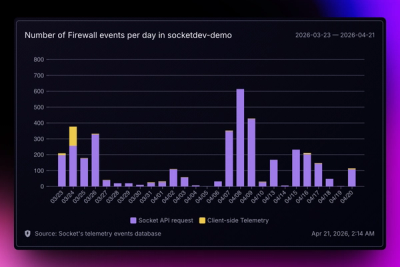
Explore exportable charts for vulnerabilities, dependencies, and usage with Reports, Socket’s new extensible reporting framework.
By André Staltz - Apr 21, 2026
@launchdarkly/ldcli
Advanced tools
The official command line interface for managing LaunchDarkly feature flags.



The LaunchDarkly CLI helps you manage your feature flags from your terminal or your IDE.
With the CLI, you can:
setup command.The LaunchDarkly CLI is available for macOS, Windows, and Linux.
The CLI is available on macOS via Homebrew:
brew tap launchdarkly/homebrew-tap
brew install ldcli
A Windows executable of ldcli is available on the releases page.
A Linux executable of ldcli is available on the releases page.
You can also install the LaunchDarkly CLI using npm or Docker.
Install with npm:
npm install -g @launchdarkly/ldcli
Pull from Docker:
docker pull launchdarkly/ldcli
Installing the CLI provides access to the ldcli command.
ldcli [command]

# Run `--help` for detailed information about CLI commands
ldcli --help
The LaunchDarkly CLI allows you to save preferred settings, either as environment variables or within a config file. Use the config commands to save your settings.
Supported settings:
access-token A LaunchDarkly access token with write-level accessanalytics-opt-out Opt out of analytics tracking (default false)base-uri LaunchDarkly base URI (default "https://app.launchdarkly.com")environment: Default environment keyflag: Default feature flag keyoutput: Output format: json or plaintext (default: plaintext in a terminal, json otherwise)project: Default project keyAvailable config commands:
config --set {key} {value}config --unset {key}config --listTo save a setting as an environment variable, prepend the variable name with LD. For example:
export LD_ACCESS_TOKEN=api-00000000-0000-0000-0000-000000000000
To save a setting in the configuration file:
ldcli config --set access-token api-00000000-0000-0000-0000-000000000000
Running this command creates a configuration file located at $XDG_CONFIG_HOME/ldcli/config.yml with the access token. Subsequent commands read from this file, so you do not need to specify the access token each time.
When you do not pass --output or --json, the default format depends on whether standard output is a terminal: plaintext in an interactive terminal, json when stdout is not a TTY (for example when piped, in CI, or in agent environments).
To force the plaintext default even when stdout is not a TTY, set either FORCE_TTY or LD_FORCE_TTY to any non-empty value (similar to tools that use NO_COLOR). That only affects the default; explicit --output, --json, LD_OUTPUT, and the output setting in your config file still apply.
LD_OUTPUT is the same setting as output in the config file, exposed as an environment variable (see the LD_ prefix above). It is not new with TTY detection; the test suite locks in that it overrides the non-TTY JSON default when set to plaintext.
Effective output is resolved in this order: --json (if set, wins over --output when both are present), then --output, then LD_OUTPUT, then the output value from your config file, then the TTY-based default above.
LaunchDarkly CLI commands:
setup guides you through creating your first flag, connecting an SDK, and evaluating your flag in your Test environmentdev-server lets you start a local server and retrieve flag values from a LaunchDarkly source environment so you can test your code locally. For assistance starting with or running dev-server, refer to the reference docs.Resource commands mirror the LaunchDarkly API and make requests for a given resource. To see a full list of resources supported by the CLI, enter ldcli --help into your terminal.
To see the commands available for a given resource:
ldcli <resource> --help
Here is an example command to create a flag:
ldcli flags create --access-token <access-token> --project default --data '{"name": "My Test Flag", "key": "my-test-flag"}'
Additional documentation is available at https://docs.launchdarkly.com/home/getting-started/ldcli.
We encourage pull requests and other contributions from the community. Check out our contributing guidelines for instructions on how to contribute to this project.
If you wish to test your changes locally, simply
make build from the repo root;./ldcli.LaunchDarkly uses the SLSA framework (Supply-chain Levels for Software Artifacts) to help developers make their supply chain more secure by ensuring the authenticity and build integrity of our published packages. To learn more, see the provenance guide.
FAQs
The official command line interface for managing LaunchDarkly feature flags.
The npm package @launchdarkly/ldcli receives a total of 10,190 weekly downloads. As such, @launchdarkly/ldcli popularity was classified as popular.
We found that @launchdarkly/ldcli demonstrated a healthy version release cadence and project activity because the last version was released less than a year ago. It has 1 open source maintainer collaborating on the project.
Did you know?

Socket for GitHub automatically highlights issues in each pull request and monitors the health of all your open source dependencies. Discover the contents of your packages and block harmful activity before you install or update your dependencies.
Product
Explore exportable charts for vulnerabilities, dependencies, and usage with Reports, Socket’s new extensible reporting framework.
Product
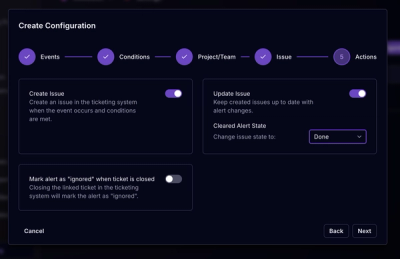
Socket for Jira lets teams turn alerts into Jira tickets with manual creation, automated ticketing rules, and two-way sync.

Company News
Socket won two 2026 Reppy Awards from RepVue, ranking in the top 5% of all sales orgs. AE Alexandra Lister shares what it's like to grow a sales career here.