Research
/Security News
Bitwarden CLI Compromised in Ongoing Checkmarx Supply Chain Campaign
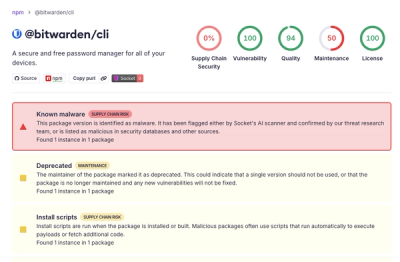
Bitwarden CLI 2026.4.0 was compromised in the Checkmarx supply chain campaign after attackers abused a GitHub Action in Bitwarden’s CI/CD pipeline.
@linked-db/linked-ql
Advanced tools
The application-flavoured SQL that runs anywhere, with pluggable, composable backends, with an offline- and sync-ready model
const db = new PGClient(); // or: MySQLClient | FlashQL | EdgeClient | etc
const result = await db.query(
`SELECT {
id,
profile: { name, email },
parent: parent_user ~> { name, email }
} FROM users;`,
{ live: true }
);
Show result: output shape + live behaviour
// Structured output (via "{ ... }"): result.rows[0].profile.name; // Foreign key traversal (via "~>"): result.rows[0].parent.name; // Live queries: // result.rows updates automatically as underlying data changes // (any reactive system can observe these updates) Observer.observe(result.rows[0].parent, 'email', (c) => { console.log(c.value, c.oldValue); });
LinkedQL brings:
Runs across:
→ All in under 80 KiB (min+zip)
→ A single interface that drops into any application
The application-flavoured SQL that runs anywhere, with pluggable backends
See the overview ↗ for the full picture.
[!IMPORTANT] LinkedQL is backed by 1,200+ tests today and growing.
Feedback, issues, and PRs help drive the next 1,000.
See Contributing
LinkedQL is distributed as an npm package:
npm install @linked-db/linked-ql
It provides clients for all supported SQL dialects — including FlashQL, the embeddable SQL engine for local and offline use.
Import and use the client for your database.
| Client/Model | Import Path | Guide |
|---|---|---|
PGClient | @linked-db/linked-ql/postgres | PostgreSQL ↗ |
MySQLClient | @linked-db/linked-ql/mysql | MySQL ↗ |
MariaDBClient | @linked-db/linked-ql/mariadb | MariaDB ↗ |
FlashQL | @linked-db/linked-ql/flashql | FlashQL ↗ |
EdgeClient | @linked-db/linked-ql/edge | Edge / Browser ↗ |
EdgeWorker | @linked-db/linked-ql/edge-worker | Edge Worker ↗ |
See:
LinkedQL exposes a minimal and consistent database interface:
await db.query(sql, options);
await db.query(sql, { live: true, ...options });
await db.stream(sql, options);
await db.transaction(fn);
await db.wal.subscribe(selector, handler);
await db.sync.sync(); // (FlashQL)
The same surface applies whether db is a direct PostgreSQL client, a local FlashQL engine, or an EdgeClient.
See:
LinkedQL collapses the traditional data stack — database, API layer, and sync engine — into a single SQL primitive that drops directly into your application.
The overview page is your map to what LinkedQL enables.
Below are a few examples that build up that model step by step.
JSON Literals let you define the exact shape your application expects directly in SQL.
const result = await db.query(`
SELECT {
id: u.id,
name: u.name,
profile: {
email: u.email,
age: u.age
}
} AS user
FROM users u;
`);
No remapping step or post-processing code. The query itself defines the shape.
This is fully covered in JSON Literals ↗
DeepRefs let you follow relationships directly in SQL using simple arrow notations.
| Notation | Meaning |
|---|---|
~> | forward traversal (follow a reference) |
<~ | reverse traversal (find dependents) |
const result = await db.query(`
SELECT
id,
parent_user ~> email AS parent_email
FROM users;
`);
This says:
→ "Given a foreign key (parent_user)"
→ "Tie in the referenced row; select email"
const result = await db.query(`
SELECT
id,
(parent_user <~ users) ~> email AS child_email
FROM users;
`);
This walks “backwards” through a relationship:
email column from eachconst result = await db.query(`
SELECT {
id,
profile: { name, email },
parent: parent_user ~> { id, name, email }
} FROM users;
`);
await db.query(`
INSERT INTO users
(email, parent_user ~> (id, email))
VALUES
('ada@example.com', ROW (50, 'parent@example.com'));
`);
This lets you construct relationships directly in an insert:
→ "Given a base row"
→ "Insert a related row that automatically references the base"
No need for an ORM or manual JOIN logic.
If you've defined foreign key relationships in your tables, you can traverse them directly in the query.
Deeper syntax and traversal patterns are fully covered in DeepRefs ↗.
LinkedQL brings live queries to your database: PostgreSQL, FlashQL, MySQL/MariaDB*.
With just a mode switch { live: true }, you can get back a live, self-updating result set.
const result = await db.query(`
SELECT p.title, p.category
FROM posts AS p
WHERE p.published = true
ORDER BY p.created_at DESC
`, { live: true });
result.rows updates automatically as the database changes:
No need for dedicated GraphQL servers in front of your database.
The query itself is the subscription.
const result = await db.query(`
SELECT
p.title,
p.category,
author ~> { name, email } AS author
FROM posts AS p
WHERE p.published = true
ORDER BY p.created_at DESC
`, { live: true });
→ Works with joins, filters, aggregates, and other constructs
→ Supports the full set of LinkedQL syntax shorthands like DeepRefs and JSON Literals
See the full story in Live Queries ↗.
See the Realtime Engine ↗ paper for a deeper dive.
[!NOTE] Fully supported across:
- databases: PostgreSQL, FlashQL, etc. (MySQL/MariaDB support coming soon)
- runtimes and deployment models: client / server / worker / edge
Meet FlashQL – a full SQL engine that runs anywhere + inside your application.
It's LinkedQL's embeddable SQL engine.
import { FlashQL } from '@linked-db/linked-ql/flashql';
const db = new FlashQL();
await db.connect();
const result = await db.query(`
CREATE TABLE users (
id INT PRIMARY KEY,
name TEXT
);
INSERT INTO users VALUES (1, 'Ada'), (2, 'Linus');
SELECT * FROM users ORDER BY id;
`);
console.log(result.rows);
await db.disconnect();
FlashQL brings the full LinkedQL feature set into an embedded, local-first runtime.
Built for:
See FlashQL ↗ for a detailed overview.
LinkedQL uses a small set of primitives (EdgeClient, FlashQL) to unlock data federation, sync, and offline-first architectures.
For example:
You can spin up a FlashQL instance locally, backed by an upstream database.
const db = new FlashQL({
getUpstreamClient: (url) =>
new EdgeClient({ url, type: 'http' }),
});
await db.connect();
It lets you declare remote data as local tables (views):
await db.query(`
CREATE VIEW users AS
SELECT * FROM users
WITH (replication_origin = 'postgres:/api/db');
`);
This simple setup gives you data federation across boundaries:
query both local and remote data as one relational graph:
const result = await db.query(`
SELECT *
FROM users u
JOIN orders o ON o.user_id = u.id;
`);
With just an extra keyword, you get automatic sync between local and remote states:
await db.query(`
CREATE REALTIME VIEW users AS
SELECT * FROM users
WITH (replication_origin = 'postgres:/api/db');
`);
With a single abstraction:
What typically takes a database, API layer, cache, and sync engine is reduced to one relational model — expressed entirely in SQL.
This is fully covered in:
If you want to explore the full LinkedQL model, see:
Capabilities overview → an easy map of LinkedQL
FlashQL and local-first architectures → embedded engine, federation, and sync
Integration patterns → how this fits into real applications
Core API → the full interface surface
Or go from the start:
LinkedQL is in active development — and contributions are welcome!
Here’s how you can jump in:
⤷ clone → install → test
git clone https://github.com/linked-db/linked-ql.git
cd linked-ql
git checkout next
npm install
npm test
next branch — be sure to switch to it as above after cloning.next before making changes (e.g. git checkout -b feature/my-idea).npm test before submitting a PR.MIT — see LICENSE
FAQs
The application-flavoured SQL that runs anywhere, with pluggable, composable backends, with an offline- and sync-ready model
We found that @linked-db/linked-ql demonstrated a healthy version release cadence and project activity because the last version was released less than a year ago. It has 1 open source maintainer collaborating on the project.
Did you know?

Socket for GitHub automatically highlights issues in each pull request and monitors the health of all your open source dependencies. Discover the contents of your packages and block harmful activity before you install or update your dependencies.

Research
/Security News
Bitwarden CLI 2026.4.0 was compromised in the Checkmarx supply chain campaign after attackers abused a GitHub Action in Bitwarden’s CI/CD pipeline.

Research
/Security News
Docker and Socket have uncovered malicious Checkmarx KICS images and suspicious code extension releases in a broader supply chain compromise.

Product
Stay on top of alert changes with filtered subscriptions, batched summaries, and notification routing built for triage.