

Product
Introducing Supply Chain Attack Campaigns Tracking in the Socket Dashboard
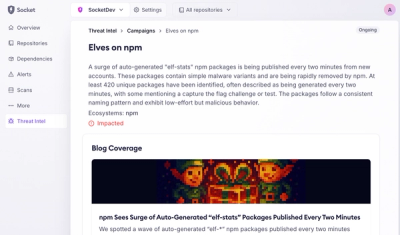
Campaign-level threat intelligence in Socket now shows when active supply chain attacks affect your repositories and packages.
By Philipp Burckhardt - Jan 21, 2026
@map-colonies/eslint-plugin
Advanced tools
Custom ESLint rules for MapColonies projects. This plugin provides specialized rules to enforce best practices and prevent common mistakes.
npm install --save-dev @map-colonies/eslint-plugin
Add the plugin to your ESLint configuration:
// eslint.config.mjs
import mapColoniesPlugin from '@map-colonies/eslint-plugin';

export default [
  mapColoniesPlugin.configs['pino-safety'],
  // ... your other configs
];
Or configure rules individually:
// eslint.config.mjs
import mapColoniesPlugin from '@map-colonies/eslint-plugin';

export default [
  {
    plugins: {
      '@map-colonies': mapColoniesPlugin,
    },
    rules: {
      '@map-colonies/pino-safety/no-swallowed-args': 'error',
      '@map-colonies/pino-safety/prefer-standard-error-key': 'warn',
    },
  },
];
pino-safety/no-swallowed-argsPrevents Pino from silently swallowing objects when arguments don't match the message format placeholders.
Problem: Pino uses printf-style formatting. If you pass extra arguments without corresponding placeholders (%s, %d, etc.), they are silently ignored.
Examples:
// ❌ Bad - object is swallowed (no placeholder)
logger.info('User logged in', { userId: 123 });

// ❌ Bad - second argument is swallowed (only one %s placeholder)
logger.info('User %s logged in', username, { extra: 'data' });

// ✅ Good - merge object pattern (object first)
logger.info({ userId: 123 }, 'User logged in');

// ✅ Good - placeholders match argument count
logger.info('User %s logged in at %d', username, timestamp);

// ✅ Good - no extra arguments
logger.info('Simple message');
Supported placeholders: %s, %d, %f, %i, %j, %o, %O
pino-safety/prefer-standard-error-keyEnsures errors are serialized correctly by using Pino's standard err key instead of error.
Problem: Pino's default error serializer looks for the err key. Using error means the error won't be properly serialized with stack traces.
Examples:
// ❌ Bad - "error" key won't be serialized properly
logger.error({ error: new Error('Failed') }, 'Operation failed');

// ✅ Good - "err" key uses Pino's error serializer
logger.error({ err: new Error('Failed') }, 'Operation failed');

// ✅ Good - other property names are fine
logger.info({ userId: 123, status: 'active' }, 'User info');
pino-safety (recommended)Enables all Pino safety rules with recommended severity levels:
pino-safety/no-swallowed-args: errorpino-safety/prefer-standard-error-key: warnpnpm run build
pnpm run test
pnpm run lint
MIT
FAQs
Custom ESLint rules for MapColonies projects
We found that @map-colonies/eslint-plugin demonstrated a healthy version release cadence and project activity because the last version was released less than a year ago. It has 11 open source maintainers collaborating on the project.
Did you know?

Socket for GitHub automatically highlights issues in each pull request and monitors the health of all your open source dependencies. Discover the contents of your packages and block harmful activity before you install or update your dependencies.
Product
Campaign-level threat intelligence in Socket now shows when active supply chain attacks affect your repositories and packages.

Research
Malicious PyPI package sympy-dev targets SymPy users, a Python symbolic math library with 85 million monthly downloads.

Security News
Node.js 25.4.0 makes require(esm) stable, formalizing CommonJS and ESM compatibility across supported Node versions.