

Security News
New React Server Components Vulnerabilities: DoS and Source Code Exposure
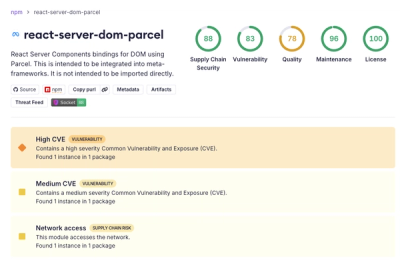
New DoS and source code exposure bugs in React Server Components and Next.js: what’s affected and how to update safely.
By Sarah Gooding - Dec 12, 2025
@persistr/server
Advanced tools
Event-driven data store, used for building applications that follow Event-Driven Design (EDD), Event-Driven Architectures (EDA), or event sourcing.
Persistr Server has an event-driven push model where it notifies applications of any changes made in the data store. Data in the store is saved as change events organized into event streams.
Persistr Server is built using Node.js. It has been tested with Node.js v14 and NPM 7. Make sure that you have both installed before installing Persistr Server.
The easiest way to install Node.js is to install Node.js via package manager for your platform. NPM should come bundled with Node.js but if for some reason it doesn't, you can review NPM install instructions here.
You must have a MySQL server already installed and an appropriate account created for Persistr Server to use. On first-run, you will be prompted to enter in your MySQL connection string. Persistr Server will create a database called "persistr" and will also create all the needed database tables. You just need to make sure that you have an appropriate MySQL user account for Persistr Server to use and provide the MySQL connection string when prompted.
Install the server using npm
npm install -g @persistr/server
Run the server. It will detect that it is running for the first time and will prompt you for configuration settings.
$ persistr-server
✔ Configure? … yes
✔ Port? … 3010
✔ Root username? … root
✔ Root password? …
✔ Log folder? … /Users/me/.persistr-server/logs/
✔ MySQL connection string? … mysql://root@localhost:3306/persistr
✔ Wrote configuration to /Users/me/.persistr-server/config.yaml
✔ Created MySQL 'persistr' database and tables
✔ Created root account
✔ Create demo account & database? … yes
✔ Created demo account & database

Persistr Server v4.5.7
Running on port 3010
Configuration settings that you will be prompted for:
~/.persistr-server/logspersistr as the initial database or it will be rejected.yes then a demo user will be created with demo username and demo password. Persistr examples are designed to run out of the box with the demo account. If you're installing the server for development, it's recommended to create the demo account. If you're using the server for production then either don't create the demo account or deactivate/delete the demo account.Configuration file is saved to ~/.persistr-server/config.yaml
There is a command-line interface for Persistr Server that can be used to manage the server and event streams. Read on for CLI install instructions.
Official Javascript client library is available. It can be used client-side in all modern browsers and server-side with Node.js.
An official collection of example code is available here. All examples run out-of-the-box with a default install of Persistr Server on a local machine.
See the LICENSE file for license rights and limitations (MIT).
FAQs
Persistr Server
We found that @persistr/server demonstrated a not healthy version release cadence and project activity because the last version was released a year ago. It has 1 open source maintainer collaborating on the project.
Did you know?

Socket for GitHub automatically highlights issues in each pull request and monitors the health of all your open source dependencies. Discover the contents of your packages and block harmful activity before you install or update your dependencies.
Security News
New DoS and source code exposure bugs in React Server Components and Next.js: what’s affected and how to update safely.

Security News
Socket CEO Feross Aboukhadijeh joins Software Engineering Daily to discuss modern software supply chain attacks and rising AI-driven security risks.
Security News
GitHub has revoked npm classic tokens for publishing; maintainers must migrate, but OpenJS warns OIDC trusted publishing still has risky gaps for critical projects.