Radar Relay SDK
The Radar Relay SDK is a software development kit that simplifies the interactions with Radar Relay’s APIs.


SDK Reference
For a full SDK reference see: developers.radarrelay.com/sdk.
Usage
Installation
Using npm
npm install @radarrelay/sdk
Using yarn
yarn add @radarrelay/sdk
Setup & Initialize
Setup refers to the instantiation of the RadarRelay class and setup for the initialization lifecycle.
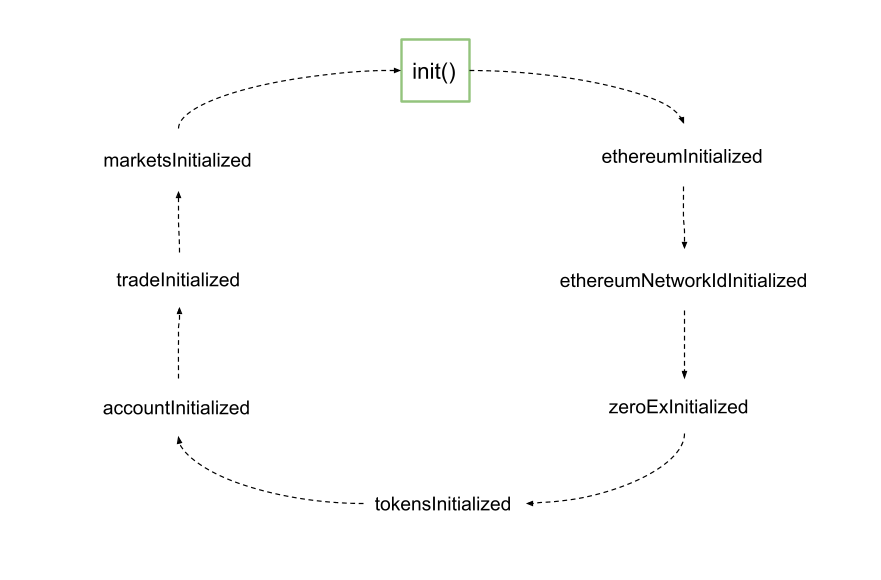
Initialize refers to the execution of the "initialization lifecycle" - A collection of asynchronous operations that hook up the wallet, set the web3 provider, and spin up the classes necessary to begin trading.
Setup and initialization of the SDK can be completed in a single call if you don't want to listen for initialization events.
import { SdkManager } from '@radarrelay/sdk';
const rr = await SdkManager.SetupAndInitializeAsync(Config);
Setup
Setup can be separated from initialization, which is useful if you would like to add listeners for the various initialization events.
import { SdkManager } from '@radarrelay/sdk';
const rr = SdkManager.Setup(Config);
Initialize
Initializing sets the desired Ethereum wallet configuration. The SDK can be initialized with three different wallet types: LightWallet, InjectedWallet, and an RpcWallet. See the below types for more information.
await SdkManager.InitializeAsync(rr);
Or directly on the SDK instance:
await rr.initializeAsync();
Wallet Configuration Types
interface SdkConfig {
  sdkInitializationTimeoutMs?: number;
}
interface EndpointConfig {
  radarRestEndpoint: string;
  radarWebsocketEndpoint: string;
}
export interface OptionalEndpointConfig {
radarRestEndpoint?: string;
radarWebsocketEndpoint?: string;
}
interface EthereumConfig {
  defaultGasPrice?: BigNumber;
}
interface LightWalletOptions {
  password: string;
  seedPhrase?: string;
  salt?: string;
  hdPathString?: string;
}
interface LightWalletConfig extends SdkConfig, EndpointConfig, EthereumConfig {
wallet: LightWalletOptions;
dataRpcUrl: string;
}
interface InjectedWalletConfig extends SdkConfig, OptionalEndpointConfig, EthereumConfig {
type: InjectedWalletType;
web3?: Web3;
dataRpcUrl?: string;
}
interface RpcWalletConfig extends SdkConfig, EndpointConfig, EthereumConfig {
rpcUrl: string;
}
Events
Anything that triggers state changes (like changing the network, or a fill)
fires an event that you can listen to via the events object.
rr.events.on(
  EventName.Loading |
  EventName.EthereumInitialized |
  EventName.EthereumNetworkIdInitialized |
  EventName.ZeroExInitialized |
  EventName.TokensInitialized |
  EventName.AccountInitialized |
  EventName.TradeInitialized |
  EventName.MarketsInitialized |
  EventName.TransactionPending |
  EventName.TransactionComplete |
  EventName.AddressChanged
)
rr.events.emit('see_above' | 'or emit anything', ...withSomeData)
Account Methods
Obtain account information for the current loaded wallet.
Wallet methods
exportSeedPhraseAsync(password)
Export an account wallet seed phrase.
Parameters:
password | string | The plaintext password |
Returns: Promise<string>
exportAddressPrivateKeyAsync(password)
Export a wallet address private key.
Parameters:
password | string | The plaintext password |
Returns: Promise<string>
Account information
getAvailableAddressesAsync(address)
Get available addresses for this account.
No parameters.
Returns: Promise<string[]>
setAddressAsync(address)
Set the current address in use.
Parameters:
address | string|number | The address or address index |
Returns: Promise<void>
getFillsAsync(page?, perPage?)
Get fills for the selected address that have been executed on Radar.
Parameters:
page | number | [Optional] The page to fetch |
perPage | number | [Optional] The number of fills per page |
Returns: Promise<RadarFill>
getOrdersAsync(page?, perPage?)
Get orders for the selected address that have been placed on Radar.
Parameters:
page | number | [Optional] The page to fetch |
perPage | number | [Optional] The number of fills per page |
Returns: Promise<RadarSignedOrder[]>
ETH / token utilities
getEthBalanceAsync()
Get ETH balance for the current selected address.
No parameters.
Returns: Promise<BigNumber>
transferEthAsync(toAddress, perPage, opts?)
Transfer ETH to another address.
Parameters:
toAddress | string | The address to transfer to |
amount | number | The amount of ETH to transfer |
opts | Opts | [Optional] The transaction options |
Returns: Promise<TransactionReceiptWithDecodedLogs | string>
wrapEthAsync(amount, opts?)
Wrap ETH to convert it to WETH.
Parameters:
amount | number | The amount of ETH to wrap |
opts | Opts | [Optional] The transaction options |
Returns: Promise<TransactionReceiptWithDecodedLogs | string>
unwrapEthAsync(amount, opts?)
Unwrap WETH to convert it to ETH.
Parameters:
amount | number | The amount of ETH to unwrap |
opts | Opts | [Optional] The transaction options |
Returns: Promise<TransactionReceiptWithDecodedLogs | string>
getTokenBalanceAsync(tokenAddress)
Get balance of a token for the current selected address.
Parameters:
address | string | The token address |
Returns: Promise<BigNumber>
getTokenAllowanceAsync(tokenAddress)
Get a token allowance.
Parameters:
address | string | The token address |
Returns: Promise<BigNumber>
setTokenAllowanceAsync(tokenAddress, amount, opts?)
Set a token allowance.
Parameters:
tokenAddress | string | The token address |
amount | number | The allowance amount |
opts | Opts | [Optional] The transaction options |
Returns: Promise<TransactionReceiptWithDecodedLogs | string>
transferTokenAsync(tokenAddress, toAddress, amount, opts?)
Set a token allowance.
Parameters:
tokenAddress | string | The token address |
toAddress | string | The address to transfer to |
amount | number | The amount of token to transfer |
opts | Opts | [Optional] The transaction options |
Returns: Promise<TransactionReceiptWithDecodedLogs | string>
Market methods
Fetching specific markets
rr.markets.getAsync(marketId)
Fetch a single market by its ID or a group of markets by passing a list of IDs.
Parameters:
marketId | string | string[] | A market ID or list of market IDs in the format of {base}-{quote}. e.g. 'ZRX-WETH' or ['ZRX-WETH', 'DAI-WETH'] |
Returns: Promise<Market | Map<string, Market>> - The Map key is mapped to the market's ID.
Fetching pages of markets
rr.markets.getNextPageAsync()
Fetch the next 100 markets.
No parameters.
Returns: Promise<Map<string, Market>> - The Map key is mapped to the market's ID.
rr.markets.getPageAsync(page, perPage)
Fetch a specific page of markets.
Parameters:
page | number | The page to fetch. |
perPage | number | The number of results per page to query. |
Returns: Promise<Map<string, Market>> - The Map key is mapped to the market's ID.
Market class methods
A Market exposes all the following instance vars:
{
id: string;
displayName: string;
baseTokenAddress: string;
quoteTokenAddress: string;
baseTokenDecimals: number;
quoteTokenDecimals: number;
minOrderSize: BigNumber;
maxOrderSize: BigNumber;
quoteIncrement: number;
score: number;
}
A Market exposes all the following methods:
limitOrderAsync(type, quantity, price, expiration)
Place a limit order.
Parameters:
type | UserOrderType | Order type of 'BUY' |
quantity | BigNumber | Amount in base token |
price | BigNumber | Price in quote |
expiration | BigNumber | Order expiration time in seconds |
Returns: Promise<Order>
marketOrderAsync(type, amount, opts?)
Execute a market order.
Parameters:
type | UserOrderType | Order type of 'BUY' |
amount | BigNumber | Amount in base token |
opts | Opts | [Optional] The transaction options |
Returns: Promise<TransactionReceiptWithDecodedLogs | string>
cancelOrderAsync(order, opts?)
Cancel an order.
Parameters:
order | SignedOrder | SignedOrder to cancel |
opts | Opts | [Optional] The transaction options |
Returns: Promise<TransactionReceiptWithDecodedLogs | string>
getFillsAsync()
Get fills for this market.
No parameters.
Returns: Promise<RadarFill[]>
getCandlesAsync()
Get candles for this market.
No parameters.
Returns: Promise<RadarCandle[]>
getTickerAsync()
Get ticker for this market.
No parameters.
Returns: Promise<RadarTicker>
getHistoryAsync()
Get history for this market.
No parameters.
Returns: Promise<RadarHistory>
getStatsAsync()
Get stats for this market.
No parameters.
Returns: Promise<RadarStats>
subscribeAsync(topic, handlerFunc)
Parameters:
topic | WebsocketRequestTopic | The market topic |
handlerFunc | (message: any) => void | The subscription handler |
Returns:
Promise<{
  requestId: number,
  subscriptionHandler: (message: any) => void,
  unsubscribe: () => void
}>
You can unsubscribe from any previously created subscriptions like so:
subscription.unsubscribe();
Setting up an Ethereum Node
Install Parity
brew install parity
Run Parity Node
parity --jsonrpc-hosts=all \
       --jsonrpc-interface=all \
       --ws-origins=all \
       --ws-hosts=all \
       --ws-interface=all \
       --chain=kovan \
       --base-path /path/for/ethereum_node_data
Unlocked Parity Node
NOTE: this is potentially dangerous, use at your own risk. Should be done on a computer free of malware and a strict firewall
Create a trading Account
~parity account new
~enter password (don't lose this)
Create Node Config File
create /path/to/parity-config.toml
[account]
unlock = ["0x000000000000000000000000000000000000"] (account address created above)
password = ["/home/{account}/.parity-account-pass"] (password saved in plain text)
Run Parity with Unlocked Account
parity --jsonrpc-hosts=all \
       --jsonrpc-interface=all \
       --ws-origins=all \
       --ws-hosts=all \
       --ws-interface=all \
       --chain=kovan \
       --config /path/to/parity-config.toml \
       --base-path /path/for/ethereum_node_data
SDK Init / State Change Lifecycle
Overview
The Ethereum and 0x.js application loading lifecycle is difficult to manage, especially when designing for optimized state changes. Specifically, changing RPC Networks, switching accounts, and updating API endpoints. To manage the lifecycle more efficiently, the Radar Relay SDK utilizes a combination of the following:
The SdkInitLifeCycle class works as follows:
Define an array that consists of:
event, which when triggered will then call the definedfunc the function that is called when this event is triggered (ideally the next in priority)
Once all events have fired the promise will resolve. If an error occurs along the lifecycle, the timeout will occur after 10s and reject the promise.
Each init method must trigger an event on the EventEmitter, which indicates the method is done as well as return the SdkInitLifeCycle.promise()
Life Cycle