

Product
Introducing Reports: An Extensible Reporting Framework for Socket Data
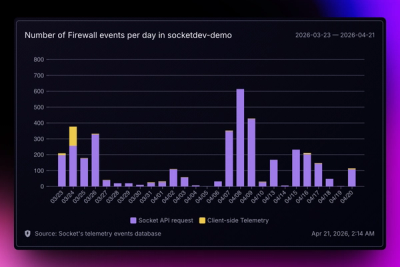
Explore exportable charts for vulnerabilities, dependencies, and usage with Reports, Socket’s new extensible reporting framework.
By André Staltz - Apr 21, 2026
@railgun-community/cookbook
Advanced tools
[](https://github.com/Railgun-Community/cookbook/actions) [

Write a Recipe in minutes to convert your dApp to a zkApp.
See the full Integration Guide here.
yarn add @railgun-community/cookbook
The RAILGUN Cookbook gives you the tools to write a "Recipe" to convert your dApp into a zkApp - private and fully anonymous for users. Your Recipe can interact with any smart contract using your private balance in RAILGUN. A Recipe contains a series of smart contact calls that are combined into a multicall.
See the full zkApp guide here.
Recipes are composed of "Steps," which are enclosed smart contract calls. Every Step has a set of inputs that correspond to a set of outputs: Spent tokens, Output tokens, and Fees. Spent tokens and Fees are eradicated during the Step, and Output tokens will be passed into the next Step as inputs.
For example, a simple 0x Exchange Swap Step will contain a Sell Token as an input, and the outputs will include Sell Token (Spent), Buy Token (Output) and no associated Fees.
Step inputs and outputs are automatically validated to ensure that each input has associated outputs that represent the total value. There is an exception for tokens that are generated mid-Step - new token values become unvalidated Output tokens - they are simply passed to the next Step as inputs.
Recipes combine Steps into functional, complex actions. Most integrations will require 1-2 Recipes, and a number of Steps for each Recipe. Steps are generic building blocks, making them multi-purpose and reusable for various Recipes. Upon execution (recipe.getRecipeOutput(recipeInput)), the Cookbook automatically sandwiches the Recipe's transactions inside of Unshield and Shield calls, calculating the associated fees with each Step, and providing the developer with a formatted list of Steps, their outputs, and the final array of populated transactions.
As an example, a simple 0x Exchange Swap call has a pre-requisite: the Sell Token must be approved for spending by the 0x contract. So, the 0x Swap Recipe has two Steps: (1) Approve sell token, (2) Swap sell token for buy token. The full Recipe uses a Step called ApproveERC20SpenderStep, which is a common Step among most integrations.
Note that each Recipe must assume a clean slate – since it's executed in a public setting (the RAILGUN Relay Adapt Contract), developers should assume that the Relay Adapt contract does not have approval to spend tokens with any token contract. This is why the ApproveERC20SpenderStep is a basic requirement for nearly every Recipe.
Combo Meals are the final frontier – every zkApp Chef's dream. They combine Recipes into very complex interactions, made 100% safe for execution against a private balance using the Cookbook.
For example, there is a Combo Meal that combines an "Add Liquidity" Recipe for Uniswap, with a "Deposit Vault" Recipe for Beefy. This gives a user the ability to add liquidity for a token pair on Uniswap, gain the LP token for that pair, and then deposit the LP token into a Beefy Vault to earn yield.
This all occurs in a single validated transaction call, saving network fees and making the user experience simple and delightful.
Given a full Recipe and its inputs, RAILGUN Quickstart will generate a zero-knowledge proof and a final serialized transaction for the RAILGUN Relay Adapt contract.
This final transaction can be submitted to the blockchain by any wallet, including a Relayer.
const swap = new ZeroXSwapRecipe(sellERC20Info, buyERC20Info, slippagePercentage);

// Inputs that will be unshielded from private balance.
const unshieldERC20Amounts = [{ ...sellERC20Info, amount }];

const recipeInput = { networkName, unshieldERC20Amounts };
const { crossContractCalls, erc20Amounts } = await swap.getRecipeOutput(recipeInput);

// Outputs to re-shield after the Recipe multicall.
const shieldERC20Addresses = erc20Amounts.map(({tokenAddress}) => tokenAddress);

// RAILGUN Quickstart will generate a [unshield -> call -> re-shield] transaction enclosing the Recipe multicall.

const {gasEstimate} = await gasEstimateForUnprovenCrossContractCalls(
    ...
    unshieldERC20Amounts,
    ...
    shieldERC20Addresses,
    ...
    crossContractCalls,
    ...
)
await generateCrossContractCallsProof(
    ...
    unshieldERC20Amounts,
    ...
    shieldERC20Addresses,
    ...
    crossContractCalls,
    ...
)
const {transaction} = await populateProvedCrossContractCalls(
    ...
    unshieldERC20Amounts,
    ...
    shieldERC20Addresses,
    ...
    crossContractCalls,
    ...
);

// Submit transaction to RPC.
await wallet.sendTransaction(transaction);

// Note: use @railgun-community/waku-relayer-client to submit through a Relayer instead of signing with your own wallet.
yarn test to run tests without RPC Fork.
Set up anvil (install foundryup): curl -L https://foundry.paradigm.xyz | bash
Add an Ethereum RPC for fork: export ETHEREUM_RPC_URL='your/rpc/url'
Make sure to have required env vars for running several integration tests (check .env.example), otherwise some tests will fail.
Fork tests currently support networks: Ethereum, Arbitrum
Run anvil fork with an RPC URL and load test account with 1000 ETH: ./run-anvil Ethereum https://your/ethereum/rpc/url
env NETWORK_NAME=Ethereum yarn test-fork.FAQs
[](https://github.com/Railgun-Community/cookbook/actions) [
Socket for GitHub automatically highlights issues in each pull request and monitors the health of all your open source dependencies. Discover the contents of your packages and block harmful activity before you install or update your dependencies.
Product
Explore exportable charts for vulnerabilities, dependencies, and usage with Reports, Socket’s new extensible reporting framework.
Product
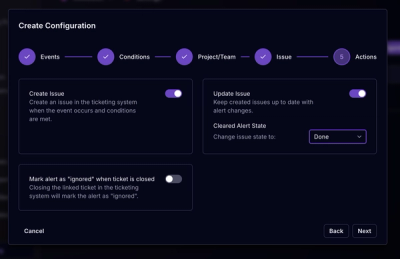
Socket for Jira lets teams turn alerts into Jira tickets with manual creation, automated ticketing rules, and two-way sync.

Company News
Socket won two 2026 Reppy Awards from RepVue, ranking in the top 5% of all sales orgs. AE Alexandra Lister shares what it's like to grow a sales career here.