


Security News
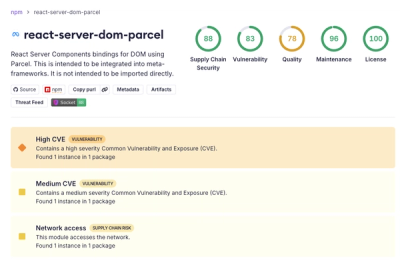
New React Server Components Vulnerabilities: DoS and Source Code Exposure
New DoS and source code exposure bugs in React Server Components and Next.js: what’s affected and how to update safely.
By Sarah Gooding - Dec 12, 2025
@s3pweb/simple-kafka-promise
Advanced tools
This library is based on node-rdkafka and aim to provide a simple producer
and consumer wrapped with promise to allow the use of async / await with minimal configuration and overhead.
This library is fully written in TypeScript.
Use s3pweb/alpine-kafka docker image with node-rdkafka included to shorten build time

npm install @s3pweb/simple-kafka-promise
Minimal configuration for the consumer is:
{ "metadata.broker.list": "0.0.0.0:9094", "group.id": "test.group" }
Minimal configuration for the producer is:
{ "metadata.broker.list": "0.0.0.0:9094" }
This project is based on node-rdkafka and supports the same configuration options. Go here for more details.
const KafkaConsumer = require('@s3pweb/simple-kafka-promise').KafkaConsumer

// Create a new instance
const consumer = new KafkaConsumer({ 'metadata.broker.list': '0.0.0.0:9094', 'group.id': 'test.group' }, 1000)

// Connect
await consumer.connect(['topicName'])

// Consume messages
const messagesArray = await consumer.listen(100, true)

// Disconnect the consumer
await consumer.disconnect()
To use with typescript, just change the import to
import { KafkaConsumer } from '@s3pweb/simple-kafka-promise';
To connect with SSL, use:
  const consumer = new KafkaConsumer({
    'metadata.broker.list': [
      'broker1:9093',
      'broker2:9093',
      'broker3:9093'
    ],
    'group.id': 'test-consumer.group',
    'security.protocol': 'ssl',
    'enable.ssl.certificate.verification': true,
    'ssl.ca.location': '/path/to/the/CA/certificate.crt'
  })
To connect with SASL, use:
  const consumer = new KafkaConsumer({
    'metadata.broker.list': [
      'broker1:9094',
      'broker2:9094',
      'broker3:9094'
    ],
    'group.id': 'test-sasl.group',
    'security.protocol': 'sasl_ssl',
    'sasl.username': 'username',
    'sasl.password': 'password',
    'sasl.mechanisms': 'SCRAM-SHA-256',
    'enable.ssl.certificate.verification': true,
    'ssl.ca.location': '/path/to/the/CA/certificate.crt'
  })
const KafkaProducer = require('@s3pweb/simple-kafka-promise').KafkaProducer

// Create a new instance
const producer = new KafkaProducer({ 'metadata.broker.list': '0.0.0.0:9094' }, '')

// Connect
await producer.connect(['topicName'])

// Produce some messages
const offset = await producer.sendMessage(topicName, { message: `My message.` }, 0, null)

// Disconnect
await producer.disconnect()
To use with typescript, just change the import to
import { KafkaProducer } from '@s3pweb/simple-kafka-promise';
To produce some messages take a look at ./examples/producer.js and to consume some messages take a look at ./examples/consumer.js.
If you have docker, you can use ./examples/docker-compose.yaml to start one zookeeper and one kafka stack on your machine.
This stack comes with kafkamanager and kafkadrop for easy monitoring and debugging.
If you want to build a docker image based on alpine linux, you need to add some packages to the base image. Go here for more details.
To create a new release, you only need to add your code (don't forget the mocks and the interfaces) and create a new tag. DO NOT push the code to NPM, create a version on Github or send a message for the new release. It will be done automatically by Github Actions.
FAQs
A simple node-rdkafka lib with Promise.
We found that @s3pweb/simple-kafka-promise demonstrated a healthy version release cadence and project activity because the last version was released less than a year ago. It has 1 open source maintainer collaborating on the project.
Did you know?

Socket for GitHub automatically highlights issues in each pull request and monitors the health of all your open source dependencies. Discover the contents of your packages and block harmful activity before you install or update your dependencies.
Security News
New DoS and source code exposure bugs in React Server Components and Next.js: what’s affected and how to update safely.

Security News
Socket CEO Feross Aboukhadijeh joins Software Engineering Daily to discuss modern software supply chain attacks and rising AI-driven security risks.
Security News
GitHub has revoked npm classic tokens for publishing; maintainers must migrate, but OpenJS warns OIDC trusted publishing still has risky gaps for critical projects.