

Product
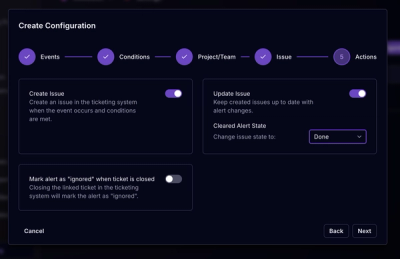
Socket for Jira Is Now Available
Socket for Jira lets teams turn alerts into Jira tickets with manual creation, automated ticketing rules, and two-way sync.
By Jeppe Hasseriis - Apr 20, 2026
@sap/cds-odata-v2-adapter-proxy
Advanced tools
Exposes a full-fledged OData V2 service, converting OData V2 requests to CDS OData V4 service calls and responses back. Runs in context of the SAP Cloud Application Programming Model (CAP) using CDS Node.js module @sap/cds or CDS Java modules com.sap.cds.
npm install @sap/cds-odata-v2-adapter-proxy -s in @sap/cds project./srv/server.js:
const cds = require("@sap/cds");
const cov2ap = require("@sap/cds-odata-v2-adapter-proxy");
cds.on("bootstrap", (app) => app.use(cov2ap()));
module.exports = cds.server;
cds run from the project root to start the server:
The CDS OData V2 Adapter Proxy instantiates an Express router. The following options are available:
''.'v2'.'all'.4004.'auto' to infer the target from server url after listening. Default is e.g. 'http://localhost:4004'.''.{}.false.'/mtx/v1'.true.10485760 (10 MB).false.false.false.false.false.false.'100mb'.true.true.true.true.'/#TRANSIENT#'.false.false.'attachment'.false.true.false.'info'.'json'.x-forwarded headers are processed. Default is true.All CDS OData V2 Adapter Proxy options can also be specified as part of CDS project-specific configuration under section
cds.cov2apand accessed during runtime viacds.env.cov2ap.
Options can also be passed as command line environment variable, by converting the camel-cased option name to snake-case. Underscores (
_) need then to be escaped as double underscore (__) when provided via command line environment variable.Example:
- path => CDS_COV2AP_PATH=odatav2
- quoteSearch => quote_search => CDS_COV2AP_QUOTE__SEARCH=false
Option
cds.odata.v2proxy.urlpathis available to specify an OData V2 proxy url path different from default/v2for CDS core.
Logging is based on cds.log, therefore CDS logging configurations apply.
| Component | Module Name(s) |
|---|---|
| CDS OData V2 Adapter Proxy | cov2ap |
In order to enable Kibana friendly logging for cds.log
feature toggle cds.features.kibana_formatter: true needs to be set.
Debug mode can be activated to log requests and responses processed (V2) and initiated (V4) by CDS OData V2 Adapter Proxy. The following information can be retrieved for analysis:
Debug log level can be activated
CDS_LOG_LEVELS_COV2AP=debugcds.env in code: cds.env.log.levels.cov2ap = "debug"Details on how to set CDS environment can be found at cds.env.
Logging can be configured to respect the following log levels:
[cov2ap] - Proxy: Proxy processing error[cov2ap] - Authorization: Authorization header parsing error[cov2ap] - MetadataRequest: Metadata request processing error[cov2ap] - Request: Request processing error[cov2ap] - Response: Response processing error[cov2ap] - Batch: Batch processing error[cov2ap] - AggregationKey: Aggregation key error[cov2ap] - MediaStream: Media stream processing error[cov2ap] - FileUpload: File upload processing error[cov2ap] - Service: Invalid service definition (name, path)[cov2ap] - Context: Invalid (sub-)definition (name, path)[cov2ap] - ContentDisposition: Content disposition warning[cov2ap] - Batch: Changeset order deviation (req, res)[cov2ap] - Request: Log OData V2 client request (url, headers, body)[cov2ap] - ProxyRequest: Log OData V4 proxy request (url, headers, body)[cov2ap] - ProxyResponse: Log OData V4 proxy response (status code/message, headers, body)[cov2ap] - Response: Log OData V2 client response (status code/message, headers, body)[cov2ap] - [HPM]: Proxy middleware processing logsThe following CDS OData V2 Adapter Proxy specific annotations are supported:
Entity Level:
@cov2ap.analytics: false: Suppress analytics conversion for the annotated entity, if set to false.@cov2ap.deltaResponse: 'timestamp': Delta response '__delta' is added to response data of annotated entity with current timestamp information.@cov2ap.isoTime: Values of type cds.Time (Edm.Time) are represented in ISO 8601 format for annotated entity.@cov2ap.isoDate: Values of type cds.Date (Edm.DateTime) are represented in ISO 8601 format for annotated entity.@cov2ap.isoDateTime: Values of type cds.DateTime (Edm.DateTimeOffset) are represented in ISO 8601 format for annotated entity.@cov2ap.isoTimestamp: Values of type cds.Timestamp (Edm.DateTimeOffset) are represented in ISO 8601 format for annotated entity.@cov2ap.isoDateTimeOffset: Values of type Edm.DateTimeOffset (cds.DateTime, cds.Timestamp) are represented in ISO 8601 format for annotated entity.Entity Element Level:
@Core.ContentDisposition.Filename: <element>: Specifies entity element, representing the filename during file upload/download.@Core.ContentDisposition.Type: '<value>': Controls the content disposition behavior in client/browser (inline or attachment).@cov2ap.headerDecode: [...]: Array of sequential decoding procedures ('uri', 'uriComponent', 'base64') used for media entity upload header.CDS project configuration cds.odata.version shall be set to v4, as OData proxy maps to OData V4.
CDS supports modelling features that are not compatible with OData V2 standard:
@odata.singleton is not supported in combination with OData V2cds.odata.format: 'structured' is not supported in combination with OData V2array of or many in entity element definitions lead to CDS compilation error: Element must not be an "array of" for OData V2To provide an OData V2 service based on the CDS OData V2 Adapter Proxy, those CDS modelling features must not be used. In general any CDS OData API flavor must not be used in combination with CDS OData V2 Adapter Proxy.
Per default, those modelling incompatibilities are reported as Warning and will not stop the compilation.
The resulting EDMX V2 may be invalid and not processable by an OData V2 client. To prevent this situation and fail
early to detect modelling incompatibilities, the severity for respective codes can be increased to Error,
by setting the following environment variables:
{
  "cdsc": {
    "severities": {
      "odata-spec-violation-array": "Error",
      "odata-spec-violation-param": "Error",
      "odata-spec-violation-returns": "Error",
      "odata-spec-violation-assoc": "Error",
      "odata-spec-violation-constraints": "Error"
    }
  }
}
When deploying the CDS OData V2 Adapter Proxy to Cloud Foundry, make sure that it has access to the whole CDS model.
Especially, it’s the case, that normally the Node.js server is only based on folder srv and folder db is then missing on Cloud Foundry.
To come around this situation, trigger a cds build during development time, that generates a csn.json at location gen/srv/srv/csn.json.
Point your Cloud Foundry deployment of the CDS OData V2 Adapter Proxy to the folder gen/srv (using manifest.json or MTA), so that
the CDS models can be found via file srv/csn.json, during runtime execution on Cloud Foundry.
Make sure, that all i18n property files reside next to the csn.json in a i18n or _i18n folder, to be detected by localization.
CDS OData V2 Adapter Proxy supports multitenant scenarios. Basic extensibility is already supported in combination with the CDS MTX module. More advanced extensibility scenarios and feature toggles are supported in combination with the CDS Streamlined MTX services.
In order to provide the feature toggle vector to be used to build-up the corresponding CSN and EDMX metadata documents,
the Express request object req needs to enhanced by feature definitions.
To add support for a specific feature toggles management you can add a simple Express middleware as follows, for example, in your server.js:
const cds = require("@sap/cds");
cds.on("bootstrap", (app) =>
  app.use((req, res, next) => {
    req.features = req.features || ["advanced"];
    next();
  })
);
The OData V2 service provided by the CDS OData V2 Adapter Proxy can be used to serve an SAP Fiori Elements V2 UI.
SAP Fiori Elements V2 examples:
Running examples can be tested as follows:
npm startnpm run start:hanaCode repository is only available SAP internal.
Response compressions can be enabled, by registering the compression Node.js
module in Express app at bootstrap time, e.g. in srv/server.js:
const cds = require("@sap/cds");
const cov2ap = require("@sap/cds-odata-v2-adapter-proxy");
const compression = require("compression");

cds.on("bootstrap", (app) => {
  app.use(compression({ filter: shouldCompress }));
  app.use(cov2ap());
});

function shouldCompress(req, res) {
  const type = res.getHeader("Content-Type");
  if (type && typeof type === "string" && type.startsWith("multipart/mixed")) {
    return true;
  }
  // fallback to standard filter function
  return compression.filter(req, res);
}
The shown compression filter function enables compression including
OData Batch ($batch) calls with content type multipart/mixed.
@sap/approuter now support out-of-the-box compression for OData $batch calls with multipart/mixed.
It's disabled by default, but can be enabled using option compressResponseMixedTypeContent.
npm install @sap/cds-odata-v2-adapter-proxy -s in @sap/cds project./srv/index.js:const express = require("express");
const cds = require("@sap/cds");
const cov2ap = require("@sap/cds-odata-v2-adapter-proxy");
const host = "0.0.0.0";
const port = process.env.PORT || 4004;
(async () => {
const app = express();
// OData V2
app.use(cov2ap());
// OData V4
await cds.connect.to("db");
await cds.serve("all").in(app);
const server = app.listen(port, host, () => console.info(`app is listing at ${host}:${port}`));
server.on("error", (error) => console.error(error.stack));
})();
node srv/index from the project root to start the server:
Note that @sap/cds is a peer dependency and needs to be available as module as well.
For CAP Java projects prefer the Native OData V2 Adapter (com.sap.cds/cds-adapter-odata-v2).
npm install @sap/cds-odata-v2-adapter-proxy -s in @sap/cds projectdb, srv, app) or compile a generated CSN (see details below)./srv/index.js:const express = require("express");
const cov2ap = require("@sap/cds-odata-v2-adapter-proxy");
const host = "0.0.0.0";
const port = process.env.PORT || 4004;
(async () => {
const app = express();
// OData V2
app.use(
cov2ap({
target: "<odata-v4-backend-url>", // locally e.g. http://localhost:8080
services: {
"<odata-v4-service-path>": "<qualified.ServiceName>",
},
})
);
const server = app.listen(port, host, () => console.info(`app is listing at ${host}:${port}`));
server.on("error", (error) => console.error(error.stack));
})();
node srv/index from the project root to start the server:
target set to the deployed OData V4 backend URL.
This can be retrieved from the Cloud Foundry environment using process.env, for example,
from the destinations environment variable. Locally e.g. http://localhost:8080 can be used.services, every OData V4 service URL path needs to mapped to
the corresponding fully qualified CDS service name, e.g. "/odata/v4/MainService/": "test.MainService",
to establish the back-link connection between OData URL and its CDS service.db, srv, add folders, or a compiled (untransformed) srv.json is provided.
This can be generated by using the following command: cds srv -s all -o .cds build can be triggered as described in section "Cloud Foundry Deployment".model (especially if csn.json/srv.json option is used).csn.json in a i18n or _i18n folder, to be detected by localization.mtxEndpoint) by setting proxy option mtxRemote: true.mtxEndpoint can be specified as absolute url (starting with http:// or https://), to be able to address MTX Sidecar
possibly available under a target different from OData v4 backend URL. If not specified absolutely, proxy target is prepended to mtxEndpoint.Code repository is only available SAP internal.
npm testnpm start
http://localhost:4004/v2/mainhttp://localhost:4004/v2/main/$metadatahttp://localhost:4004/v2/main/Header?$expand=ItemsFor more details see CONTRIBUTION guide.
What’s New in OData Version 4.0
This package is provided under the terms of the SAP Developer License Agreement.
FAQs
CDS OData V2 Adapter Proxy for CDS OData V4 Services
We found that @sap/cds-odata-v2-adapter-proxy demonstrated a not healthy version release cadence and project activity because the last version was released a year ago. It has 1 open source maintainer collaborating on the project.
Did you know?

Socket for GitHub automatically highlights issues in each pull request and monitors the health of all your open source dependencies. Discover the contents of your packages and block harmful activity before you install or update your dependencies.
Product
Socket for Jira lets teams turn alerts into Jira tickets with manual creation, automated ticketing rules, and two-way sync.
Company News
Socket won two 2026 Reppy Awards from RepVue, ranking in the top 5% of all sales orgs. AE Alexandra Lister shares what it's like to grow a sales career here.

Security News
NIST will stop enriching most CVEs under a new risk-based model, narrowing the NVD's scope as vulnerability submissions continue to surge.