


Product
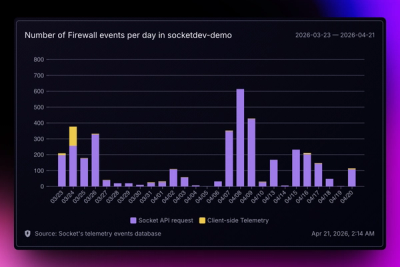
Introducing Reports: An Extensible Reporting Framework for Socket Data
Explore exportable charts for vulnerabilities, dependencies, and usage with Reports, Socket’s new extensible reporting framework.
By André Staltz - Apr 21, 2026
@spectrum-web-components/calendar
Advanced tools
Web component implementation of a Spectrum Calendar
<sp-calendar> elements display all the days within a given month, indicating the current day. Users can also see past or future months, and select a specific date via pointer, Space or Enter.

yarn add @spectrum-web-components/calendar
Import the side effectful registration of <sp-calendar> via:
import '@spectrum-web-components/calendar/sp-calendar.js';
When looking to leverage the Calendar base class as a type and/or for extension purposes, do so via:
import { Calendar } from '@spectrum-web-components/calendar';
By default, the <sp-calendar> element will display the current month with emphasis on the current day and no pre-selected date.
<sp-calendar></sp-calendar>
A pre-selected date value can be provided to the <sp-calendar> element and it will dictate the displayed month of the element.
Setting the value property requires a DateValue type (DateValue = CalendarDate | CalendarDateTime | ZonedDateTime).
When reading the value by element.value, the consumer will always receive a CalendarDate type value.
More about these types and when to use each one can be found on the @internationalized/date page.
To clear the element's value, the clear method can be used. (element.clear())
import {CalendarDate} from '@internationalized/date';

<sp-calendar id="min-max-calendar"
    .value=${new CalendarDate(2020, 2, 14)}
></sp-calendar>
The min and max properties can be used to limit the selected value to a specific range. Ranges can be open, by providing only one of the mentioned properties, or closed, when both min and max are provided. These properties are also of DateValue type, but will always be of CalendarDate type when read, similar to value.
If the provided closed interval is not a valid one (e.g min > max), the assignment of those properties gets ignored. The same way, if a pre-selected value doesn't comply with the interval, it gets ignored and the element will behave as it wouldn't have a value provided.
    <div id="calendar-with-min-max"></div>

    <script type="module">
        import { CalendarDate } from '@internationalized/date';
        import { SpectrumElement } from '@spectrum-web-components/base';
        import { html, render } from 'lit';
        import '@spectrum-web-components/calendar/sp-calendar.js';

        class CalendarWithMinMax extends SpectrumElement {
            render(){
                return html`
                <sp-calendar
                    .min=${new CalendarDate(2020, 2, 14)}
                    .max=${new CalendarDate(2020, 2, 19)}
                ></sp-calendar>`
            }
        }

        customElements.define("calendar-with-min-max", CalendarWithMinMax);

        onCodeExamplesLoaded(() => {
            const root = document.querySelector('#calendar-with-min-max');
            root.innerHTML = '';
            render(html`<calendar-with-min-max></calendar-with-min-max>`, root);
        })
    </script>
In order to react to date selection changes, consumers can leverage the change event and read the value of the event target in the handler.
import { CalendarDate } from '@internationalized/date';
import { Calendar } from '@spectrum-web-components/calendar';

const handleCalendarChange = (event: Event) => {
    const selectedDate = (event.target as Calendar).value as CalendarDate;
    // use the selectedDate...
};
The <sp-calendar> element supports multiple locales and updates its content accordingly.
element.locale represents the language in which the <sp-calendar> element is currently being delivered. By default, the value will represent the language established by the lang attribute on the root <html> element, with a fallback to navigator.language. This can be customized via a language context provider by a parent element that listens for sp-language-context event and supplies update language settings to the callback function. Applications leveraging the <sp-theme> element to manage the visual delivery or text direction of their content will also be provided with a reactive context for supplying language information to its descendants.
Currently the <sp-calendar> elements supports only the Gregorian calendar and the AD era.
While providing support for screen readers, the element needs some labels to be internationalized by the consumer to offer non-english alternatives. This can be done via the labels property.
FAQs
Web component implementation of a Spectrum Calendar
The npm package @spectrum-web-components/calendar receives a total of 1 weekly downloads. As such, @spectrum-web-components/calendar popularity was classified as not popular.
We found that @spectrum-web-components/calendar demonstrated a not healthy version release cadence and project activity because the last version was released a year ago. It has 13 open source maintainers collaborating on the project.
Did you know?

Socket for GitHub automatically highlights issues in each pull request and monitors the health of all your open source dependencies. Discover the contents of your packages and block harmful activity before you install or update your dependencies.
Product
Explore exportable charts for vulnerabilities, dependencies, and usage with Reports, Socket’s new extensible reporting framework.
Product
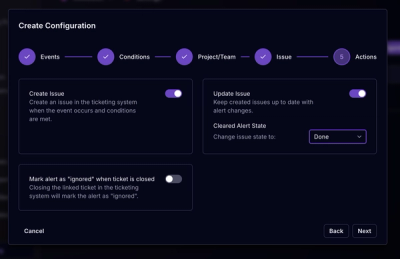
Socket for Jira lets teams turn alerts into Jira tickets with manual creation, automated ticketing rules, and two-way sync.

Company News
Socket won two 2026 Reppy Awards from RepVue, ranking in the top 5% of all sales orgs. AE Alexandra Lister shares what it's like to grow a sales career here.