


Company News
Socket Has Acquired Secure Annex
Socket has acquired Secure Annex to expand extension security across browsers, IDEs, and AI tools.
By Feross Aboukhadijeh - Apr 28, 2026
@stencil/store
Advanced tools
Store is a lightweight shared state library by the StencilJS core team. Implements a simple key/value map that efficiently re-renders components when necessary.
Store is a lightweight shared state library by the StencilJS core team. It implements a simple key/value map that efficiently re-renders components when necessary.
Highlights:
npm install @stencil/store --save-dev
store.ts:
import { createStore } from "@stencil/store";

const { state, onChange } = createStore({
  clicks: 0,
  seconds: 0,
  squaredClicks: 0
});

onChange('clicks', value => {
  state.squaredClicks = value ** 2;
});

export default state;
component.tsx:
import { Component, h } from '@stencil/core';
import state from '../store';

@Component({
  tag: 'app-profile',
})
export class AppProfile {

  componentWillLoad() {
    setInterval(() => state.seconds++, 1000);
  }

  render() {
    return (
      <div>
        <p>
          <MyGlobalCounter />
          <p>
            Seconds: {state.seconds}
            <br />
            Squared Clicks: {state.squaredClicks}
          </p>
        </p>
      </div>
    );
  }
}

const MyGlobalCounter = () => {
  return (
    <button onClick={() => state.clicks++}>
      {state.clicks}
    </button>
  );
};
createStore<T>(initialState?: T | (() => T), shouldUpdate?)Create a new store with the given initial state. The type is inferred from initialState, or can be passed as the generic type T.
initialState can be a function that returns the actual initial state. This feature is just in case you have deep objects that mutate
as otherwise we cannot keep track of those.
const { reset, state } = createStore(() => ({
  pageA: {
    count: 1
  },
  pageB: {
    count: 1
  }
}));

state.pageA.count = 2;
state.pageB.count = 3;

reset();

state.pageA.count; // 1
state.pageB.count; // 1
Please, bear in mind that the object needs to be created inside the function, not just referenced. The following example won't work as you might want it to, as the returned object is always the same one.
const object = {
  pageA: {
    count: 1
  },
  pageB: {
    count: 1
  }
};
const { reset, state } = createStore(() => object);

state.pageA.count = 2;
state.pageB.count = 3;

reset();

state.pageA.count; // 2
state.pageB.count; // 3
By default, store performs a exact comparison (===) between the new value, and the previous one in order to prevent unnecessary rerenders, however, this behaviour can be changed by providing a shouldUpdate function through the second argument. When this function returns false, the value won't be updated. By providing a custom shouldUpdate() function, applications can create their own fine-grained change detection logic, beyond the default ===. This may be useful for certain use-cases to avoid any expensive re-rendering.
const shouldUpdate = (newValue, oldValue, propChanged) => {
  return JSON.stringify(newValue) !== JSON.stringify(oldValue);
}
Returns a store object with the following properties.
store.stateThe state object is proxied, i. e. you can directly get and set properties. If you access the state object in the render function of your component, Store will automatically re-render it when the state object is changed.
Note: Proxy objects are not supported by IE11 (not even with a polyfill), so you need to use the store.get and store.set methods of the API if you wish to support IE11.
store.on(event, listener)Add a listener to the store for a certain action.
store.onChange(propName, listener)Add a listener that is called when a specific property changes (either from a set or reset).
store.get(propName)Get a property's value from the store.
store.set(propName, value)Set a property's value in the store.
store.reset()Reset the store to its initial state.
store.use(...subscriptions)Use the given subscriptions in the store. A subscription is an object that defines one or more of the properties get, set or reset.
const { reset, state, use } = createStore({ a: 1, b: 2});

const unlog = use({
  get: (key) => {
    console.log(`Someone's reading prop ${key}`);
  },
  set: (key, newValue, oldValue) => {
    console.log(`Prop ${key} changed from ${oldValue} to ${newValue}`);
  },
  reset: () => {
    console.log('Store got reset');
  },
  dispose: () => {
    console.log('Store got disposed');
  },
})

state.a; // Someone's reading prop a
state.b = 3; // Prop b changed from 2 to 3
reset(); // Store got reset

unlog();

state.a; // Nothing is logged
state.b = 5; // Nothing is logged
reset(); // Nothing is logged
store.dispose()Resets the store and all the internal state of the store that should not survive between tests.
Like any global state library, state should be disposed between each spec test.
Use the dispose() API in the beforeEach hook.
import store from '../store';

beforeEach(() => {
  store.dispose();
});
FAQs
Store is a lightweight shared state library by the StencilJS core team. Implements a simple key/value map that efficiently re-renders components when necessary.
The npm package @stencil/store receives a total of 99,610 weekly downloads. As such, @stencil/store popularity was classified as popular.
We found that @stencil/store demonstrated a healthy version release cadence and project activity because the last version was released less than a year ago. It has 5 open source maintainers collaborating on the project.
Did you know?

Socket for GitHub automatically highlights issues in each pull request and monitors the health of all your open source dependencies. Discover the contents of your packages and block harmful activity before you install or update your dependencies.
Company News
Socket has acquired Secure Annex to expand extension security across browsers, IDEs, and AI tools.

Research
/Security News
Socket is tracking cloned Open VSX extensions tied to GlassWorm, with several updated from benign-looking sleepers into malware delivery vehicles.
Product
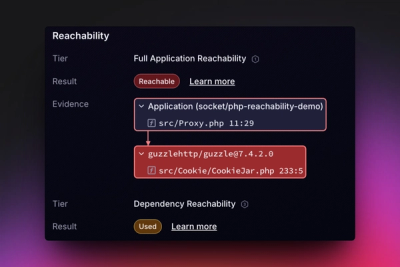
Reachability analysis for PHP is now available in experimental, helping teams identify which vulnerabilities are actually exploitable.