


Security News
Deno 2.6 + Socket: Supply Chain Defense In Your CLI
Deno 2.6 introduces deno audit with a new --socket flag that plugs directly into Socket to bring supply chain security checks into the Deno CLI.
By Sarah Gooding - Dec 12, 2025
@tapestrylab/cli
Advanced tools
Unified command-line interface for all Tapestry design system tools.
npm install -g @tapestrylab/cli
# or
pnpm add -g @tapestrylab/cli
The tapestry CLI provides a single entrypoint for all Tapestry tools:
Extract component metadata from source files:
tapestry extract --root ./src --output ./metadata.json
Options:
-c, --config <path> - Path to config file-r, --root <path> - Project root directory-o, --output <path> - Output file path-i, --include <patterns...> - Include patterns-e, --exclude <patterns...> - Exclude patterns--json - Output as JSONGenerate documentation from component source files:
tapestry generate --source ./src/Button.tsx --template component-docs
Options:
-s, --source <path> - Source file or directory (default: ./src/components)-o, --output <path> - Output directory (default: ./docs)-t, --template <name|path> - Template name or path to template file-f, --format <format> - Output format: markdown, mdx, or html (default: mdx)--theme <path> - Path to custom theme file--no-relationships - Skip relationship resolution--project-root <path> - Project root for relationship resolutionList all built-in templates:
tapestry list
Initialize Tapestry configuration in the current directory:
tapestry init
Options:
--force - Overwrite existing filesThis will create:
tapestry.config.js - Configuration filetemplates/ - Directory for custom templatestemplates/custom.taptpl.json - Example custom templatecustom.theme.js - Example custom theme# Extract metadata from all components
tapestry extract --root ./src/components --output ./metadata.json
# Generate documentation for a single component
tapestry generate --source ./src/Button.tsx --template component-docs --format mdx
# Generate documentation for all components in a directory
tapestry generate --source ./src/components --output ./docs --template api-reference
# Initialize Tapestry configuration
tapestry init

# Edit the generated tapestry.config.js and templates/custom.taptpl.json

# Generate docs with custom template and theme
tapestry generate --template ./templates/custom.taptpl.json --theme ./custom.theme.js
If you were previously using tapestry-extract or tapestry-template, you can now use the unified tapestry CLI:
Before:
tapestry-extract extract --root ./src --output ./metadata.json
tapestry-template generate --source ./src/Button.tsx --template component-docs
tapestry-template list
tapestry-template init
After:
tapestry extract --root ./src --output ./metadata.json
tapestry generate --source ./src/Button.tsx --template component-docs
tapestry list
tapestry init
The individual CLIs (tapestry-extract and tapestry-template) will continue to work, but we recommend using the unified tapestry CLI for a better experience.
This CLI package is a thin wrapper that delegates to the underlying packages:
tapestry extract → @tapestrylab/extracttapestry generate → @tapestrylab/templatetapestry list → @tapestrylab/templatetapestry init → @tapestrylab/templateMIT
FAQs
Unified CLI for all Tapestry tools
We found that @tapestrylab/cli demonstrated a healthy version release cadence and project activity because the last version was released less than a year ago. It has 1 open source maintainer collaborating on the project.
Did you know?

Socket for GitHub automatically highlights issues in each pull request and monitors the health of all your open source dependencies. Discover the contents of your packages and block harmful activity before you install or update your dependencies.
Security News
Deno 2.6 introduces deno audit with a new --socket flag that plugs directly into Socket to bring supply chain security checks into the Deno CLI.
Security News
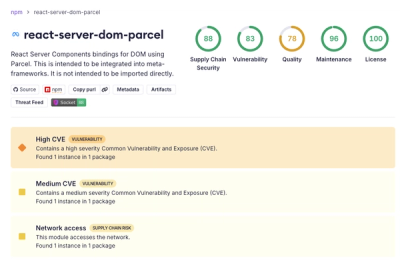
New DoS and source code exposure bugs in React Server Components and Next.js: what’s affected and how to update safely.

Security News
Socket CEO Feross Aboukhadijeh joins Software Engineering Daily to discuss modern software supply chain attacks and rising AI-driven security risks.