

Security News
New React Server Components Vulnerabilities: DoS and Source Code Exposure
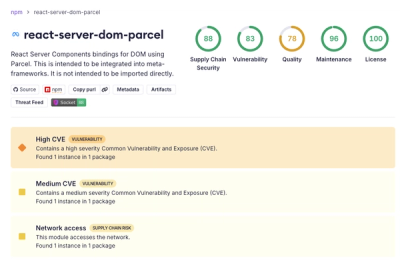
New DoS and source code exposure bugs in React Server Components and Next.js: what’s affected and how to update safely.
By Sarah Gooding - Dec 12, 2025
@typespec-events/typespec
Advanced tools
Standardize your analytics and tracking events across your entire stack. `typespec-events` uses [TypeSpec](https://typespec.io) as a single source of truth to generate type-safe code for multiple languages, ensuring consistency and reducing maintenance ov
Standardize your analytics and tracking events across your entire stack. typespec-events uses TypeSpec as a single source of truth to generate type-safe code for multiple languages, ensuring consistency and reducing maintenance overhead.
The official documentation is available at here.
Managing tracking events across different teams, codebases, and technologies often leads to inconsistent data, missing events, and a high maintenance burden when changes are required.
With typespec-events, you define your events once in a language-agnostic way using TypeSpec. A custom emitter then generates code for your target platforms, ensuring your events are always in sync.
This monorepo contains the following packages:
| Package | Description |
|---|---|
packages/typespec | The core TypeSpec library and the multi-language emitter. |
packages/runtime | A lightweight, type-safe runtime for consuming generated event schemas. |
docs | The official documentation website, built with Starlight. |
packages/playground | An example project demonstrating usage and for integration testing. |
Install the necessary packages:
pnpm add @typespec-events/typespec @typespec-events/runtime @typespec/compiler zod
Define your events in a .tsp file:
// main.tsp
import "@typespec-events/typespec";
using TypespecEvents;

@event("user_signed_up")
model UserSignedUpEvent {
  userId: string;
  email: string;
}
Configure your tspconfig.yaml:
emit:
  - "@typespec-events/typespec"
Generate the code:
tsp compile .
Use the generated code:
// In your application code
import { defineTracker } from '@typespec-events/runtime';
import { eventSchemas } from './tsp-output/@typespec-events/events.zod';

const track = defineTracker({
  track: (eventName, properties) => {
    console.log(`Tracking: ${eventName}`, properties);
  },
  events: eventSchemas,
});

track('user_signed_up', { userId: '123', email: 'test@example.com' });
For more detailed information, please visit the Official Documentation.
This project uses pnpm for package management and Moon for task running.
Install dependencies:
pnpm install
Run tests:
pnpm run test
Build all packages:
pnpm run build
FAQs
Standardize your analytics and tracking events across your entire stack. `typespec-events` uses [TypeSpec](https://typespec.io) as a single source of truth to generate type-safe code for multiple languages, ensuring consistency and reducing maintenance ov
We found that @typespec-events/typespec demonstrated a healthy version release cadence and project activity because the last version was released less than a year ago. It has 1 open source maintainer collaborating on the project.
Did you know?

Socket for GitHub automatically highlights issues in each pull request and monitors the health of all your open source dependencies. Discover the contents of your packages and block harmful activity before you install or update your dependencies.
Security News
New DoS and source code exposure bugs in React Server Components and Next.js: what’s affected and how to update safely.

Security News
Socket CEO Feross Aboukhadijeh joins Software Engineering Daily to discuss modern software supply chain attacks and rising AI-driven security risks.
Security News
GitHub has revoked npm classic tokens for publishing; maintainers must migrate, but OpenJS warns OIDC trusted publishing still has risky gaps for critical projects.