Security News
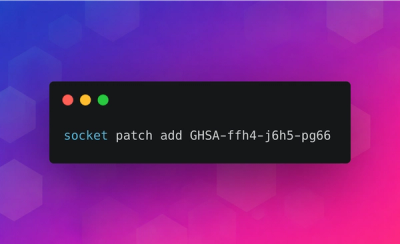
Socket Releases Free Certified Patches for Critical vm2 Sandbox Escape
A critical vm2 sandbox escape can allow untrusted JavaScript to break isolation and execute commands on the host Node.js process.
@webpod/ip
Advanced tools
Lite IP tools
This lib is an alternative for the ip package which resolves many upstream issues.
./corenpm i @webpod/ip
- const ip = require('ip')
+ const ip = require('@webpod/ip')
Temporary workaround to avoid refactoring is using overrides / resolutions in your package.json:
{
"overrides": {
"ip": "@webpod/ip"
}
}
Browser-compatible core build is available as @webpod/ip/core: it omits node:os dependency and polyfills the Buffer API.
By default, the library is in the strict mode that rejects non-canonical embedded IPv4 in IPv6. Switch to legacy flow if needed:
import { Address } from '@webpod/ip'
Address.from('::ffff:5.6.7.8') // ok
Address.from('1:2:3:4::5.6.7.8') // throws
Address.strict = false
Address.from('1:2:3:4::5.6.7.8') // now it's fine
The API is fully compatible with the latest ip@2.0.1 but enforces stricter validations. See coherence.md for details.
import ip from '@webpod/ip'
// -------------------------------------------------------
// Addresses & formats
// -------------------------------------------------------
ip.address() // '192.168.1.50' (example local address)
ip.isPrivate('127.0.0.1') // true
ip.isV4Format('127.0.0.1') // true
ip.isV6Format('::ffff:127.0.0.1') // true
ip.isEqual('::1', '::0:1') // true
// -------------------------------------------------------
// Conversions
// -------------------------------------------------------
ip.toBuffer('127.0.0.1') // <Buffer 7f 00 00 01>
ip.toString(Buffer.from([127, 0, 0, 1])) // '127.0.0.1'
ip.toLong('127.0.0.1') // 2130706433
ip.fromLong(2130706433) // '127.0.0.1'
ip.fromPrefixLen(24) // '255.255.255.0'
// in-place buffer usage
const buf = Buffer.alloc(128)
const offset = 64
ip.toBuffer('127.0.0.1', buf, offset) // writes [127, 0, 0, 1] at offset 64
ip.toString(buf, offset, 4) // '127.0.0.1'
// -------------------------------------------------------
// Masking, bitwise, and ranges
// -------------------------------------------------------
ip.mask('192.168.1.134', '255.255.255.0') // '192.168.1.0'
ip.cidr('192.168.1.134/26') // '192.168.1.128'
ip.not('255.255.255.0') // '0.0.0.255'
ip.or('192.168.1.134', '0.0.0.255') // '192.168.1.255'
// -------------------------------------------------------
// Subnets
// -------------------------------------------------------
ip.subnet('192.168.1.134', '255.255.255.192')
/*
{
networkAddress: '192.168.1.128',
firstAddress: '192.168.1.129',
lastAddress: '192.168.1.190',
broadcastAddress: '192.168.1.191',
subnetMask: '255.255.255.192',
subnetMaskLength: 26,
numHosts: 62,
length: 64,
contains: [Function: contains]
}
*/
ip.cidrSubnet('192.168.1.134/26').contains('192.168.1.190') // true
import { Address } from '@webpod/ip'
// -------------------------------------------------------
// Prototype methods
// -------------------------------------------------------
const addr4 = Address.from('192.168.1.134')
addr4.family // 4
addr4.big // 323223590n
addr4.toString() // '192.168.1.134'
addr4.toLong() // 323223590
addr4.toBuffer() // <Buffer c0 a8 01 86>
addr4.toArray() // [192, 168, 1, 134]
const addr6 = Address.from('::1')
addr6.family // 6
addr6.big // 1n
addr6.toString() // '::1'
addr6.toString(4) // '0.0.0.1'
addr6.toBuffer().toString('hex') // '00000000000000000000000000000001'
// -------------------------------------------------------
// Specific ranges check
// -------------------------------------------------------
Address.from('127.0.0.1').range // 'loopback'
Address.from('192.0.2.10').range // 'documentation'
Address.isSpecial('127.0.0.1') // true
Address.isSpecial('127.0.0.1', 'loopback') // true
Address.isSpecial('127.0.0.1', 'documentation') // false
Address.isSpecial('1.2.3.4') // false
Follow coherence.md, benchmark.md and meta.md to explore suitable options.
MIT
FAQs
Lite IP tools
We found that @webpod/ip demonstrated a healthy version release cadence and project activity because the last version was released less than a year ago. It has 3 open source maintainers collaborating on the project.
Did you know?

Socket for GitHub automatically highlights issues in each pull request and monitors the health of all your open source dependencies. Discover the contents of your packages and block harmful activity before you install or update your dependencies.

Security News
A critical vm2 sandbox escape can allow untrusted JavaScript to break isolation and execute commands on the host Node.js process.

Research
Five malicious NuGet packages impersonate Chinese .NET libraries to deploy a stealer targeting browser credentials, crypto wallets, SSH keys, and local files.

Security News
pnpm 11 turns on a 1-day Minimum Release Age and blocks exotic subdeps by default, adding safeguards against fast-moving supply chain attacks.