

Security News
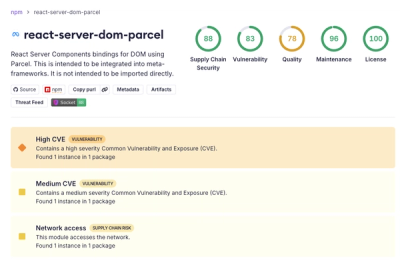
New React Server Components Vulnerabilities: DoS and Source Code Exposure
New DoS and source code exposure bugs in React Server Components and Next.js: what’s affected and how to update safely.
By Sarah Gooding - Dec 12, 2025
@zk-kit/smt
Advanced tools
Sparse Merkle tree implementation in TypeScript.






A sparse Merkle tree is a data structure useful for storing a key/value map where every leaf node of the tree contains the cryptographic hash of a key/value pair and every non leaf node contains the concatenated hashes of its child nodes. Sparse Merkle trees provides a secure and efficient verification of large data sets and they are often used in peer-to-peer technologies. This implementation is an optimized version of the traditional sparse Merkle tree and it is based on the concepts expressed in the papers and resources below.
You can install @zk-kit/smt package with npm:
npm i @zk-kit/smt --save
or yarn:
yarn add @zk-kit/smt
You can also load it using a script tag using unpkg:
<script src="https://unpkg.com/@zk-kit/smt"></script>
or JSDelivr:
<script src="https://cdn.jsdelivr.net/npm/@zk-kit/smt"></script>
import { ChildNodes, SMT } from "@zk-kit/smt"
import sha256 from "crypto-js/sha256"
import { poseidon2, poseidon3 } from "poseidon-lite"

// Hexadecimal hashes.
const hash = (childNodes: ChildNodes) => sha256(childNodes.join("")).toString()

// Create the SMT with an Hexadecimal (SHA256) hash.
const tree = new SMT(hash)

// 0
console.log(tree.root)

// Big number hashes.
const hash2 = (childNodes) => (childNodes.length === 2 ? poseidon2(childNodes) : poseidon3(childNodes))

// Create the SMT with a BigNumber (Poseidon) hash.
const tree2 = new SMT(hash2, true)

// 0n
console.log(tree2.root)

// Add nodes to the SMT.
tree.add("2b", "44")
tree.add("16", "78")
tree.add("d", "e7")
tree.add("10", "141")
tree.add("20", "340")

// 31ee2a59741c9c32a32d8c7fafe461cca1ccaf5986c2d592586e3e6482a48645
console.log(tree.root)

// Get the value of the leaf.
const value = tree.get("16")

// 78
console.log(value)

// Update the value of the leaf.
tree.update("16", "79")

// 79
console.log(tree.get("16"))

// Delete the leaf.
tree.delete("16")

// undefined
console.log(tree.get("16"))

// Compute the proof of membership for the leaf.
const membershipProof = tree.createProof("2b")

// Compute the proof of membership for a previously deleted leaf.
const nonMembershipProof = tree.createProof("16") // This key has been deleted.

/*
{
    entry: [ '2b', '44', '1' ],
    matchingEntry: undefined,
    siblings: [
        '006a0ab15a212e0e0126b81e056b11576628b1ad80792403dbb3a90be2e71d64',
        'f786ce5a843614d7da216d95c0087c1eb29244927feeeeeb658aa60cf124cd5e'
    ],
    root: 'c3c023c84afc0a7bab1dbebcef5f7beaf3d6af4af98e8f481620dec052be7d0d',
    membership: true
}
*/
console.log(membershipProof)

/*
{
    entry: [ '16' ],
    matchingEntry: undefined,
    siblings: [
        '960f23d9fbb44241be53efb7c4d69ac129bb1cb9482dcb6789d3cc7e6de2de2b',
        '2a1aef839e68d1bdf43c1b3b1ed9ef16c27162e8a175898c9ac64a679b0fc825'
    ],
    root: 'c3c023c84afc0a7bab1dbebcef5f7beaf3d6af4af98e8f481620dec052be7d0d',
    membership: false
}
*/
console.log(nonMembershipProof)

// Verify the proofs.
console.log(tree.verifyProof(membershipProof)) // true
console.log(tree.verifyProof(nonMembershipProof)) // true
FAQs
Sparse Merkle tree implementation in TypeScript.
We found that @zk-kit/smt demonstrated a not healthy version release cadence and project activity because the last version was released a year ago. It has 4 open source maintainers collaborating on the project.
Did you know?

Socket for GitHub automatically highlights issues in each pull request and monitors the health of all your open source dependencies. Discover the contents of your packages and block harmful activity before you install or update your dependencies.
Security News
New DoS and source code exposure bugs in React Server Components and Next.js: what’s affected and how to update safely.

Security News
Socket CEO Feross Aboukhadijeh joins Software Engineering Daily to discuss modern software supply chain attacks and rising AI-driven security risks.
Security News
GitHub has revoked npm classic tokens for publishing; maintainers must migrate, but OpenJS warns OIDC trusted publishing still has risky gaps for critical projects.