Research
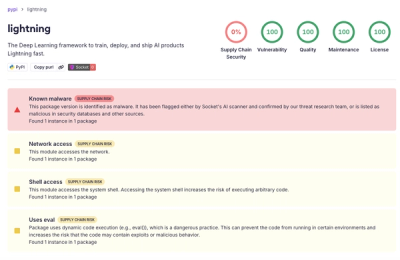
lightning PyPI Package Compromised in Supply Chain Attack
Socket detected a malicious supply chain attack on PyPI package lightning versions 2.6.2 and 2.6.3, which execute credential-stealing malware on import.
For when the keys in an object represent paths, and you want
to be able to fetch them regardless of your operating system's
preference for path separators (\, /).
var assert = require('assert')
var ap = require('./')
var o = ap({
'./node_modules/any-path/package.json': {name: 'any-path'}
})
assert.equal(
o['.\\node_modules\\any-path\\package.json'].name, 'any-path'
) // lookup works \o/
assert.equal(
o['./node_modules/any-path/package.json'].name, 'any-path'
) // lookup works \o/
assert.equal(
o['.\\node_modules/any-path\\package.json'].name, 'any-path'
) // lookup works \o/
Put the object back into its initial state.
var o = anyPath({
'.\\foo\\bar\\README.md': {name: 'README.md'}
})
o.__restore__().should.deep.equal({
'.\\foo\\bar\\README.md': {name: 'README.md'}
})
ISC
FAQs
make the keys on an object path.sep agnostic.
The npm package any-path receives a total of 437 weekly downloads. As such, any-path popularity was classified as not popular.
We found that any-path demonstrated a not healthy version release cadence and project activity because the last version was released a year ago. It has 1 open source maintainer collaborating on the project.
Did you know?

Socket for GitHub automatically highlights issues in each pull request and monitors the health of all your open source dependencies. Discover the contents of your packages and block harmful activity before you install or update your dependencies.

Research
Socket detected a malicious supply chain attack on PyPI package lightning versions 2.6.2 and 2.6.3, which execute credential-stealing malware on import.

Research
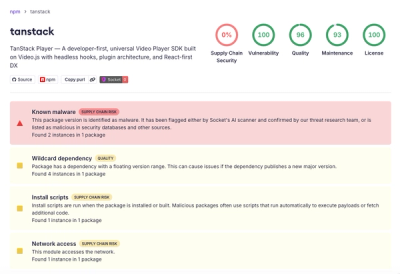
A brand-squatted TanStack npm package used postinstall scripts to steal .env files and exfiltrate developer secrets to an attacker-controlled endpoint.

Research
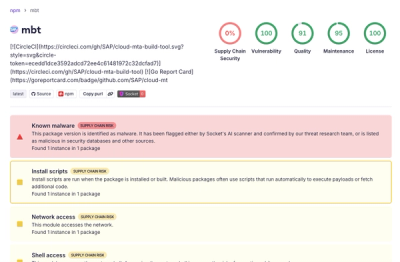
Compromised SAP CAP npm packages download and execute unverified binaries, creating urgent supply chain risk for affected developers and CI/CD environments.