

Product
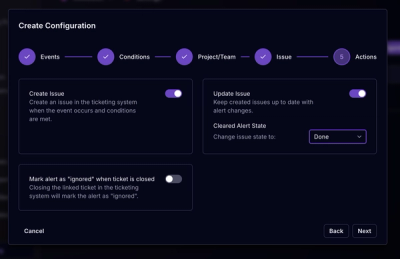
Socket for Jira Is Now Available
Socket for Jira lets teams turn alerts into Jira tickets with manual creation, automated ticketing rules, and two-way sync.
By Jeppe Hasseriis - Apr 20, 2026


Asar is a simple extensive archive format, it works like tar that concatenates
all files together without compression, while having random access support.
This module requires Node 10 or later.
$ npm install --engine-strict asar
$ asar --help

  Usage: asar [options] [command]

  Commands:

    pack|p <dir> <output>
       create asar archive

    list|l <archive>
       list files of asar archive

    extract-file|ef <archive> <filename>
       extract one file from archive

    extract|e <archive> <dest>
       extract archive


  Options:

    -h, --help     output usage information
    -V, --version  output the version number
Given:
    app
(a) ├── x1
(b) ├── x2
(c) ├── y3
(d) │   ├── x1
(e) │   └── z1
(f) │       └── x2
(g) └── z4
(h)     └── w1
Exclude: a, b
$ asar pack app app.asar --unpack-dir "{x1,x2}"
Exclude: a, b, d, f
$ asar pack app app.asar --unpack-dir "**/{x1,x2}"
Exclude: a, b, d, f, h
$ asar pack app app.asar --unpack-dir "{**/x1,**/x2,z4/w1}"
const asar = require('asar');

const src = 'some/path/';
const dest = 'name.asar';

await asar.createPackage(src, dest);
console.log('done.');
Please note that there is currently no error handling provided!
You can pass in a transform option, that is a function, which either returns
nothing, or a stream.Transform. The latter will be used on files that will be
in the .asar file to transform them (e.g. compress).
const asar = require('asar');

const src = 'some/path/';
const dest = 'name.asar';

function transform (filename) {
  return new CustomTransformStream()
}

await asar.createPackageWithOptions(src, dest, { transform: transform });
console.log('done.');
There is also an unofficial grunt plugin to generate asar archives at bwin/grunt-asar.
Asar uses Pickle to safely serialize binary value to file, there is
also a node.js binding of Pickle class.
The format of asar is very flat:
| UInt32: header_size | String: header | Bytes: file1 | ... | Bytes: file42 |
The header_size and header are serialized with Pickle class, and
header_size's Pickle object is 8 bytes.
The header is a JSON string, and the header_size is the size of header's
Pickle object.
Structure of header is something like this:
{
   "files": {
      "tmp": {
         "files": {}
      },
      "usr" : {
         "files": {
           "bin": {
             "files": {
               "ls": {
                 "offset": "0",
                 "size": 100,
                 "executable": true,
                 "integrity": {
                   "algorithm": "SHA256",
                   "hash": "...",
                   "blockSize": 1024,
                   "blocks": ["...", "..."]
                 }
               },
               "cd": {
                 "offset": "100",
                 "size": 100,
                 "executable": true,
                 "integrity": {
                   "algorithm": "SHA256",
                   "hash": "...",
                   "blockSize": 1024,
                   "blocks": ["...", "..."]
                 }
               }
             }
           }
         }
      },
      "etc": {
         "files": {
           "hosts": {
             "offset": "200",
             "size": 32,
             "integrity": {
                "algorithm": "SHA256",
                "hash": "...",
                "blockSize": 1024,
                "blocks": ["...", "..."]
              }
           }
         }
      }
   }
}
offset and size records the information to read the file from archive, the
offset starts from 0 so you have to manually add the size of header_size and
header to the offset to get the real offset of the file.
offset is a UINT64 number represented in string, because there is no way to
precisely represent UINT64 in JavaScript Number. size is a JavaScript
Number that is no larger than Number.MAX_SAFE_INTEGER, which has a value of
9007199254740991 and is about 8PB in size. We didn't store size in UINT64
because file size in Node.js is represented as Number and it is not safe to
convert Number to UINT64.
integrity is an object consisting of a few keys:
algorithm, currently only SHA256 is supported.hash value representing the hash of the entire file.blocks of the file. i.e. for a blockSize of 4KB this array contains the hash of every block if you split the file into N 4KB blocks.blockSize representing the size in bytes of each block in the blocks hashes aboveThe 'tar' npm package is used for working with tar archives. It provides functionality to create, extract, and list files in tar archives. While 'tar' is a general-purpose tool for tar files, 'asar' is specifically optimized for Electron applications and their resource packaging needs.
The 'zip' npm package allows for creating and extracting zip archives. Similar to 'asar', it provides methods to compress and decompress files, but it uses the zip format instead of the ASAR format. 'zip' is more widely used for general file compression and decompression tasks.
The 'node-tar' package is another tool for handling tar archives in Node.js. It offers a range of features for creating, extracting, and manipulating tar files. Compared to 'asar', 'node-tar' is more versatile for general tar file operations but lacks the specific optimizations for Electron applications.
FAQs
Creating Electron app packages
The npm package asar receives a total of 279,770 weekly downloads. As such, asar popularity was classified as popular.
We found that asar demonstrated a not healthy version release cadence and project activity because the last version was released a year ago. It has 2 open source maintainers collaborating on the project.
Did you know?

Socket for GitHub automatically highlights issues in each pull request and monitors the health of all your open source dependencies. Discover the contents of your packages and block harmful activity before you install or update your dependencies.
Product
Socket for Jira lets teams turn alerts into Jira tickets with manual creation, automated ticketing rules, and two-way sync.
Company News
Socket won two 2026 Reppy Awards from RepVue, ranking in the top 5% of all sales orgs. AE Alexandra Lister shares what it's like to grow a sales career here.

Security News
NIST will stop enriching most CVEs under a new risk-based model, narrowing the NVD's scope as vulnerability submissions continue to surge.