

Product
Introducing Reports: An Extensible Reporting Framework for Socket Data
Explore exportable charts for vulnerabilities, dependencies, and usage with Reports, Socket’s new extensible reporting framework.
By André Staltz - Apr 21, 2026
Author IDE and Instruction Renderer
Create a .npmrc file from .npmrc.template. Replace <<YOUR_GH_PERSONAL_ACCESS_TOKEN>> with your github personal access token, configured with read package permissions. Make sure to allow SSO with ibm-skills-network. (This is required because author-ide uses the @ibm-skills-network/editor.md package which is not public, so you need authorization in order for npm install to install it)
Create a .env file from .env.template.
GITLAB_TOKEN can be found here under credential field.(Note this is an api token for SN self-hosted gitlab from staging)GITLAB_URL set to "https://author-gitlab.staging.skills.network/api/v4/" in order to point to the SN self-hosted gitlab from staging.PORT to 3002 in order to be inline with the default development settings of author-ide for other services like atlas and author-workbench.SECRET blank.LABS_BASE_URL can be left blank. It should be set only if you need to test iframe communcations between author-ide and the labs ui locally (author-ide is iframed inside labs ui in a typical lab environment). You would have to run labs ui locally and set LABS_BASE_URL to the url of the locally running labs ui (usually http://monocle.localhost:5000)LABS_ACCESS_TOKEN can be found here. It needs to be set if you want to test the Test button inside author-ide(to make the Test button work, you also requires theLTI params to be set (see below))LTI params can be found here. Note, you're required to set the LTI params only if you want to test the Test button inside author-ide. Note, the LTI credentials provided are for the staging environment, so when a lab is loaded, the author-ide on the left will be from the staging environment and not your local environment.AWB_URL should be set to the url of the locally running AWB (usually http://localhost:3000)AWB_CLIENT_ID and AWB_CLIENT_SECRET should be generated in locally running AWB at http://localhost:3000/oauth/applications (requires admin role) and create a new application (just give it a name (something like Author IDE) and leave the other fields blank).AWS_ACCESS_KEY_ID, AWS_SECRET_ACCESS_KEY, COS_REGION, IBM_COS_ENDPOINT, S3_BUCKET, and S3_BUCKET_PRIVATE can be found hereconfig/settings/development.local.yml file in author-workbench:author_ide:
url: "http://localhost:3002"
access_token: "<access token>"
where <access token> is generated and displayed as "Admin Token:" in the logs in step 4. after running npm start
author-iderequiresauthor-workbenchto be running in order to hit theeditendpoints with valid tokens.
# Use the node version (v16.12.0) designated for this workspace
nvm install
# or
nvm use

# Install deps
npm install

# Start dev server (should hotload code changes)
npm start
You'll mostly be working with the edit/ and render/ endpoints. Read this to get started.
op run -- docker-compose build
/token - Generate a token/edit?token=<token> - HTML edit page/render?token=<token> - HTML render pageRead this for more details on the endpoints.
See https://wiki.skills.network/en/Team/Development/how-we-develop-services
There is a chance that any public file might be cached by akamai and this may cause errors. It's usually a good idea to purge the akamai cache after deploying a new Author IDE image so this issue doesn't occur.
Follow this guide for clearing the akamai cache and make sure to select the CP Code for skills-network-apps-production
Ideally, you shouldn't be creating tokens manually. Author workbench and Labs UI are responsible for generating token for authors and learners.
{
  "atlas_token": <atlas token for a lab and its project>,
  "tool_type": <tool type>,
  "author": {
    "email": <user email>,
    "display_name": <user name>,
    "user_id": <user id>
  },
  "gitlab": {
    "id": <Gitlab project ID>,
    "filename": "<filename>"
  },
  "asset_library_prefix_url": "<asset library prefix url>"
}
e.g.
{
  "atlas_token": "eyJhbGciOiJIUzI1NiJ9.eyJwcm9qZWN0X2lkIjoiMTAyNTciLCJsYWJfaWQiOjk3Nzl9.TXZrPT3qCS5TWg2b9dySJYd0v26awxCS70lZTlj5y3E",
  "tool_type": "instructional-lab",
  "author": {
    "email": "fedorivy@mcmaster.ca",
    "display_name": "Eugene Fedoriv",
    "user_id": 2
  },
  "gitlab": {
    "id": "39771753",
    "filename": "labs/eugene-asdlkasjd.md"
  },
  "asset_library_prefix_url": "https://cf-course-data-dev.s3.us.cloud-object-storage.appdomain.cloud/IBM-GPXX0AISEN",
  "admin": false,
  "iat": 1664382344,
  "exp": 1664468744
}
FAQs
Did you know?

Socket for GitHub automatically highlights issues in each pull request and monitors the health of all your open source dependencies. Discover the contents of your packages and block harmful activity before you install or update your dependencies.
Product
Explore exportable charts for vulnerabilities, dependencies, and usage with Reports, Socket’s new extensible reporting framework.
Product
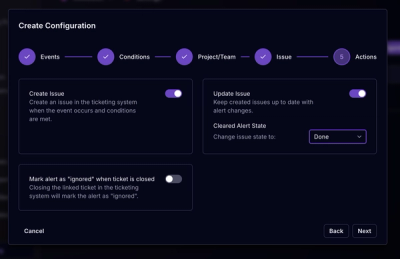
Socket for Jira lets teams turn alerts into Jira tickets with manual creation, automated ticketing rules, and two-way sync.

Company News
Socket won two 2026 Reppy Awards from RepVue, ranking in the top 5% of all sales orgs. AE Alexandra Lister shares what it's like to grow a sales career here.