


Security News
Deno 2.6 + Socket: Supply Chain Defense In Your CLI
Deno 2.6 introduces deno audit with a new --socket flag that plugs directly into Socket to bring supply chain security checks into the Deno CLI.
By Sarah Gooding - Dec 12, 2025
better-auth-convex
Advanced tools
Local installation of Better Auth directly in your Convex app schema, with direct database access instead of component-based queries.
The official @convex-dev/better-auth component stores auth tables in a component schema. This package provides an alternative approach with direct schema integration.
This package provides direct local installation:
ctx.runQuery/ctx.runMutation overhead (>50ms latency that increases with app size)[!WARNING] BREAKING CHANGE: Auth tables are stored in your app schema instead of the component schema. If you're already in production with
@convex-dev/better-auth, you'll need to write a migration script to move your auth data.
convex/auth.ts - We'll use a different setupconvex/http.ts - We use different route registrationpnpm add better-auth@1.3.34 better-auth-convex
You'll need convex/auth.config.ts and update your files to install Better Auth directly in your app:
// convex/auth.ts
import { betterAuth } from 'better-auth';
import { convex } from '@convex-dev/better-auth/plugins';
import { admin, organization } from 'better-auth/plugins'; // Optional plugins
import {
  type AuthFunctions,
  createClient,
  createApi,
} from 'better-auth-convex';
import { internal } from './_generated/api';
import type { MutationCtx, QueryCtx, GenericCtx } from './_generated/server';
import type { DataModel } from './_generated/dataModel';
import schema from './schema'; // YOUR app schema with auth tables

// 1. Internal API functions for auth operations
const authFunctions: AuthFunctions = internal.auth;

// 2. Auth client with triggers that run in your app context
export const authClient = createClient<DataModel, typeof schema>({
  authFunctions,
  schema,
  triggers: {
    user: {
      beforeCreate: async (_ctx, data) => {
        // Ensure every user has a username, filling in a simple fallback
        const username =
          data.username?.trim() ||
          data.email?.split('@')[0] ||
          `user-${Date.now()}`;

        return {
          ...data,
          username,
        };
      },
      onCreate: async (ctx, user) => {
        // Direct access to your database
        // Example: Create personal organization
        const orgId = await ctx.db.insert('organization', {
          name: `${user.name}'s Workspace`,
          slug: `personal-${user._id}`,
          // ... other fields
        });

        // Update user with personalOrganizationId
        await ctx.db.patch(user._id, {
          personalOrganizationId: orgId,
        });
      },
      beforeDelete: async (ctx, user) => {
        // Example: clean up custom tables before removing the user
        if (user.personalOrganizationId) {
          await ctx.db.delete(user.personalOrganizationId);
        }

        return user;
      },
    },
    session: {
      onCreate: async (ctx, session) => {
        // Set default active organization on session creation
        if (!session.activeOrganizationId) {
          const user = await ctx.db.get(session.userId);

          if (user?.personalOrganizationId) {
            await ctx.db.patch(session._id, {
              activeOrganizationId: user.personalOrganizationId,
            });
          }
        }
      },
    },
  },
});

// 3. Create auth configuration (with options for HTTP-only mode)
export const createAuth = (
  ctx: GenericCtx,
  { optionsOnly } = { optionsOnly: false }
) => {
  const baseURL = process.env.NEXT_PUBLIC_SITE_URL!;

  return betterAuth({
    baseURL,
    logger: { disabled: optionsOnly },
    plugins: [
      convex(), // Required
      admin(),
      organization({
        // Organization plugin config
      }),
    ],
    session: {
      expiresIn: 60 * 60 * 24 * 30, // 30 days
      updateAge: 60 * 60 * 24 * 15, // 15 days
    },
    database: authClient.httpAdapter(ctx),
    // ... other config (social providers, user fields, etc.)
  });
};

// 4. Static auth instance for configuration
export const auth = createAuth({} as any, { optionsOnly: true });

// 5. IMPORTANT: Use getAuth for queries/mutations (direct DB access)
export const getAuth = <Ctx extends QueryCtx | MutationCtx>(ctx: Ctx) => {
  return betterAuth({
    ...auth.options,
    database: authClient.adapter(ctx, auth.options),
  });
};

// 6. Export trigger handlers for Convex
export const {
  beforeCreate,
  beforeDelete,
  beforeUpdate,
  onCreate,
  onDelete,
  onUpdate,
} = authClient.triggersApi();

// 7. Export API functions for internal use
export const {
  create,
  deleteMany,
  deleteOne,
  findMany,
  findOne,
  updateMany,
  updateOne,
} = createApi(schema, auth.options);

// Optional: If you need custom mutation builders (e.g., for custom context)
// Pass internalMutation to both createClient and createApi
// export const authClient = createClient<DataModel, typeof schema>({
//   authFunctions,
//   schema,
//   internalMutation: myCustomInternalMutation,
//   triggers: { ... }
// });
//
// export const { create, ... } = createApi(schema, {
//   ...auth.options,
//   internalMutation: myCustomInternalMutation,
// });
The trigger API exposes both before* and on* hooks. The before variants run inside the same Convex transaction just ahead of the database write, letting you normalize input, enforce invariants, or perform cleanup and return any transformed payload that should be persisted.
// convex/http.ts
import { httpRouter } from 'convex/server';
import { registerRoutes } from 'better-auth-convex';
import { createAuth } from './auth';

const http = httpRouter();

registerRoutes(http, createAuth);

export default http;
// ✅ In queries/mutations: Use getAuth (direct DB access)
export const someQuery = query({
  handler: async (ctx) => {
    const auth = getAuth(ctx); // Direct DB access
    const user = await auth.api.getUser({ userId });
  },
});

// ⚠️ In actions: Use createAuth (needs HTTP adapter for external calls)
export const someAction = action({
  handler: async (ctx) => {
    const auth = createAuth(ctx); // Actions can't directly access DB
    // Use for webhooks, external API calls, etc.
  },
});
// Component approach (@convex-dev/better-auth):
// - Auth tables in components.betterAuth schema
// - Requires ctx.runQuery/runMutation for auth operations
// - Component boundaries between auth and app tables

// Local approach (better-auth-convex):
// ✅ Auth tables in your app schema
// ✅ Direct queries across auth + app tables
// ✅ Single transaction for complex operations
// ✅ Direct function calls
All helpers are exported from the main package:
import { getAuthUserId, getSession, getHeaders } from 'better-auth-convex';

// Get current user ID
const userId = await getAuthUserId(ctx);

// Get full session
const session = await getSession(ctx);

// Get headers for auth.api calls
const headers = await getHeaders(ctx);
Both createClient and createApi accept an optional internalMutation parameter, allowing you to wrap internal mutations with custom context or behavior.
This is useful when you need to:
import { customMutation, customCtx } from 'convex-helpers/server/customFunctions';
import { internalMutationGeneric } from 'convex/server';
import { registerTriggers } from '@convex/triggers';

const triggers = registerTriggers();

// Wrap mutations to include trigger-wrapped database
const internalMutation = customMutation(
  internalMutationGeneric,
  customCtx(async (ctx) => ({
    db: triggers.wrapDB(ctx).db,
  }))
);

// Pass to createClient
export const authClient = createClient<DataModel, typeof schema>({
  authFunctions,
  schema,
  internalMutation, // Use custom mutation builder
  triggers: { ... }
});

// Pass to createApi
export const { create, updateOne, ... } = createApi(schema, {
  ...auth.options,
  internalMutation, // Use same custom mutation builder
});
This ensures all auth operations (CRUD + triggers) use your wrapped database context.
Better Auth configuration changes may require schema updates. The Better Auth docs will often note when this is the case. To regenerate the schema (it's generally safe to do), run:
cd convex && npx @better-auth/cli generate -y --output authSchema.ts
Import the generated schema in your convex/schema.ts:
import { authSchema } from './authSchema';
import { defineSchema } from 'convex/server';

export default defineSchema({
  ...authSchema,
  // Your other tables here
});
Alternatively, use the generated schema as a reference to manually update your existing schema:
// Example: Adding a missing field discovered from generated schema
import { defineSchema, defineTable } from 'convex/server';
import { v } from 'convex/values';

export default defineSchema({
  user: defineTable({
    // ... existing fields
    twoFactorEnabled: v.optional(v.union(v.null(), v.boolean())), // New field from Better Auth update
    // ... rest of your schema
  }).index('email_name', ['email', 'name']),
  // ... other indexes
});
Better Auth may log warnings about missing indexes for certain queries. You can add custom indexes by extending the generated schema:
// convex/schema.ts
import { authSchema } from './authSchema';
import { defineSchema } from 'convex/server';

export default defineSchema({
  ...authSchema,
  // Override with custom indexes
  user: authSchema.user.index('username', ['username']),
  // Your other tables
});
Note: authSchema table names and field names should not be customized directly. Use Better Auth configuration options to customize the schema, then regenerate to see the expected structure.
Built on top of Better Auth and @convex-dev/better-auth, optimized for Convex.
FAQs
Better Auth Convex local integration
The npm package better-auth-convex receives a total of 181 weekly downloads. As such, better-auth-convex popularity was classified as not popular.
We found that better-auth-convex demonstrated a healthy version release cadence and project activity because the last version was released less than a year ago. It has 1 open source maintainer collaborating on the project.
Did you know?

Socket for GitHub automatically highlights issues in each pull request and monitors the health of all your open source dependencies. Discover the contents of your packages and block harmful activity before you install or update your dependencies.
Security News
Deno 2.6 introduces deno audit with a new --socket flag that plugs directly into Socket to bring supply chain security checks into the Deno CLI.
Security News
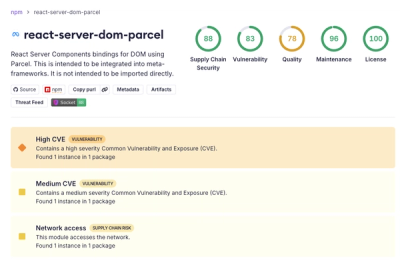
New DoS and source code exposure bugs in React Server Components and Next.js: what’s affected and how to update safely.

Security News
Socket CEO Feross Aboukhadijeh joins Software Engineering Daily to discuss modern software supply chain attacks and rising AI-driven security risks.