

Product
Socket for Jira Is Now Available
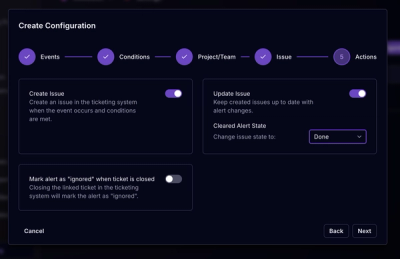
Socket for Jira lets teams turn alerts into Jira tickets with manual creation, automated ticketing rules, and two-way sync.
By Jeppe Hasseriis - Apr 20, 2026
capacitor-build-safety
Advanced tools
Make app releases safer. Reduce thinking with automated checks.
If a tester cannot immediately see from which commit and which branch a given build originates, then this lack of certainty can cause a huge waste of time. Moreover, there are industries that require each deployment to be end-to-end traceable. To be end-to-end traceable, we want a bombproof trace all the way from an app or web-server back to the specific Git-commit that was used to build it.
To do so, capsafe adds a file commit-evidence.json to all your builds.

capsafe was written with Capacitor in mind, although you do not need to use Capacitor.
Capacitor is a great tool for cross-platform app development (iOS/Android/Web).
However, Capacitor builds are prone to mistakes.
In particular, the following mistakes can lead to broken app releases or wasted developer time:
capsafe helps to prevent those mistakes.
For example, capsafe prevents broken Android releases with the following message, if a developer forgot to sync Capacitor for the most recent commit:
error: Current commit 25a7a56bca71 does not match with commit 8c8476eb77f6 in 'android/app/src/main/assets/public/commit-evidence.json': Run 'capsafe disable' to disable this check temporarily (if you know what you are doing)
Similarly, capsafe prevents broken iOS-builds if a developer forgot to do a web-build:
error: 'ios/App/public/commit-evidence.json' does not exist: Run 'capsafe disable' to disable this check temporarily (if you know what you are doing)
Beside of native apps, capsafe is also usable for browser-based tests that run against web-builds.
capsafe ensures that browser-based tests are always running against the latest commit.
capsafe provides three commands to prevent broken apps: create-commit-evidence, verify-commit-evidence, validate-capacitor-config.
Typically, those commands run in the following steps:
create-commit-evidence creates a file commit-evidence.json in your web-build folder. commit-evidence.json contains information about the current HEAD-commit (the tree hash and the commit hash).cap sync copy commit-evidence.json to native asset directories, along with all other web-assets.verify-commit-evidence verifies that the current HEAD-commit still matches with commit-evidence.json in the respective native asset directory.validate-capacitor-config runs before each app release or in a continuous integration pipeline.For pure native development, the checks of capsafe might be annoying.
In this case, you can quickly disable capsafe by running:
npx capsafe disable
This will disable safety checks until you switch the current branch, or until you delete capsafe.disable.json.
To remain safe, you should add capsafe.disable.json to your .gitignore.
Firstly, install capsafe via npm:
npm install --save-dev capacitor-build-safety
Next, extend your build scripts for Web/Android/iOS, depending on your setup.
Ensure that create-commit-evidence is invoked after each web build.
For example, your package.json might contain a build script like this:
"scripts": {
  "build: "node scripts/build.js"
}
In this case, you can extend the build script with a simple &&-chaining:
"scripts": {
  "build: "node scripts/build.js && npx capsafe create-commit-evidence build"
}
To enforce that verify-commit-evidence succeeds before every Android build, add the following to your app-module's build.gradle:
afterEvaluate {
    preBuild.dependsOn(verifyCommitEvidence)  // Each build must use the most recent commit.
    preProductionReleaseBuild.dependsOn(verifyCommitEvidence, validateCapacitorConfig) // Capacitor config must be only validated for production builds.
}
task verifyCommitEvidence(type: Exec) {
    commandLine 'npx', 'capsafe', 'verify-commit-evidence', 'src/main/assets/public'
}
task validateCapacitorConfig(type: Exec) {
    commandLine 'npx', 'capsafe', 'validate-capacitor-config', 'src/main/assets/capacitor.config.json'
}
You can use Xcode to enforce that verify-commit-evidence succeeds before every iOS build.
To do so, navigate to your app target's Build Phases and add a new Run Script Phase.
Paste the following snippet into the Run Script Phase:
npx capsafe verify-commit-evidence public/
To run as fast as possible, place the Run Script Phase before all other Build Phases.
Once this is done, Xcode should generate something like this in your app's project.pbxproj:
B8DF42F32508BDBC00B0603F /* Run Script */ = {
    isa = PBXShellScriptBuildPhase;
    buildActionMask = 2147483647;
    files = (
    );
    inputFileListPaths = (
    );
    inputPaths = (
    );
    name = "Run Script";
    outputFileListPaths = (
    );
    outputPaths = (
    );
    runOnlyForDeploymentPostprocessing = 0;
    shellPath = /bin/sh;
    shellScript = "npx capsafe verify-commit-evidence public/";
    showEnvVarsInLog = 0;
};
If you have tests that run against a web-build (without live reload), then you might extend your web tests like so:
npx capsafe verify-commit-evidence build && my_web_testing_tool
FAQs
Make app releases safer. Reduce thinking with automated checks.
We found that capacitor-build-safety demonstrated a not healthy version release cadence and project activity because the last version was released a year ago. It has 1 open source maintainer collaborating on the project.
Did you know?

Socket for GitHub automatically highlights issues in each pull request and monitors the health of all your open source dependencies. Discover the contents of your packages and block harmful activity before you install or update your dependencies.
Product
Socket for Jira lets teams turn alerts into Jira tickets with manual creation, automated ticketing rules, and two-way sync.
Company News
Socket won two 2026 Reppy Awards from RepVue, ranking in the top 5% of all sales orgs. AE Alexandra Lister shares what it's like to grow a sales career here.

Security News
NIST will stop enriching most CVEs under a new risk-based model, narrowing the NVD's scope as vulnerability submissions continue to surge.