

Product
Introducing Reports: An Extensible Reporting Framework for Socket Data
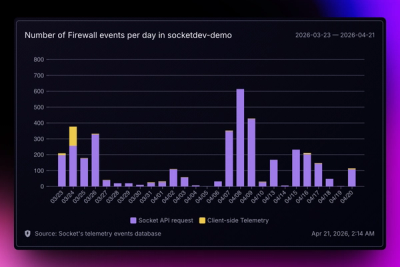
Explore exportable charts for vulnerabilities, dependencies, and usage with Reports, Socket’s new extensible reporting framework.
By André Staltz - Apr 21, 2026
compute-erf
Advanced tools




Computes the error function.
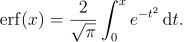
The error function is defined as
$ npm install compute-erf
For use in the browser, use browserify.
var erf = require( 'compute-erf' );
Evaluates the error function (element-wise). x may be either a number, an array, a typed array, or a matrix. Values may include NaN, +infinity, and -infinity.
var matrix = require( 'dstructs-matrix' ),
	data,
	mat,
	out,
	i;

out = erf( -1 );
// returns -0.8427

out = erf( [ -10, -1, 0, 1, 10 ] );
// returns [ -1, -0.8427, 0, 0.8427, 1 ]

data = [ 0, 1, 2 ];
out = erf( data );
// returns [ 0, ~0.8427007, ~0.9953222 ]

data = new Int8Array( data );
out = erf( data );
// returns Float64Array( [ 0, ~0.8427007, ~0.9953222 ] )

data = new Float64Array( 6 );
for ( i = 0; i < 6; i++ ) {
	data[ i ] = i / 2;
}
mat = matrix( data, [3,2], 'float64' );
/*
	[ 0  0.5
	  1  1.5
	  2  2.5 ]
*/

out = erf( mat );
/*
	[  0    ~0.52
	  ~0.84 ~0.97
	  ~1    ~1    ]
*/
The function accepts the following options:
function for accessing array values.typed array or matrix data type. Default: float64.boolean indicating if the function should return a new data structure. Default: true.'.'.For non-numeric arrays, provide an accessor function for accessing array values.
var data = [
	['beep', -10],
	['boop', -1],
	['bip', 0],
	['bap', 1],
	['baz', 10]
];

function getValue( d, i ) {
	return d[ 1 ];
}

var out = erf( data, {
	'accessor': getValue
});
// returns [ -1, -0.8427, 0, 0.8427, 1 ]
To deepset an object array, provide a key path and, optionally, a key path separator.
var data = [
	{'x':[0,-10]},
	{'x':[1,-1]},
	{'x':[2,0]},
	{'x':[3,1]},
	{'x':[4,10]}
];

var out = erf( data, 'x|1', '|' );
/*
	[
		{'x':[0,-1]},
		{'x':[1,-0.8427]},
		{'x':[2,0]},
		{'x':[3,0.8427]},
		{'x':[4,1]}
	]
*/

var bool = ( data === out );
// returns true
By default, when provided a typed array or matrix, the output data structure is float64 in order to preserve precision. To specify a different data type, set the dtype option (see matrix for a list of acceptable data types).
var data, out;

data = new Int8Array( [0, 1, 2] );

out = erf( data, {
	'dtype': 'int32'
});
// returns Int32Array( [0,0,0] )

// Works for plain arrays, as well...
out = erf( [0, 1, 2], {
	'dtype': 'uint8'
});
// returns Uint8Array( [0,0,0] )
By default, the function returns a new data structure. To mutate the input data structure (e.g., when input values can be discarded or when optimizing memory usage), set the copy option to false.
var data,
	bool,
	mat,
	out,
	i;

var data = [ -10, -1, 0, 1, 10 ];

var out = erf( data, {
	'copy': false
});
// returns [ -1, -0.8427, 0, 0.8427, 1 ]

bool = ( data === out );
// returns true

data = new Float64Array( 6 );
for ( i = 0; i < 6; i++ ) {
	data[ i ] = i / 2;
}
mat = matrix( data, [3,2], 'float64' );
/*
	[ 0  0.5
	  1  1.5
	  2  2.5 ]
*/

out = erf( mat, {
	'copy': false
});
/*
	[  0    ~0.52
	  ~0.84 ~0.97
	  ~1    ~1    ]
*/

bool = ( mat === out );
// returns true
If an element is not a numeric value, the evaluated error function is NaN.
var data, out;

out = erf( null );
// returns NaN

out = erf( true );
// returns NaN

out = erf( {'a':'b'} );
// returns NaN

out = erf( [ true, null, [] ] );
// returns [ NaN, NaN, NaN ]

function getValue( d, i ) {
	return d.x;
}
data = [
	{'x':true},
	{'x':[]},
	{'x':{}},
	{'x':null}
];

out = erf( data, {
	'accessor': getValue
});
// returns [ NaN, NaN, NaN, NaN ]

out = erf( data, {
	'path': 'x'
});
/*
	[
		{'x':NaN},
		{'x':NaN},
		{'x':NaN,
		{'x':NaN}
	]
*/
Be careful when providing a data structure which contains non-numeric elements and specifying an integer output data type, as NaN values are cast to 0.
var out = erf( [ true, null, [] ], {
	'dtype': 'int8'
});
// returns Int8Array( [0,0,0] );
var matrix = require( 'dstructs-matrix' ),
	erf = require( 'compute-erf' );

var data,
	mat,
	out,
	tmp,
	i;

// Plain arrays...
data = new Array( 10 );
for ( i = 0; i < data.length; i++ ) {
	data[ i ] = Math.random()*20 - 10;
}
out = erf( data );

// Object arrays (accessors)...
function getValue( d ) {
	return d.x;
}
for ( i = 0; i < data.length; i++ ) {
	data[ i ] = {
		'x': data[ i ]
	};
}
out = erf( data, {
	'accessor': getValue
});

// Deep set arrays...
for ( i = 0; i < data.length; i++ ) {
	data[ i ] = {
		'x': [ i, data[ i ].x ]
	};
}
out = erf( data, {
	'path': 'x/1',
	'sep': '/'
});

// Typed arrays...
data = new Int32Array( 10 );
for ( i = 0; i < data.length; i++ ) {
	data[ i ] = Math.random() * 100;
}
tmp = erf( data );
out = '';
for ( i = 0; i < data.length; i++ ) {
	out += tmp[ i ];
	if ( i < data.length-1 ) {
		out += ',';
	}
}

// Matrices...
mat = matrix( data, [5,2], 'int32' );
out = erf( mat );


// Matrices (custom output data type)...
out = erf( mat, {
	'dtype': 'uint8'
});
To run the example code from the top-level application directory,
$ node ./examples/index.js
Unit tests use the Mocha test framework with Chai assertions. To run the tests, execute the following command in the top-level application directory:
$ make test
All new feature development should have corresponding unit tests to validate correct functionality.
This repository uses Istanbul as its code coverage tool. To generate a test coverage report, execute the following command in the top-level application directory:
$ make test-cov
Istanbul creates a ./reports/coverage directory. To access an HTML version of the report,
$ make view-cov
Copyright © 2014-2015. The Compute.io Authors.
FAQs
Error function.
The npm package compute-erf receives a total of 589 weekly downloads. As such, compute-erf popularity was classified as not popular.
We found that compute-erf demonstrated a not healthy version release cadence and project activity because the last version was released a year ago. It has 2 open source maintainers collaborating on the project.
Did you know?

Socket for GitHub automatically highlights issues in each pull request and monitors the health of all your open source dependencies. Discover the contents of your packages and block harmful activity before you install or update your dependencies.
Product
Explore exportable charts for vulnerabilities, dependencies, and usage with Reports, Socket’s new extensible reporting framework.
Product
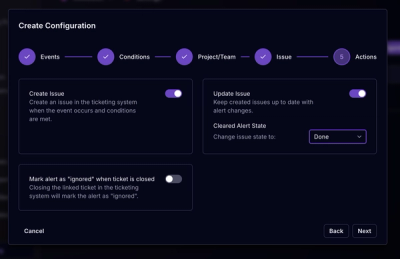
Socket for Jira lets teams turn alerts into Jira tickets with manual creation, automated ticketing rules, and two-way sync.
Company News
Socket won two 2026 Reppy Awards from RepVue, ranking in the top 5% of all sales orgs. AE Alexandra Lister shares what it's like to grow a sales career here.