

Company News
Socket Has Acquired Secure Annex
Socket has acquired Secure Annex to expand extension security across browsers, IDEs, and AI tools.
By Feross Aboukhadijeh - Apr 28, 2026
ednl-liftstatus-web-components
Advanced tools
The EDNL LiftStatus web components for use in web applications.
Copy or clone the repo and run npm install.
To get live data, you need an access token to put in the <ls-data> component inside index.html.
For the time being, navigate to https://next.liftstatus.nl/ and login. On the left, click on "liften".
In the address bar you can append the url with a lift ID like so: https://next.liftstatus.nl/lifts/31901.
The below Lift ID's are great for testing.
| Lift ID | Usefulness |
|---|---|
| 31901 | Has a lot of movement |
| 32386 | Has a lot of movement |
| 32383 | Has a lot of movement |
| 31981 | Has a lot of movement |
| 49234 | Good for testing status messages and has a back door |
| 55040 | Good for testing status messages |
| 33137 | Good for testing status messages |
Once on the selected elevator page, open the developer tools and navigate to the network tab. From here, filter on WS and select the request to api.liftstatus.nl/socket.io. You can find the token in the headers of this request.
Note: if you do not see a request, you might need to refresh the browser with the network tab open.
Copy the access token and give it as a parameter in the <ls-data> component inside of index.html.
After that you can run npm run start to run the project. It should open to localhost:3000.
https://ednl-ls-web-components-demo.web.app/
https://unpkg.com/browse/ednl-liftstatus-web-components/dist/ednl-liftstatus-web-components/
https://springtree.github.io/ednl-liftstatus-web-components/
To edit it you can run npm run docs.
i18next (single shared instance in src/utils/i18n.ts).nl and en.nl.What is translated:
ui:*, errors:* in src/utils/translations.ts).sensorLabels, sensorLabelsShort, sensorValues).What is not translated:
src/stores/status-codes.json (used as-is).Data flow:
language is set on <ls-data> (nl / en).<ls-data> normalizes it via getLocale() and stores it in store.state.locale.store.t(...)) and/or locale utilities.watchStoreLocale), so changing language at runtime updates connected components.id-key), so multiple instances can run different locales on the same page.We use Conventional Commits.
Format:
<type>(optional-scope): <short description>
Common types:
build, chore, ci, docs, feat, fix, perf, refactor, revert, style, test
Examples:
feat(ls-date-picker): add support for selecting custom rangesfix(ls-data): prevent reconnect loop when token is missingdocs(readme): document local development setuprefactor(store): simplify idKey resolution for publishFAQs
The EDNL LiftStatus web components
The npm package ednl-liftstatus-web-components receives a total of 402 weekly downloads. As such, ednl-liftstatus-web-components popularity was classified as not popular.
We found that ednl-liftstatus-web-components demonstrated a healthy version release cadence and project activity because the last version was released less than a year ago. It has 1 open source maintainer collaborating on the project.
Did you know?

Socket for GitHub automatically highlights issues in each pull request and monitors the health of all your open source dependencies. Discover the contents of your packages and block harmful activity before you install or update your dependencies.
Company News
Socket has acquired Secure Annex to expand extension security across browsers, IDEs, and AI tools.

Research
/Security News
Socket is tracking cloned Open VSX extensions tied to GlassWorm, with several updated from benign-looking sleepers into malware delivery vehicles.
Product
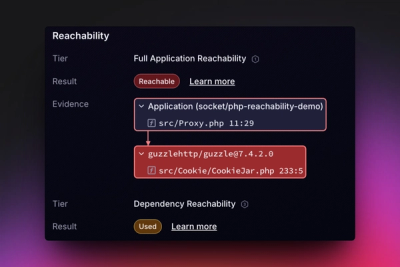
Reachability analysis for PHP is now available in experimental, helping teams identify which vulnerabilities are actually exploitable.