


Security News
Deno 2.6 + Socket: Supply Chain Defense In Your CLI
Deno 2.6 introduces deno audit with a new --socket flag that plugs directly into Socket to bring supply chain security checks into the Deno CLI.
By Sarah Gooding - Dec 12, 2025
Easily create HTML5 elements

| Platform | Build status |
|---|---|
| Linux | |
| Windows |


const { html, head, title, body, h1, p } = Elebend;
html((context) => {
head((context) => {
title('This is an example.');
});
body((context) => {
h1('Example header');
p('Example content');
});
});
Can't really say, but one of the reasons why I made this is to personally use it for a project I am working on.
npm i elebend-js
<script src="https://cdn.jsdelivr.net/npm/elebend-js/dist/index.min.js"></script>
<script src="https://unpkg.com/elebend-js/dist/index.min.js"></script>
Loading the module provides a single object whose keys are based upon the HTML5 Tag names.
Loading the module defines an object named 'Elebend' whose keys are based upon the HTML5 Tag names.
Elebend is an object whose entries are functions that allows you to create an specific HTML5 element. The key to these functions are based upon the HTML5 Tag names.
For example, let's try to create a simple webpage using Elebend:
const { html, head, title, body, h1, p } = Elebend;
const el = html(() => {
  head(() => {
    title('This is an example.');
  });
  body(() => {
    h1('Example header');
    p('Example content');
  });
});
In this example, we created a fully built hiearchy for a single element, in which we can append into another element to render it.
Elebend.tagname(attr: string | function | object [, body: string | function | object]);
Where:
tagname is a name equivalent to an HTML5 tag e.g. a, p, div, main, etc.attr is the element's attributes IF it is an object provided. If it is a string or a function, attr is treated as a content body.body is an optional parameter, which is the content body of the element. Self-closing tags completely ignores this parameter.Refer to the HTML5 Spec for the element tags.
To define a text node, you can use Elebend.text(string).
Calling any Elebend function automatically appends to its Elebend callee (given that the function is called in an Elebend callback).
If the given body/attr is a callback, that callback receives a single parameter, context, which points to the parent node.
npm install
npm run build
FAQs
Easily create HTML5 elements
We found that elebend-js demonstrated a not healthy version release cadence and project activity because the last version was released a year ago. It has 1 open source maintainer collaborating on the project.
Did you know?

Socket for GitHub automatically highlights issues in each pull request and monitors the health of all your open source dependencies. Discover the contents of your packages and block harmful activity before you install or update your dependencies.
Security News
Deno 2.6 introduces deno audit with a new --socket flag that plugs directly into Socket to bring supply chain security checks into the Deno CLI.
Security News
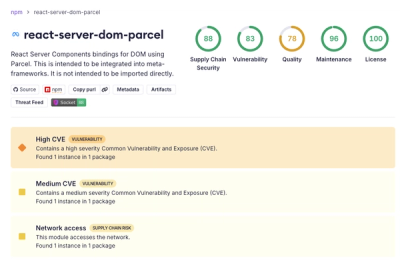
New DoS and source code exposure bugs in React Server Components and Next.js: what’s affected and how to update safely.

Security News
Socket CEO Feross Aboukhadijeh joins Software Engineering Daily to discuss modern software supply chain attacks and rising AI-driven security risks.