


Product
Socket for Jira Is Now Available
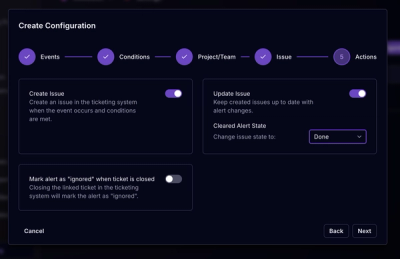
Socket for Jira lets teams turn alerts into Jira tickets with manual creation, automated ticketing rules, and two-way sync.
By Jeppe Hasseriis - Apr 20, 2026
electron-log
Advanced tools


Simple logging module Electron/Node.js/NW.js application. No dependencies. No complicated configuration.
By default, it writes logs to the following locations:
~/.config/{app name}/logs/main.log~/Library/Logs/{app name}/main.log%USERPROFILE%\AppData\Roaming\{app name}\logs\main.logStarts from v5, electron-log requires Electron 13+ or Node.js 14+. Feel free to use electron-log v4 for older runtime. v4 supports Node.js 0.10+ and almost any Electron build.
Install with npm:
npm install electron-log
import log from 'electron-log/main';

// Initialize the logger to be available in renderer process
log.initialize();

log.info('Log from the main process');
If a bundler is used, you can import the module in a renderer code:
import log from 'electron-log/renderer';
log.info('Log from the renderer process');
Without a bundler, you can use a global variable __electronLog. It contains
only log functions like info, warn and so on.
There are a few other ways how a logger can be initialized for a renderer process. Read more.
To use the logger inside a preload script, use the
electron-log/renderer import.
There's also the electron-log/preload entrypoint, but it's used only as a
bridge between the main and renderer processes and doesn't export a logger. In
most cases, you don't need this preload entrypoint.
import log from 'electron-log/node';
log.info('Log from the nw.js or node.js');
If you would like to upgrade to the latest version, read the migration guide and the changelog.
electron-log supports the following log levels:
error, warn, info, verbose, debug, silly
Transport is a simple function which does some work with log message. By default, two transports are active: console and file.
You can set transport options or use methods using:
log.transports.console.format = '{h}:{i}:{s} {text}';
log.transports.file.getFile();
Each transport has level and
transforms options.
Just prints a log message to application console (main process) or to DevTools console (renderer process).
'%c{h}:{i}:{s}.{ms}%c › {text}' (main),
'{h}:{i}:{s}.{ms} › {text}' (renderer)Read more about console transport.
The file transport writes log messages to a file.
'[{y}-{m}-{d} {h}:{i}:{s}.{ms}] [{level}] {text}'log.transports.file.resolvePathFn = () => path.join(APP_DATA, 'logs/main.log');
Read more about file transport.
It displays log messages from main process in the renderer's DevTools console.
By default, it's disabled for a production build. You can enable in the
production mode by setting the level property.
In the renderer process, this transport does the opposite: it sends the data to the main process via IPC. Then, the data is written to the console and the filesystem.
false in the production.Sends a JSON POST request with LogMessage in the body to the specified url.
Read more about remote transport.
Just set level property to false, for example:
log.transports.file.level = false;
log.transports.console.level = false;
Transport is just a function (msg: LogMessage) => void, so you can
easily override/add your own transport.
More info.
Sometimes it's helpful to use electron-log instead of default console. It's
pretty easy:
console.log = log.log;
If you would like to override other functions like error, warn and so on:
Object.assign(console, log.functions);
Colors can be used for both main and DevTools console.
log.info('%cRed text. %cGreen text', 'color: red', 'color: green')
Available colors:
For DevTools console you can use other CSS properties.
electron-log can catch and log unhandled errors/rejected promises:
log.errorHandler.startCatching(options?);
Sometimes it's helpful to save critical electron events to the log file.
log.eventLogger.startLogging(options?);
By default, it save the following events:
certificate-error, child-process-gone, render-process-gone of appcrashed, gpu-process-crashed of webContentsdid-fail-load, did-fail-provisional-load, plugin-crashed,
preload-error of every WebContents. You can switch any event on/off.In some situations, you may want to get more control over logging. Hook is a function which is called on each transport call.
(message: LogMessage, transport: Transport, transportName) => LogMessage
You can create multiple logger instances with different settings:
import log from 'electron-log/main';

const anotherLogger = log.create({ logId: 'anotherInstance' });
Be aware that you need to configure each instance (e.g. log file path) separately.
import log from 'electron-log/main';
const userLog = log.scope('user');

userLog.info('message with user scope');
// Prints 12:12:21.962 (user) › message with user scope
By default, scope labels are padded in logs. To disable it, set
log.scope.labelPadding = false.
It's like a transaction, you may add some logs to the buffer and then decide whether to write these logs or not. It allows adding verbose logs only when some operations failed.
import log from 'electron-log/main';

log.buffering.begin();
try {
  log.info('First silly message');
  // do somethings complex
  log.info('Second silly message');
  // do something else

  // Finished fine, we don't need these logs anymore
  log.buffering.reject();
} catch (e) {
  log.buffering.commit();
  log.warn(e);
}
Winston is a versatile logging library for Node.js that supports multiple transports, log levels, and formats. It is highly configurable and can be used in a variety of applications, not just Electron.
Bunyan is a simple and fast JSON logging library for Node.js. It is designed for high-performance logging and supports various transports and log levels. It is particularly useful for applications that require structured logging.
Log4js is a logging library inspired by the Java log4j library. It supports multiple appenders (transports), log levels, and configurations. It is a mature and widely-used library in the Node.js ecosystem.
FAQs
Just a simple logging module for your Electron application
The npm package electron-log receives a total of 615,175 weekly downloads. As such, electron-log popularity was classified as popular.
We found that electron-log demonstrated a healthy version release cadence and project activity because the last version was released less than a year ago. It has 1 open source maintainer collaborating on the project.
Did you know?

Socket for GitHub automatically highlights issues in each pull request and monitors the health of all your open source dependencies. Discover the contents of your packages and block harmful activity before you install or update your dependencies.
Product
Socket for Jira lets teams turn alerts into Jira tickets with manual creation, automated ticketing rules, and two-way sync.
Company News
Socket won two 2026 Reppy Awards from RepVue, ranking in the top 5% of all sales orgs. AE Alexandra Lister shares what it's like to grow a sales career here.

Security News
NIST will stop enriching most CVEs under a new risk-based model, narrowing the NVD's scope as vulnerability submissions continue to surge.