


Security News
Deno 2.6 + Socket: Supply Chain Defense In Your CLI
Deno 2.6 introduces deno audit with a new --socket flag that plugs directly into Socket to bring supply chain security checks into the Deno CLI.
By Sarah Gooding - Dec 12, 2025
Low level etcd v2 & v3 client written in Javascript with failover support
npm install etcdjs
Pass a connection string
var etcdjs = require('etcdjs')
var store = etcdjs('127.0.0.1:4001')

store.set('hello', 'world', function(err, result) {
  store.get('hello', function(err, result) {
    console.log('hello:', result.node.value)
  })
})
If you have more than run instance of etcd running you can pass an array to load balance
var store = etcdjs(['127.0.0.1:4001', '127.0.0.1:4002', '127.0.0.1:4003'])
If you have a discovery token from https://discovery.etcd.io/ you can also pass that
var store = etcdjs('https://discovery.etcd.io/my-token')
etcdjs will automatically refresh its internal host list every 30s so you can transparently
add more machines to your cluster without updating your seed host list.
store = etcd(host, opts)host should be a etcd host (or an array of hosts) and opts default to
{
  refresh: false,        // refresh the interval host list automatically
  timeout: 60 * 1000,    // default timeout for ops
  json: false            // stringify/parse all values as JSON
}
Note: The refresh option will try to discover additional etcd hosts via the etcd /machines endpoint which may not always return hostnames which are routable. Make sure the endpoint returns what you expect before turning on this feature.
store.get(key, [opts], cb)Get a key. opts defaults to
{
  recursive: false,
  sorted: false,
  json: false,      // parse value as JSON for this request
  wait: false,
  waitIndex: (none)
}
store.set(key, value, [opts], [cb])Set a key. opts defaults to
{
  ttl: (none),
  dir: false,
  json: false,      // stringify value as JSON for this request
  prevExist: (none),
  prevValue: (none),
  prevIndex: (none)
}
store.update(key, value, [opts], [cb])Set a key if it already exists. Same as set(key, value, {prevExists: true})
store.del(key, [opts], [cb])Delete a key. opts defaults to
{
  recursive: false,
  dir: false,
  prevExist: (none),
  prevValue: (none),
  prevIndex: (none)
}
store.mkdir(key, [opts], [cb])Create a directory. Same as set(key, null, {dir: true})
store.rmdir(key, [opts], [cb])Remove a directory. Same as del(key, {dir: true})
store.wait(key, [opts], [cb])Wait a key to change. Same as get(key, {wait: true}) except the callback is called with a third argument next that will wait for the next change.
store.wait('hello', function onchange (err, result, next) {
  console.log('change!', result);
  next(onchange); // next will set waitIndex so we do not miss events
});
.wait returns a destroy function which can be used to kill a waiting request.
var destroy = store.wait('hello', function onchange (err, result, next) {
  // ... do stuff ..
})

destroy()
store.set('key', 'value') // won't trigger the wait
store.compareAndSwap(key, value, prevValue, [opts], [cb])Only set if prevValue matches previous value. Similar to set(key, value, {prevValue: prevValue})
store.compareAndDelete(key, prevValue, [opts], [cb])Only delete if prevValue matches previous value. Similar to del(key, value, {prevValue: prevValue})
store.push(key, value, [opts], [cb])Create an in-order key that is guaranteed to be greater than the previous push. Check result.key to see the actual key.
store.machines(cb)Returns an array of all machines in the cluster
store.leader(cb)Returns the leader of the cluster
store.destroy()Destroy the client and all open connections
store.stats.self([node], cb)Returns node stats
store.stats.store(cb)Returns store stats
store.stats.leader(cb)Returns leader stats
MIT
FAQs
Low level etcd v2 client written in Javascript with failover support
The npm package etcdjs receives a total of 38 weekly downloads. As such, etcdjs popularity was classified as not popular.
We found that etcdjs demonstrated a not healthy version release cadence and project activity because the last version was released a year ago. It has 2 open source maintainers collaborating on the project.
Did you know?

Socket for GitHub automatically highlights issues in each pull request and monitors the health of all your open source dependencies. Discover the contents of your packages and block harmful activity before you install or update your dependencies.
Security News
Deno 2.6 introduces deno audit with a new --socket flag that plugs directly into Socket to bring supply chain security checks into the Deno CLI.
Security News
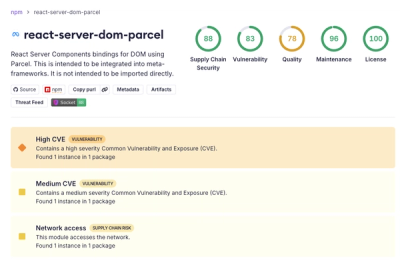
New DoS and source code exposure bugs in React Server Components and Next.js: what’s affected and how to update safely.

Security News
Socket CEO Feross Aboukhadijeh joins Software Engineering Daily to discuss modern software supply chain attacks and rising AI-driven security risks.