express-dev-panel
A zero-config developer panel for Express applications. Drop-in middleware that gives you a beautiful single-page dashboard with:
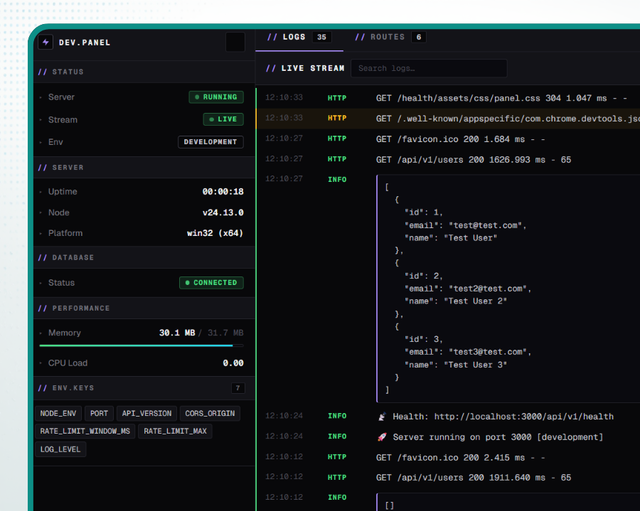
- Live log stream over Server-Sent Events with level filters and full-text search
- Route inspector that walks your Express app and lists every route with its HTTP method, path, parameters, handler chain, and mount breadcrumb
- Editor deep-links - click any route or handler name to jump straight to the source file at the exact line in VS Code, Cursor, WebStorm, IntelliJ, PhpStorm or PyCharm
- System stats - uptime, Node version, platform, memory, CPU load, env keys
- Optional DB health pill when you wire up a
getDbStatus callback
Install
npm install express-dev-panel
Quick start
import express from 'express';
import { createPanel } from 'express-dev-panel';
const app = express();
if (process.env.NODE_ENV !== 'production') {
app.use(
createPanel(app, {
prefix: '/__panel',
}),
);
}
app.listen(3000);
Open http://localhost:3000/__panel.
Options
createPanel(app, {
prefix: '/__panel',
getDbStatus: async () => {
try {
await prisma.$queryRaw`SELECT 1`;
return 'connected';
} catch {
return 'disconnected';
}
},
envKeys: ['NODE_ENV', 'PORT', 'DATABASE_URL'],
maxLogs: 200,
statsIntervalMs: 1000,
captureConsole: true,
});
Feeding logs into the panel
The panel keeps an in-memory ring buffer of log entries and pushes them to connected browsers via SSE. Pick whichever feeder fits your stack:
Option A - built-in logger (recommended, zero config)
The package ships with a panel-aware logger. Anything you log is mirrored to your console and to the dev panel automatically - no winston, no transport wiring.
import { logger } from 'express-dev-panel';

logger.info('Server started on port 3000');
logger.warn('Cache miss', { key: 'user:42' });
logger.error('DB query failed', new Error('connection refused'));
Optional configuration:
import { configureLogger } from 'express-dev-panel';
configureLogger({
level: 'http',
isDev: process.env.NODE_ENV !== 'production',
files: {
errorPath: 'logs/error.log',
combinedPath: 'logs/combined.log',
},
});
Stray console.log / console.info / console.warn / console.error calls are
captured into the panel automatically (see the captureConsole option above).
If you turned that off but still want to opt in manually:
import { captureConsole } from 'express-dev-panel';
if (process.env.NODE_ENV !== 'production') captureConsole();
Option B - winston integration
If you already have a winston logger, plug in the bundled memory transport:
import winston from 'winston';
import { createMemoryTransport } from 'express-dev-panel';
export const logger = winston.createLogger({
level: 'http',
transports: [
new winston.transports.Console(),
createMemoryTransport(),
],
});
Option C - manual push
import { pushLog } from 'express-dev-panel';

pushLog({
  level: 'info',
  message: 'Server started',
  timestamp: new Date().toISOString(),
});
Editor deep-links
Each route path and handler name is rendered as an anchor with data-loc-file/line/column. The panel exposes a small dropdown to pick the editor URI scheme the choice is persisted in localStorage. Clicking the link triggers your editor to open the file at the exact line.
License
MIT