


Security News
Deno 2.6 + Socket: Supply Chain Defense In Your CLI
Deno 2.6 introduces deno audit with a new --socket flag that plugs directly into Socket to bring supply chain security checks into the Deno CLI.
By Sarah Gooding - Dec 12, 2025
express-flickr-gallery
Advanced tools
Retrieve and/or integrate your flickr albums into an express web application
Express middleware to enable the addition of a flickr gallery to any express application.
This module works by loading your flickr albums (also known as sets) and then rendering them as a gallery page for you. For example, if you have 2 albums and add this middleware to your app and navigate to mysite.com/gallery you will be presented with a page showing two thumbnails stating the album name below. Clicking one of these will render a new page with thumbnails of all images in the album.
For this to work you need to define two templates of your own that will inject the HTML rendered by this middleware as described in the next section. For an example of this being used in an actual website checkout my own site photography page at evanshortiss.com/photography
In the below example you could use the following URLs:
'use strict';
var express = require('express')
, path = require('path')
, app = express()
, port = 8001
, flickr = require('express-flickr-gallery');
// Use any view engine that you like...
app.set('view engine', 'jade');
app.set('views', path.join(__dirname, './views'));
// Called once the gallery has initialised
function onGalleryInitialised (err, router) {
if (err) {
console.error('Failed to init flickr middleware. Retry in 5 seconds');
setTimeout(loadFlickrMiddleware, 5000);
} else {
app.use('/gallery', router);
// Start to listen now that all routes are loaded
app.listen(port, function (err) {
if (err) {
throw err;
}
console.log('Example server listening on port %s', port)
});
}
}
// Load the gallery middleware
// This is asynchronous so it can take a few seconds pending connection
// speed and the flickr API availability
flickr.middleware.init(express, {
flickr: {
// If you place albums IDs in the below array then only those will be
// shown in the list and all your other albums are ignored
// albums: []
api_key: process.env.FLICKR_API_KEY,
secret: process.env.FLICKR_SECRET,
user_id: process.env.FLICKR_USER_ID
},
templates: {
// The strings here should correspond to your views that the express-flickr
// partials will be rendered in
albumList: 'album-list',
album: 'album-page'
}
}, onGalleryInitialised);
Now you need to simply create the album-page and album-list templates. I use Jade in all these examples, but you can use any language you like. For example the album-list template could look similar to that shown below. The expressFlickrHtml is a variable made available to your template for placement wherever you like in your own page.
doctype
html
  head
    title= 'My Website!'
    link(rel='stylesheet', href='/css/style.css')
  body
    div.container
      div.album-list!= expressFlickrHtml
The middleware API is straightforward to use as it exposes only a single function.
The init function must be provided an instance of express as the first parameter, you should use express 4+. An optional callback can also be supplied and is receommended to handle errors in the event that the flickr API is unavailble. opts should be an Object containing the following:
{
  // Optional
  // Object that contains classes to apply to the rendered html
  // this will allow you to easily style and integrate this with your site
  renderer: {
    classNames: {
      container: 'container-class',
      row: 'row-class',
      col: 'col-class'
    }
  },

  // Required
  // Options related to integrating with the flickr api
  flickr: {
    // If you place albums IDs in the below array then only those will be
    // shown in the list of albums
    // albums: []
    api_key: 'YOUR_FLICKR_API_KEY',
    secret: 'YOUR_FLICKR_API_SECRET',
    user_id: 'YOUR_FLICKR_USERNAME'
  },

  // Required
  // The templates into which the album list and album content will be loaded
  templates: {
    // The strings here should correspond to your view name
    albumList: 'album-list',
    album: 'album-page'
  }
}
You can also use this library to get a simplified JSON object representing your albums and their content.
Intialises the API. opts can contain the following options.
Get all your albums, or the ones specified in the albums param supplied to init.
Get the contents of an album using its ID.
Ben Salinas (bsalinas)
FAQs
Retrieve and/or integrate your flickr albums into an express web application
The npm package express-flickr-gallery receives a total of 1 weekly downloads. As such, express-flickr-gallery popularity was classified as not popular.
We found that express-flickr-gallery demonstrated a not healthy version release cadence and project activity because the last version was released a year ago. It has 1 open source maintainer collaborating on the project.
Did you know?

Socket for GitHub automatically highlights issues in each pull request and monitors the health of all your open source dependencies. Discover the contents of your packages and block harmful activity before you install or update your dependencies.
Security News
Deno 2.6 introduces deno audit with a new --socket flag that plugs directly into Socket to bring supply chain security checks into the Deno CLI.
Security News
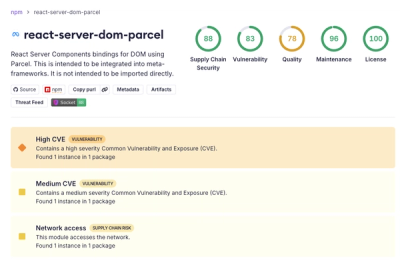
New DoS and source code exposure bugs in React Server Components and Next.js: what’s affected and how to update safely.

Security News
Socket CEO Feross Aboukhadijeh joins Software Engineering Daily to discuss modern software supply chain attacks and rising AI-driven security risks.