

Product
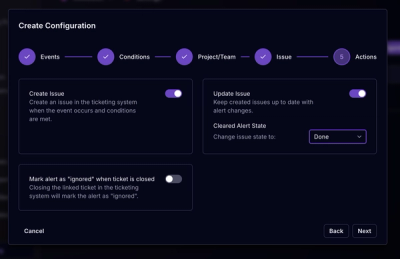
Socket for Jira Is Now Available
Socket for Jira lets teams turn alerts into Jira tickets with manual creation, automated ticketing rules, and two-way sync.
By Jeppe Hasseriis - Apr 20, 2026
express-validation
Advanced tools
express-validation is a middleware that validates a request and returns a response with errors; if any of the configured validation rules fail.





express-validation is an express middleware that validates a request and returns a response with errors; if any of the configured validation rules fail.
We use joi to define validation rules. We have a hard dependency on Joi in order to avoid compatibility issues with Joi releases. We are using snyk, which should help with this process.
Currently support Joi v17.x.x
We support validating the following parameter types:
Install with npm:
npm i express-validation --save
Install with yarn:
yarn add express-validation
In order to setup and use express-validation consider the following simple express application. It has a single route; configured to use the express-validation middleware function validate; it accepts as input loginValidation; which defines validation rules for this route.
const express = require('express')
const bodyParser = require('body-parser')
const { validate, ValidationError, Joi } = require('express-validation')

const loginValidation = {
  body: Joi.object({
    email: Joi.string()
      .email()
      .required(),
    password: Joi.string()
      .regex(/[a-zA-Z0-9]{3,30}/)
      .required(),
  }),
}

const app = express();
app.use(bodyParser.json())

app.post('/login', validate(loginValidation, {}, {}), (req, res) => {
  res.json(200)
})

app.use(function(err, req, res, next) {
  if (err instanceof ValidationError) {
    return res.status(err.statusCode).json(err)
  }

  return res.status(500).json(err)
})

app.listen(3000)
We have defined two rules email and password. They are encapsulated inside body; which is important; as this defines their location within the request.
We also need to setup an express global error handler, express-validation will pass errors to this handler. We can check within the handler for errors of type validationError distinguishing validation errors from other types of error.
express-validation, by default will return errors in the following format, an object details keyed by parameter, each containing an array of errors in joi format.
{
      "name": "ValidationError",
      "message": "Validation Failed",
      "statusCode": 400,
      "error": "Bad Request",
      "details": {
        "body": [
          {
            "message": "\"password\" is not allowed to be empty",
            "path": [
              "password"
            ],
            "type": "string.empty",
            "context": {
              "label": "password",
              "value": "",
              "key": "password"
            }
          }
        ]
      }
    }
We support other simpler formats via configuration
keyByField, flattens the error details object to a list of messages, keyed by field name{
"name": "ValidationError",
"message": "Validation Failed",
"statusCode": 400,
"error": "Bad Request",
"details": [
{ "accesstoken": "\"accesstoken\" is not allowed to be empty" },
{ "password": "\"password\" is not allowed to be empty" }
]
}
express-validation exposes the following api:
validate(schema, [options], [joiOptions]) => [validationError]The exported validate function takes a schema object and two optional arguments,
options and joiOptions and
returns a validationError instance if schema contains errors.
schema (Object)Default: {}
Includes validition rules, defined using joi, the rules are keyed by the following parameter types:
options (Object)Default: { context: false, statusCode: 400, keyByField: false }
Options, used by express-validation:
context, grants Joi access to the request object. This allows you to:
statusCode, defaults to 400, this will also set the error message via nodes status codes
keyByField, flattens the error details object to a list of messages, keyed by field namejoiOptions (Object)Default: {}
Options, used by joi, see Joi options, note:
ValidationErrorWe expose a custom error; ValidationError, use this in you global express error handler to distinguish validation errors from other types of error.
JoiWe also expose the version of Joi we have as a dependency, in order to avoid compatibility issues with other versions of Joi.
For more information on how to use express-validation please see the following examples:
You can return multiple errors, not just the first encountered, by setting, the joi option abortEarly: false
Enabling the context in options, allows you to reference other parts of the request in your validation.
You can specify joi default values in your schema.
This work is licensed under the MIT License (see the LICENSE file).
https://github.com/AndrewKeig/express-validation/blob/master/LICENSE
FAQs
express-validation is a middleware that validates a request and returns a response with errors; if any of the configured validation rules fail.
The npm package express-validation receives a total of 56,215 weekly downloads. As such, express-validation popularity was classified as popular.
We found that express-validation demonstrated a not healthy version release cadence and project activity because the last version was released a year ago. It has 3 open source maintainers collaborating on the project.
Did you know?

Socket for GitHub automatically highlights issues in each pull request and monitors the health of all your open source dependencies. Discover the contents of your packages and block harmful activity before you install or update your dependencies.
Product
Socket for Jira lets teams turn alerts into Jira tickets with manual creation, automated ticketing rules, and two-way sync.

Company News
Socket won two 2026 Reppy Awards from RepVue, ranking in the top 5% of all sales orgs. AE Alexandra Lister shares what it's like to grow a sales career here.

Security News
NIST will stop enriching most CVEs under a new risk-based model, narrowing the NVD's scope as vulnerability submissions continue to surge.