gl-buffer
A wrapper for WebGL buffer objects.
Example
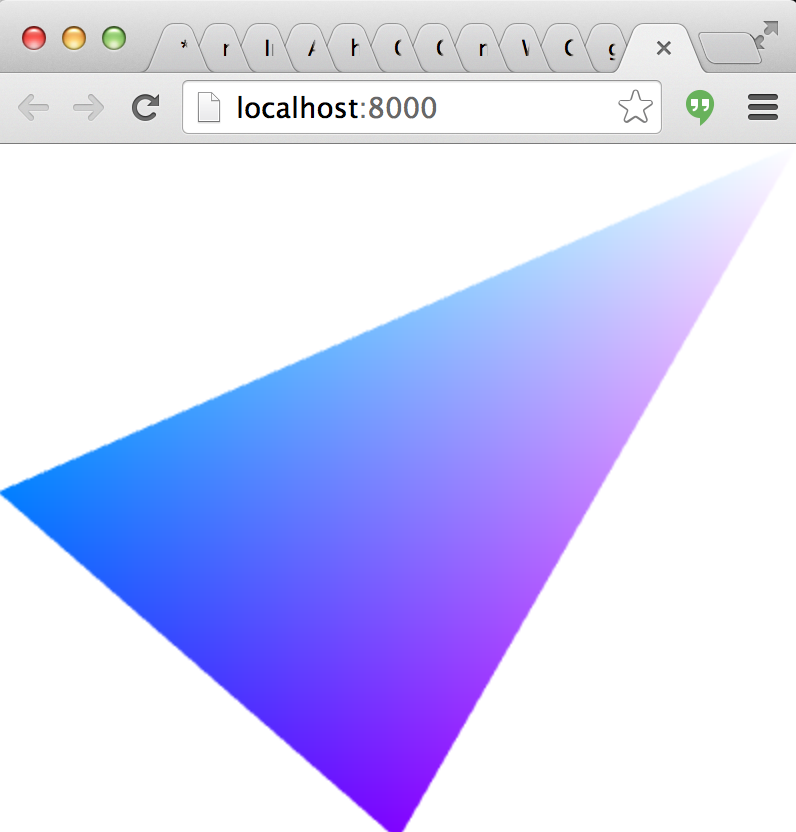
View this demo in your browser
var shell = require("gl-now")()
var glslify = require("glslify")
var createBuffer = require("gl-buffer")
var createShader = glslify({
vertex: "\
attribute vec2 position;\
varying vec2 uv;\
void main() {\
gl_Position = vec4(position, 0.0, 1.0);\
uv = position.xy;\
}",
fragment: "\
precision highp float;\
uniform float tick;\
varying vec2 uv;\
void main() {\
gl_FragColor = vec4(0.5*(uv+1.0), 0.5*(cos(tick)+1.0), 1.0);\
}",
inline: true
})
var buffer, shader
shell.on("gl-init", function() {
var gl = shell.gl
buffer = createBuffer(gl, [-1, 0, 0,-1, 1, 1])
shader = createShader(gl)
shader.attributes.position.location = 0
})
shell.on("gl-render", function(t) {
var gl = shell.gl
shader.bind()
buffer.bind()
shader.attributes.position.pointer()
shader.uniforms.tick = Date.now() / 1000.0
gl.drawArrays(gl.TRIANGLES, 0, 3)
})
Output:
Install
npm install gl-buffer
API
var createBuffer = require("gl-buffer")
Constructor
The constructor for a GL buffer works as follows:
var buffer = createBuffer(gl[, data, type, usage])
gl is a WebGL contextdata is either an integer, an array, a typed array, an array buffer or an ndarray representing the data of the buffer. Default is 0type is an optional parameter specifying the type of the webgl buffer. Default is gl.ARRAY_BUFFER.usage is an optional parameter representing the intended usage for the buffer (in the WebGL sense). It is not clear this does anything in current WebGL implementations. Default gl.DYNAMIC_DRAW
Properties
buffer.gl
A reference to the buffer's WebGL context
buffer.handle
A handle to the underlying WebGLBuffer object
buffer.type
The type of the buffer (either gl.ARRAY_BUFFER or gl.ELEMENT_ARRAY_BUFFER)
buffer.length
The size of the buffer in bytes
buffer.usage
The internal WebGL usage for the buffer.
Methods
buffer.bind()
Binds the buffer to the appropriate target. Equivalent to gl.bindBuffer( ... )
buffer.dispose()
Deletes the buffer releasing all associated resources. Equivalent to gl.deleteBuffer(...)
buffer.update(data[, offset])
Updates the data in the buffer. There are two basic modes to this function. In the first, it calls gl.bufferSubData to update a portion of the buffer in place, and in the second it calls gl.bufferData to completely resize the buffer.
data the new data to add to the buffer. This follows the same semantics as in the constructor.offset the offset in bytes to copy data into the buffer from or if unspecified then the buffer is resized by calling gl.bufferData instead of gl.bufferSubData. Default 0.
Credits
(c) 2013-2014 Mikola Lysenko. MIT License