

Product
Socket for Jira Is Now Available
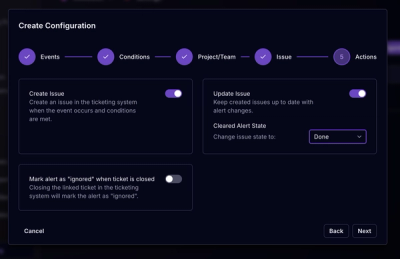
Socket for Jira lets teams turn alerts into Jira tickets with manual creation, automated ticketing rules, and two-way sync.
By Jeppe Hasseriis - Apr 20, 2026
git push blog server
Here's what a custom server could look like storing repository data in ./repo:
var http = require('http');
var glog = require('glog')(__dirname + '/repo');
var ecstatic = require('ecstatic')(__dirname + '/static');

var server = http.createServer(function (req, res) {
    if (glog.test(req.url)) {
        glog(req, res);
    }
    else ecstatic(req, res);
});
server.listen(5000);
First run your http server:
$ node server.js
Now create a new git repo for articles and set up the remote to point at your glog server:
$ git init
$ git remote add publish http://localhost:5000/blog.git
Write an article in markdown, create an annotated tag for the article, and push to the git blog server:
$ echo -e '# beep\nboop' > robot.markdown
$ git add *.markdown && git commit -m 'initial'
$ glog publish robot.markdown 'this is the title text'
$ git push publish master --tags
Now the content should be live on your blog, yay!
Continuing from the previous example, we'll add user permissions to our glog server.
To create a user once you've set the git remote, from your blog repo do:
$ glog useradd substack
Created user substack
To publish as this user add this remote:

http://substack:42aee89a@localhost:5000/blog.git
If you don't already have a remote for the blog repo, pass --remote=REMOTE to
the glog useradd command.
Once users have been configured, everyone who tries to git push new articles
will need to have a user token.
Now you can list the glog users with glog users:
$ glog users
substack
For the rest of the user commands, just type glog to see the usage page.
When you attach a glog handler to your server, these routes are installed:
Used by pushover to make git push
deploys work. You can set this as a git remote and interact with it like any
other git endpoint.
Annotated git tags with the filename as the tag name are used to store title text, publish date, and which files are "published".
Return a streaming json array of article metadata for all articles.
Optionally, you can set these query string parameters:
'html' or 'markdown'example output:
$ curl localhost:5000/blog.json
[
{"file":"robot.markdown","author":"James Halliday","email":"mail@substack.net","date":"Mon Dec 24 15:31:27 2012 -0800","title":"robots are pretty great","commit":"81c62aa62b6770a2f6bdf6865d393daf05930b4a"}
,
{"file":"test.markdown","author":"James Halliday","email":"mail@substack.net","date":"Mon Dec 24 04:31:53 2012 -0800","title":"testing title","commit":"2a516000d239bbfcf7cdbb4b5acf09486bdf9586"}
]
 $ curl localhost:5000/blog.json?inline=html
[
{"file":"robot.markdown","author":"James Halliday","email":"mail@substack.net","date":"Mon Dec 24 15:31:27 2012 -0800","title":"robots are pretty great","commit":"81c62aa62b6770a2f6bdf6865d393daf05930b4a","body":"<h1>robots!</h1>\n\n<p>Pretty great basically.</p>"}
,
{"file":"test.markdown","author":"James Halliday","email":"mail@substack.net","date":"Mon Dec 24 04:31:53 2012 -0800","title":"testing title","commit":"2a516000d239bbfcf7cdbb4b5acf09486bdf9586","body":"<h1>title text</h1>\n\n<p>beep boop.</p>\n\n<p><em>rawr</em></p>"}
]
Return an atom rss stream with inline content.
Fetch a source document $FILE as markdown.
Fetch a source document $FILE.markdown rendered as html.
var glog = require('glog')
Create a new blog handle using opts.repodir to store git blog data.
If opts is a string, it's taken as the opts.repodir.
You can also set opts.title and opts.id which are used as defaults by the
rss feed, and opts.highlight which is the highlight-function used by marked.
All other opts are passed through directly to marked.parse(src, opts).
Handle the (req, res) in order to serve blog.json and blog.git.
Get a single article, returning a readable stream of a single blog documents object. Blog documents have:
Return a readable stream of blog article documents.
Optionally:
opts.limit - number of results to showopts.start - show results starting at this tag or titleopts.after - show results after this tag or titleReturn a readable stream with the contents of file.
Return a through stream you can pipe blog.list() to that will inline article
contents rendered in format: either 'html' or 'markdown'.
.inline() adds a doc.body string with the article contents to the document
object.
Return whether or not to defer to blog for handling routes.
Return an atom rss stream
with the blog content inlined in <content> tags.
opts are the required elements from the atom spec but you can probably ignore them and it will still work:
usage:

  glog publish FILE "TITLE..."

    Publish FILE with TITLE by creating an annotated tag.

  glog users

    Show the list of glog users.

  glog useradd USER

    Generate an auth token for USER to use as a git remote.

  glog userdel USER

    Delete a USER.

  glog token USER

    Show the git remote token for USER.
With npm, to get the glog command do:
npm install -g glog
and to get the library do:
npm install glog
MIT
FAQs
git push blog server
The npm package glog receives a total of 92 weekly downloads. As such, glog popularity was classified as not popular.
We found that glog demonstrated a not healthy version release cadence and project activity because the last version was released a year ago. It has 2 open source maintainers collaborating on the project.
Did you know?

Socket for GitHub automatically highlights issues in each pull request and monitors the health of all your open source dependencies. Discover the contents of your packages and block harmful activity before you install or update your dependencies.
Product
Socket for Jira lets teams turn alerts into Jira tickets with manual creation, automated ticketing rules, and two-way sync.
Company News
Socket won two 2026 Reppy Awards from RepVue, ranking in the top 5% of all sales orgs. AE Alexandra Lister shares what it's like to grow a sales career here.

Security News
NIST will stop enriching most CVEs under a new risk-based model, narrowing the NVD's scope as vulnerability submissions continue to surge.