


Product
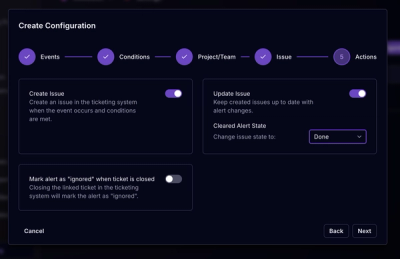
Socket for Jira Is Now Available
Socket for Jira lets teams turn alerts into Jira tickets with manual creation, automated ticketing rules, and two-way sync.
By Jeppe Hasseriis - Apr 20, 2026
https://user-images.githubusercontent.com/2223602/126318148-99da7ed6-a578-48dd-bdd2-21056dbad003.mp4

A small command-line tool that turns GLTF assets into declarative and re-usable react-three-fiber JSX components.
Usage
$ npx gltfjsx [Model.glb] [options]
Options
--output, -o Output file name/path
--types, -t Add Typescript definitions
--keepnames, -k Keep original names
--keepgroups, -K Keep (empty) groups, disable pruning
--bones, -b Lay out bones declaratively (default: false)
--meta, -m Include metadata (as userData)
--shadows, s Let meshes cast and receive shadows
--printwidth, w Prettier printWidth (default: 120)
--precision, -p Number of fractional digits (default: 3)
--draco, -d Draco binary path
--root, -r Sets directory from which .gltf file is served
--instance, -i Instance re-occuring geometry
--instanceall, -I Instance every geometry (for cheaper re-use)
--exportdefault, -E Use default export
--transform, -T Transform the asset for the web (draco, prune, resize)
--resolution, -R Resolution for texture resizing (default: 1024)
--keepmeshes, -j Do not join compatible meshes
--keepmaterials, -M Do not palette join materials
--format, -f Texture format (default: "webp")
--simplify, -S Mesh simplification (default: false)
--ratio Simplifier ratio (default: 0)
--error Simplifier error threshold (default: 0.0001)
--console, -c Log JSX to console, won't produce a file
--debug, -D Debug output
First you run your model through gltfjsx. npx allows you to use npm packages without installing them.
npx gltfjsx model.gltf --transform
This will create a Model.jsx file that plots out all of the assets contents.
/*
auto-generated by: https://github.com/pmdrs/gltfjsx
author: abcdef (https://sketchfab.com/abcdef)
license: CC-BY-4.0 (http://creativecommons.org/licenses/by/4.0/)
source: https://sketchfab.com/models/...
title: Model
*/

import { useGLTF, PerspectiveCamera } from '@react-three/drei'

export function Model(props) {
  const { nodes, materials } = useGLTF('/model-transformed.glb')
  return (
    <group {...props} dispose={null}>
      <PerspectiveCamera name="camera" fov={40} near={10} far={1000} position={[10, 0, 50]} />
      <pointLight intensity={10} position={[100, 50, 100]} rotation={[-Math.PI / 2, 0, 0]} />
      <group position={[10, -5, 0]}>
        <mesh geometry={nodes.robot.geometry} material={materials.metal} />
        <mesh geometry={nodes.rocket.geometry} material={materials.wood} />
      </group>
    </group>
  )
}

useGLTF.preload('/model.gltf')
Add your model to your /public folder as you would normally do. With the --transform flag it has created a compressed copy of it (in the above case model-transformed.glb). Without the flag just copy the original model.
/public
  model-transformed.glb
The component can now be dropped into your scene.
import { Canvas } from '@react-three/fiber'
import { Model } from './Model'

function App() {
  return (
    <Canvas>
      <Model />
You can re-use it, it will re-use geometries and materials out of the box:
<Model position={[0, 0, 0]} />
<Model position={[10, 0, -10]} />
Or make the model dynamic. Change its colors for example:
<mesh geometry={nodes.robot.geometry} material={materials.metal} material-color="green" />
Or exchange materials:
<mesh geometry={nodes.robot.geometry}>
  <meshPhysicalMaterial color="hotpink" />
</mesh>
Make contents conditional:
{condition && <mesh geometry={nodes.robot.geometry} material={materials.metal} />}
Add events:
<mesh geometry={nodes.robot.geometry} material={materials.metal} onClick={handleClick} />
You don't need to do anything if your models are draco compressed, since useGLTF defaults to a draco CDN. By adding the --draco flag you can refer to local binaries which must reside in your /public folder.
The asset will be preloaded by default, this makes it quicker to load and reduces time-to-paint. Remove the preloader if you don't need it.
useGLTF.preload('/model.gltf')
With the --transform flag it creates a binary-packed, draco-compressed, texture-resized (1024x1024), webp compressed, deduped, instanced and pruned *.glb ready to be consumed on a web site. It uses glTF-Transform. This can reduce the size of an asset by 70%-90%.
It will not alter the original but create a copy and append [modelname]-transformed.glb.
Add the --types flag and your GLTF will be typesafe.
type GLTFResult = GLTF & {
  nodes: { robot: THREE.Mesh; rocket: THREE.Mesh }
  materials: { metal: THREE.MeshStandardMaterial; wood: THREE.MeshStandardMaterial }
}

export default function Model(props: JSX.IntrinsicElements['group']) {
  const { nodes, materials } = useGLTF<GLTFResult>('/model.gltf')
If your GLTF contains animations it will add drei's useAnimations hook, which extracts all clips and prepares them as actions:
const { nodes, materials, animations } = useGLTF('/model.gltf')
const { actions } = useAnimations(animations, group)
If you want to play an animation you can do so at any time:
<mesh onClick={(e) => actions.jump.play()} />
If you want to blend animations:
const [name, setName] = useState("jump")
...
useEffect(() => {
  actions[name].reset().fadeIn(0.5).play()
  return () => actions[name].fadeOut(0.5)
}, [name])
Use the --instance flag and it will look for similar geometry and create instances of them. Look into drei/Merged to understand how it works. It does not matter if you instanced the model previously in Blender, it creates instances for each mesh that has a specific geometry and/or material.
--instanceall will create instances of all the geometry. This allows you to re-use the model with the smallest amount of drawcalls.
Your export will look like something like this:
const context = createContext()
export function Instances({ children, ...props }) {
  const { nodes } = useGLTF('/model-transformed.glb')
  const instances = useMemo(() => ({ Screw1: nodes['Screw1'], Screw2: nodes['Screw2'] }), [nodes])
  return (
    <Merged meshes={instances} {...props}>
      {(instances) => <context.Provider value={instances} children={children} />}
    </Merged>
  )
}

export function Model(props) {
  const instances = useContext(context)
  return (
    <group {...props} dispose={null}>
      <instances.Screw1 position={[-0.42, 0.04, -0.08]} rotation={[-Math.PI / 2, 0, 0]} />
      <instances.Screw2 position={[-0.42, 0.04, -0.08]} rotation={[-Math.PI / 2, 0, 0]} />
    </group>
  )
}
Note that similar to --transform it also has to transform the model. In order to use and re-use the model import both Instances and Model. Put all your models into the Instances component (you can nest).
The following will show the model three times, but you will only have 2 drawcalls tops.
import { Instances, Model } from './Model'

<Instances>
  <Model position={[10,0,0]}>
  <Model position={[-10,0,0]}>
  <Model position={[-10,10,0]}>
</Instance>
import { parse } from 'gltfjsx'
import { GLTFLoader, DRACOLoader } from 'three-stdlib'

const gltfLoader = new GLTFLoader()
const dracoloader = new DRACOLoader()
dracoloader.setDecoderPath('https://www.gstatic.com/draco/v1/decoders/')
gltfLoader.setDRACOLoader(dracoloader)

gltfLoader.load(url, (gltf) => {
  const jsx = parse(gltf, optionalConfig)
})
const jsx = parse(scene, optionalConfig)
The GLTFStructureLoader can come in handy while testing gltf assets. It allows you to extract the structure without the actual binaries and textures making it possible to run in a testing environment.
import { GLTFStructureLoader } from 'gltfjsx'
import fs from 'fs/promises'

it('should have a scene with a blue mesh', async () => {
  const loader = new GLTFStructureLoader()
  const data = await fs.readFile('./model.glb')
  const { scene } = await new Promise((res) => loader.parse(data, '', res))
  expect(() => scene.children.length).toEqual(1)
  expect(() => scene.children[0].type).toEqual('mesh')
  expect(() => scene.children[0].material.color).toEqual('blue')
})
/public folderFAQs
GLTF to JSX converter
The npm package gltfjsx receives a total of 1,514 weekly downloads. As such, gltfjsx popularity was classified as popular.
We found that gltfjsx demonstrated a not healthy version release cadence and project activity because the last version was released a year ago. It has 3 open source maintainers collaborating on the project.
Did you know?

Socket for GitHub automatically highlights issues in each pull request and monitors the health of all your open source dependencies. Discover the contents of your packages and block harmful activity before you install or update your dependencies.
Product
Socket for Jira lets teams turn alerts into Jira tickets with manual creation, automated ticketing rules, and two-way sync.
Company News
Socket won two 2026 Reppy Awards from RepVue, ranking in the top 5% of all sales orgs. AE Alexandra Lister shares what it's like to grow a sales career here.

Security News
NIST will stop enriching most CVEs under a new risk-based model, narrowing the NVD's scope as vulnerability submissions continue to surge.