

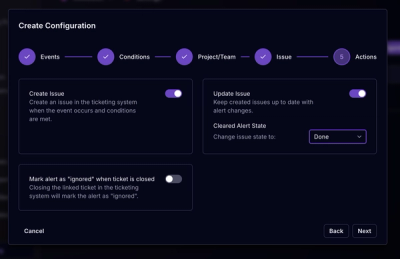
Product
Socket for Jira Is Now Available
Socket for Jira lets teams turn alerts into Jira tickets with manual creation, automated ticketing rules, and two-way sync.
By Jeppe Hasseriis - Apr 20, 2026
http-status-codes
Advanced tools
Constants enumerating the HTTP status codes. Based on the Java Apache HttpStatus API.
Constants enumerating the HTTP status codes. Based on the Java Apache HttpStatus API.
All status codes defined in RFC1945 (HTTP/1.0), RFC2616 (HTTP/1.1), RFC2518 (WebDAV), RFC6585 (Additional HTTP Status Codes), and RFC7538 (Permanent Redirect) are supported.
TypeScript or JavaScript. Completely library agnostic. No dependencies.
npm install http-status-codes --save
import {
	ReasonPhrases,
	StatusCodes,
	getReasonPhrase,
	getStatusCode,
} from 'http-status-codes';

response
	.status(StatusCodes.OK)
	.send(ReasonPhrases.OK);

response
	.status(StatusCodes.INTERNAL_SERVER_ERROR)
	.send({
		error: getReasonPhrase(StatusCodes.INTERNAL_SERVER_ERROR)
	});

response
	.status(getStatusCode('Internal Server Error'))
	.send({
		error: 'Internal Server Error'
	});
| Code | Constant | Reason Phrase |
|---|---|---|
| 100 | CONTINUE | Continue |
| 101 | SWITCHING_PROTOCOLS | Switching Protocols |
| 102 | PROCESSING | Processing |
| 103 | EARLY_HINTS | Early Hints |
| 200 | OK | OK |
| 201 | CREATED | Created |
| 202 | ACCEPTED | Accepted |
| 203 | NON_AUTHORITATIVE_INFORMATION | Non Authoritative Information |
| 204 | NO_CONTENT | No Content |
| 205 | RESET_CONTENT | Reset Content |
| 206 | PARTIAL_CONTENT | Partial Content |
| 207 | MULTI_STATUS | Multi-Status |
| 300 | MULTIPLE_CHOICES | Multiple Choices |
| 301 | MOVED_PERMANENTLY | Moved Permanently |
| 302 | MOVED_TEMPORARILY | Moved Temporarily |
| 303 | SEE_OTHER | See Other |
| 304 | NOT_MODIFIED | Not Modified |
| 305 | USE_PROXY | Use Proxy |
| 307 | TEMPORARY_REDIRECT | Temporary Redirect |
| 308 | PERMANENT_REDIRECT | Permanent Redirect |
| 400 | BAD_REQUEST | Bad Request |
| 401 | UNAUTHORIZED | Unauthorized |
| 402 | PAYMENT_REQUIRED | Payment Required |
| 403 | FORBIDDEN | Forbidden |
| 404 | NOT_FOUND | Not Found |
| 405 | METHOD_NOT_ALLOWED | Method Not Allowed |
| 406 | NOT_ACCEPTABLE | Not Acceptable |
| 407 | PROXY_AUTHENTICATION_REQUIRED | Proxy Authentication Required |
| 408 | REQUEST_TIMEOUT | Request Timeout |
| 409 | CONFLICT | Conflict |
| 410 | GONE | Gone |
| 411 | LENGTH_REQUIRED | Length Required |
| 412 | PRECONDITION_FAILED | Precondition Failed |
| 413 | REQUEST_TOO_LONG | Request Entity Too Large |
| 414 | REQUEST_URI_TOO_LONG | Request-URI Too Long |
| 415 | UNSUPPORTED_MEDIA_TYPE | Unsupported Media Type |
| 416 | REQUESTED_RANGE_NOT_SATISFIABLE | Requested Range Not Satisfiable |
| 417 | EXPECTATION_FAILED | Expectation Failed |
| 418 | IM_A_TEAPOT | I'm a teapot |
| 419 | INSUFFICIENT_SPACE_ON_RESOURCE | Insufficient Space on Resource |
| 420 | METHOD_FAILURE | Method Failure |
| 421 | MISDIRECTED_REQUEST | Misdirected Request |
| 422 | UNPROCESSABLE_ENTITY | Unprocessable Entity |
| 423 | LOCKED | Locked |
| 424 | FAILED_DEPENDENCY | Failed Dependency |
| 426 | UPGRADE_REQUIRED | Upgrade Required |
| 428 | PRECONDITION_REQUIRED | Precondition Required |
| 429 | TOO_MANY_REQUESTS | Too Many Requests |
| 431 | REQUEST_HEADER_FIELDS_TOO_LARGE | Request Header Fields Too Large |
| 451 | UNAVAILABLE_FOR_LEGAL_REASONS | Unavailable For Legal Reasons |
| 500 | INTERNAL_SERVER_ERROR | Internal Server Error |
| 501 | NOT_IMPLEMENTED | Not Implemented |
| 502 | BAD_GATEWAY | Bad Gateway |
| 503 | SERVICE_UNAVAILABLE | Service Unavailable |
| 504 | GATEWAY_TIMEOUT | Gateway Timeout |
| 505 | HTTP_VERSION_NOT_SUPPORTED | HTTP Version Not Supported |
| 507 | INSUFFICIENT_STORAGE | Insufficient Storage |
| 511 | NETWORK_AUTHENTICATION_REQUIRED | Network Authentication Required |
http-status-codes v2 is mostly backwards compatible with v1. There is a single breaking change and two recommended changes.
The reason phrase for the status code 500 has been changed from "Server Error" to "Internal Server Error". This is the correct phrase according to RFC7231. If you are migrating from v1, and have code that relies on the result of getStatusText(500) or getReasonPhrase('Server Error'), then this could affect you.
The function getStatusText has been renamed to getReasonPhrase. The old function is still available, but may be deprecated in a future version. To fix this simply rename instances of getStatusText() to getReasonPhrase(). The function is otherwise the same as it was before.
In http-status-codes v1, Status Codes were exported directly from the top-level module. i.e. HttpStatus.OK. In v2 all Status Codes live under an object called StatusCodes. i.e. HttpStatus.StatusCodes.OK. We made this change to cater to TypeScript users who prefer a dedicated value with an enum type. The previous values are still exported, but we won't continue to update them. Please migrate if you're using the old-style imports.
If you'd like to propose a new status code, feel free to update "codes.json" with the necessary
information and open a pull request. There is no need to modify source code or even this README.
This is done automatically by npm run update-codes.
In general, we try to include only codes that have an official RFC and have been approved, however exceptions can be made if the code is already in widespread use in the wild.
npm run update-codes
npm run test
npm run build
npm version [major | minor | patch]
npm publish
After releasing, please add release notes via GitHub Releases.
A utility to interact with HTTP status codes. It provides similar functionality to http-status-codes, allowing for both numeric code and text message retrieval. It also supports looking up codes based on the message.
Another simple package that provides HTTP status codes and messages. It is similar to http-status-codes but with a smaller footprint, offering a basic mapping between codes and their default messages.
FAQs
Constants enumerating the HTTP status codes. Based on the Java Apache HttpStatus API.
The npm package http-status-codes receives a total of 6,237,101 weekly downloads. As such, http-status-codes popularity was classified as popular.
We found that http-status-codes demonstrated a not healthy version release cadence and project activity because the last version was released a year ago. It has 1 open source maintainer collaborating on the project.
Did you know?

Socket for GitHub automatically highlights issues in each pull request and monitors the health of all your open source dependencies. Discover the contents of your packages and block harmful activity before you install or update your dependencies.
Product
Socket for Jira lets teams turn alerts into Jira tickets with manual creation, automated ticketing rules, and two-way sync.
Company News
Socket won two 2026 Reppy Awards from RepVue, ranking in the top 5% of all sales orgs. AE Alexandra Lister shares what it's like to grow a sales career here.

Security News
NIST will stop enriching most CVEs under a new risk-based model, narrowing the NVD's scope as vulnerability submissions continue to surge.