

Product
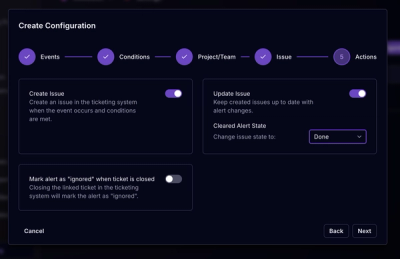
Socket for Jira Is Now Available
Socket for Jira lets teams turn alerts into Jira tickets with manual creation, automated ticketing rules, and two-way sync.
By Jeppe Hasseriis - Apr 20, 2026




Note: v10.0.4 accidentally contains the removal of CoffeeScript; v10.0.5 puts it back in Note: v11 removes CoffeeScript and converts this codebase to ESM
Hubot is a framework to build chat bots, modeled after GitHub's Campfire bot of the same name, hubot. He's pretty cool. He's extendable with scripts and can work on many different chat services.
This repository provides a library that's distributed by npm that you
use for building your own bots. See the documentation
for details on getting up and running with your very own robot friend.
In most cases, you'll probably never have to hack on this repo directly if you are building your own bot. But if you do, check out CONTRIBUTING.md
This will create a directory called myhubot in the current working directory.
npx hubot --create myhubot --adapter @hubot-friends/hubot-slack
npx hubot --create myhubot --adapter @hubot-friends/hubot-discord
npx hubot --create myhubot --adapter @hubot-friends/hubot-ms-teams
npx hubot --create myhubot --adapter @hubot-friends/hubot-irc
Review scripts/example.mjs. Create more scripts in the scripts folder.
Hubot includes a deterministic command subsystem for slash-style commands. It is safe by default and does not interfere with legacy hear and respond listeners.
export default (robot) => {
	robot.commands.register({
		id: 'tickets.create',
		description: 'Create a ticket',
		aliases: ['ticket new', 'new ticket'],
		args: {
			title: { type: 'string', required: true },
			priority: { type: 'enum', values: ['low', 'medium', 'high'], default: 'medium' }
		},
		sideEffects: ['creates external ticket'],
		handler: async (ctx) => {
			return `Created ticket: ${ctx.args.title}`
		}
	})
}
Invoke with addressing the bot:
@hubot tickets.create --title "VPN down" --priority high@hubot tickets.create title:"VPN down" priority:highCommands that declare side effects will require confirmation before execution.
The user is asked to confirm. They do so like so:
@hubot yes
@hubot no
@hubot cancel
Aliases are for discovery and search only. They do not execute commands or create proposals. They are intent utterances.
Hubot automatically registers a help command that provides command discovery and documentation:
@hubot help                          # List all commands
@hubot help tickets                  # Filter commands by prefix
@hubot help search "create ticket"   # Search by keyword, alias, description, or example
const results = robot.commands.search('ticket new')
// [{ id: 'tickets.create', score: 100, matchedOn: 'alias' }, ...]
Extend validation with custom argument types:
export default (robot) => {
	// Register custom type resolver
	robot.commands.registerTypeResolver('project_id', async (value, schema, context) => {
		if (!value.startsWith('PRJ-')) {
			throw new Error('must start with PRJ-')
		}
		return value.toUpperCase()
	})

	// Use it in a command
	robot.commands.register({
		id: 'projects.deploy',
		description: 'Deploy a project',
		args: {
			projectId: { type: 'project_id', required: true }
		},
		handler: async (ctx) => {
			return `Deploying ${ctx.args.projectId}`
		}
	})
}
When creating a CommandBus instance, you can configure:
prefix - Command prefix (default: '')proposalTTL - Timeout for pending confirmations in milliseconds (default: 300000 = 5 minutes)logPath - Path to NDJSON event log file (default: .data/commands-events.ndjson)disableLogging - Disable event logging to disk (default: true - logging is disabled by default)permissionProvider - Custom permission checking handler (optional)Control who can execute commands using room-based and role-based permissions.
Restrict command execution to specific chat rooms:
robot.commands.register({
	id: 'sensitive.action',
	description: 'Admin-only action',
	permissions: {
		rooms: ['#admin', '#ops']  // Only allowed in these rooms
	},
	handler: async (ctx) => {
		return 'Action executed!'
	}
})
Users in other rooms get: Permission denied: command not allowed in this room
Restrict command execution to users with specific roles:
robot.commands.register({
	id: 'deploy.production',
	description: 'Deploy to production',
	permissions: {
		roles: ['admin', 'devops']  // Only users with these roles
	},
	handler: async (ctx) => {
		return 'Deploying...'
	}
})
To enable role checking, provide a permissionProvider when creating CommandBus:
const commandBus = new CommandBus(robot, {
	permissionProvider: {
		hasRole: async (user, requiredRoles, context) => {
			// Custom logic to check if user has any of the required roles
			const userRoles = await fetchUserRoles(user.id)
			return requiredRoles.some(role => userRoles.includes(role))
		}
	}
})
Without a permission provider, role-based permissions are ignored (allow by default). Room-based permissions are always enforced.
See the LICENSE file for license rights and limitations (MIT).
FAQs
A simple helpful robot for your Company
The npm package hubot receives a total of 18,037 weekly downloads. As such, hubot popularity was classified as popular.
We found that hubot demonstrated a healthy version release cadence and project activity because the last version was released less than a year ago. It has 7 open source maintainers collaborating on the project.
Did you know?

Socket for GitHub automatically highlights issues in each pull request and monitors the health of all your open source dependencies. Discover the contents of your packages and block harmful activity before you install or update your dependencies.
Product
Socket for Jira lets teams turn alerts into Jira tickets with manual creation, automated ticketing rules, and two-way sync.
Company News
Socket won two 2026 Reppy Awards from RepVue, ranking in the top 5% of all sales orgs. AE Alexandra Lister shares what it's like to grow a sales career here.

Security News
NIST will stop enriching most CVEs under a new risk-based model, narrowing the NVD's scope as vulnerability submissions continue to surge.